2027 Toyota Highlander goes electric as a three-row EV
I’ve read a lot of EV announcements that feel like they were written for slide decks, not for people who actually live with cars. This one is worth your time because it’s Toyota taking a very specific swing at a very specific problem: how to make an electric vehicle that works for families who don’t want their lives reorganized around charging, apps, and compromises.
Highlander has always been Toyota’s “quietly competent” three-row. It’s the vehicle you buy when you want the week to go smoothly. For 2027, Toyota is keeping that job description, then swapping the entire powertrain for battery electric and moving assembly to the U.S., with battery module assembly happening in North Carolina and via a U.S. supplier partner.
On paper, it reads like Toyota is finally putting a big flag in the ground: this is our first three-row battery-electric vehicle for the U.S., and it’s also the first Toyota BEV assembled in America. But the more interesting angle is how carefully the details aim at real-world friction: usable range targets, a North American Charging System (NACS) port, a battery preconditioning function for faster DC charging, and vehicle-to-load (V2L) power so the car can run devices, or potentially serve as backup power with the right accessories.
None of this guarantees that the 2027 Highlander will be the “best” three-row EV. But it does suggest Toyota is trying to build the sort of EV that a skeptical household can live with without constantly thinking about it. In 2026, that’s still not a solved problem.
Why does this matter right now?
Because the EV conversation has shifted from “Can it be done?” to “Can normal people live with it?” Three-row SUVs are a perfect stress test. They carry more people, more stuff, and more expectations. They also tend to have longer days—school runs, sports, errands, family trips, where a charging plan that sounds fine on a calm Sunday becomes annoying by Wednesday.
Toyota is also making a strategic statement about where it thinks the American EV market is headed: families want space, predictable ownership, and fewer surprises. That’s why the 2027 Highlander reads less like a tech flex and more like an attempt to reduce lifestyle disruption.
The headline numbers Toyota is putting forward are meant to feel familiar rather than exotic. In the lineup, XLE AWD and Limited AWD models with the 95.8-kWh battery target a manufacturer-estimated 320 miles of total driving range. XLE FWD with a 77.0-kWh battery targets 287 miles, while XLE AWD with the 77.0-kWh pack targets 270 miles. Those are not claims of EV dominance. They’re claims of “this should cover your week.”
Charging is the other pressure point, and Toyota is addressing it directly by fitting a standard NACS port for access to thousands of DC fast-charging stations in the U.S. Under ideal conditions, it’s targeting roughly 10% to 80% in about 30 minutes on DC fast charging. It also includes Level 1 and Level 2 AC charging support, with a dual-voltage 120V/240V cable included, plus an 11-kW onboard AC charger. The battery preconditioning feature matters because charging speed is often less about the charger and more about battery temperature. Toyota is also promising Plug & Charge capability on selected networks, which, when it works well, reduces the “download three apps and pray” aspect of public charging.
Then there’s V2L power, which Toyota is positioning as both a lifestyle feature (tailgates, tools, camping) and a practical one (backup power in outages), with the clear caveat that bi-directional accessories are required. The bigger point is that Toyota is treating the car as part of a household energy story, not just a vehicle.
How does it compare to rivals or alternatives?
The three-row EV field is getting real, fast. If you’re shopping this kind of vehicle, you’re likely cross-shopping not just other EVs but hybrids and plug-in hybrids that avoid the charging headache entirely.
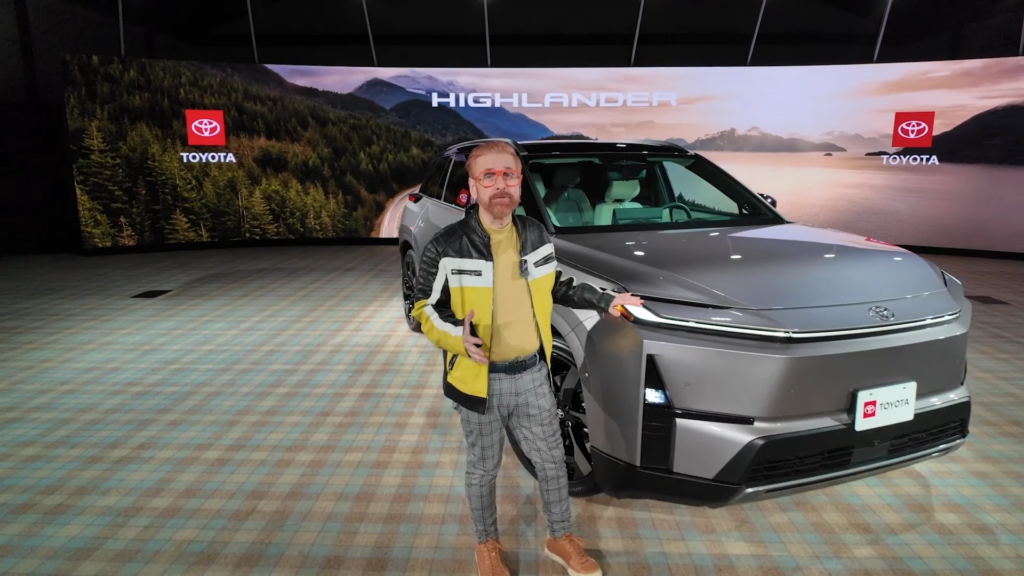
The 2027 Highlander’s most obvious EV alternatives are vehicles like the Kia EV9 and the Hyundai Ioniq 9 class of family-focused three-row EVs. Those competitors tend to lean into bold design, big screens, and feature packaging that tries to justify the “new era” vibe. Toyota’s press-release version of Highlander is more restrained: clean lines, flush door handles, full-width LED daytime running lights, and an emphasis on aerodynamics and quietness.
Where Toyota may win is in the practical middle of the market, people who want technology that reduces effort rather than adds chores. A 14-inch touchscreen and a 12.3-inch driver display are large, but the detail I liked is that Toyota says the temperature controls still have hard buttons. That’s the sort of small decision that matters on day three of a road trip.
Toyota Safety Sense 4.0 is also standard, and the feature set is what you’d expect in a modern safety suite: pre-collision braking with pedestrian detection, full-speed adaptive cruise, lane departure alert with steering assist, lane tracing assist, road sign assist, and proactive driving assist. Parking assist with automatic braking is standard, with features like panoramic view monitor and advanced park available. In the real world, this stuff isn’t about bragging rights. It’s about lowering the mental load when you’re tired and distracted.
If you want maximum performance or maximum wow-factor, Toyota’s stated outputs suggest the Highlander is quick enough rather than wild. AWD models are rated at up to 338 combined system horsepower and 323 lb.-ft. of torque, while FWD models are rated at 221 horsepower and 198 lb.-ft. of torque. That’s a noticeable gap between drivetrains, and it implies Toyota is treating AWD as the “full” Highlander experience for people who want the stronger acceleration feel and capability systems like Multi-Terrain Select and Crawl Control.
If you’re allergic to public charging, the real alternatives aren’t other EVs, they’re Toyota’s own hybrids, plus plug-in hybrids in the segment that can run electric for daily driving without requiring you to rely on fast-charging infrastructure. Toyota hasn’t said what happens to non-EV Highlander offerings in the broader lineup, but many shoppers will still ask a simple question: do I want to manage charging, or do I want to refuel in five minutes and move on? Highlander going full BEV forces that choice more directly.
Who is this for and who should skip it?
This is for the person who already likes what Highlander represents, calm competence, but wants an EV that doesn’t demand a personality transplant.
It’s for:
- Families who routinely use all three rows (or at least want them available) and need real cargo room when the third row folds flat. Toyota is quoting more than 45 cubic feet of rear storage with the third row down.
- Households that want an EV but also want the comfort of Toyota’s conservative engineering tone: quiet ride measures, noise-absorbing materials, acoustic glass, and attention to airflow and turbulence.
- People who care about charging simplicity. A standard NACS port, battery preconditioning, and Plug & Charge support are all aimed at reducing friction.
- Anyone who sees value in V2L power, whether that’s for weekend life (tools, tailgates, camping) or for emergency preparedness.
You might want to skip it if:
- You’re not ready to rely on public charging and you can’t charge at home or at work. Even with NACS, daily EV life is easiest when you can start the morning full.
- You don’t need a three-row vehicle. Larger EVs carry larger costs, purchase price (still TBD here), tires, energy use, and potentially insurance costs. If you’re mostly driving solo, you’re paying for capability you won’t use.
- You want the sharpest third-row packaging in the segment. Toyota says the third row has ample room for two adults and improved access, but until we see how the packaging feels in person, some rivals may still offer more “true adult” comfort depending on seating geometry and floor height.
What is the long-term significance?
There are two big signals here.
First, Toyota is moving from “testing the waters” to building a full-size family EV with domestic manufacturing. Assembling the 2027 Highlander in Georgetown, Kentucky, and assembling battery modules in North Carolina (plus a supplier partner in the U.S.) is not just a logistics detail. It’s a statement about how Toyota intends to scale electrification in America: local production, local supply, and a product aimed at mainstream needs rather than early-adopter novelty.
Second, Toyota is leaning into EV features that connect the vehicle to the household, not just the driveway. V2L power is part of that, but so are features like charge scheduling, ECO Charge, and Charge Assist ideas that imply the car is going to live in a world of variable energy prices and renewable energy timing. That’s where EV ownership becomes less about “cars” and more about systems: home energy, grid demand, charging availability, and how much friction you’re willing to accept.
The Highlander nameplate matters, too. This isn’t Toyota launching a weirdly named EV experiment and hoping people find it. This is Toyota taking a familiar family vehicle and saying, plainly: the next generation is electric. That’s a cultural shift as much as a product shift.
Toyota says sales are expected to begin in late 2026 and continue into early 2027, with pricing to be announced closer to launch. In the meantime, the smartest way to think about the 2027 Highlander is not as a single vehicle but as a litmus test: can Toyota translate its reputation for low-drama family transportation into the EV era without turning ownership into a hobby?
If the answer is yes, it won’t just help Toyota. It will help normalize the idea that an electric three-row SUV can be boring in the best way; quiet, competent, and easy to live with. And that’s exactly what a lot of people have been waiting for.