5 Crucial Considerations for Installing Solar Panels

Solar panels are an investment in the future.
Not only can they contribute to long-term savings on your electricity bill. They can be an invaluable contribution to solving the current climate crisis. Sunlight is the most available free energy resource – just one hour is enough to power the entire planet’s economy for a year.
In recent years, solar tech has come a long way, with costs dropping and the lifespan of systems increasing. Today, they run in arctic conditions and even power entire airports.
But solar is not a one-size-fits-all solution. Before you install solar panels, there are several crucial questions to ask yourself to find the right solution for your needs.
1 – Sizing
First off, you’ll need to determine how large a solar installation will have to be to meet your particular energy needs – and if it makes sense economically.
The average US household uses around 11,000 kWh per year in electricity. Certain factors, such as an electric car, increase demand dramatically.
Currently, the average solar system size is 5 kW. To meet 100% of 11,000 kWh, you’d need a system rated between 7 and 9 kW, depending on your location. Using 250-W panels, this translates to around 28-34 of them.
This can pose problems in terms of cost and space. Generally, you can use less-efficient, cheaper panels if your available ground or roof space suffices, or more expensive, highly efficient panels if it doesn’t.
2 – Batteries
If you’re considering solar for a house off the power grid – like a holiday cabin – you’ll need one or more batteries. These store power produced by solar panels for nights and bad-weather days.
On the grid, you can do without a battery. In this case, you’ll pay for grid power when demand is high and solar supply low – in the mornings and evenings.
Generally, a US household consumes about 30 kWh daily. Common batteries store about 10 kWh, meaning 3 batteries can run a household for 24 hours.
3 – The ideal spot
Space – and aesthetics – are major consideration for potential solar panel owners, whether on the ground or on roofs.
Ground installations are simpler, but take up valuable yard space and won’t win beauty contests.
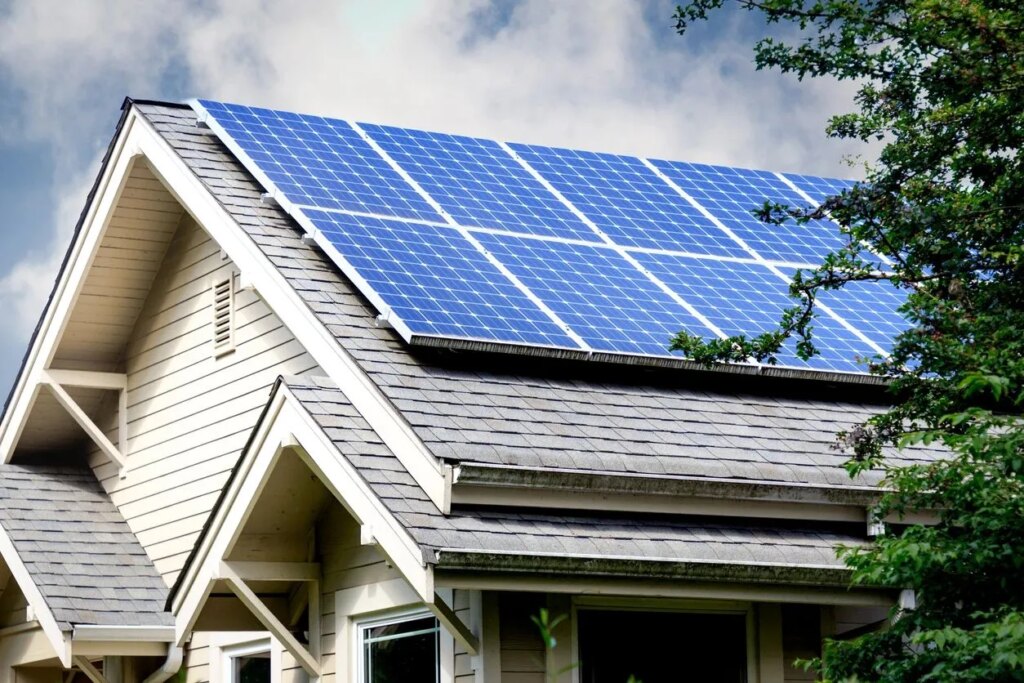
In contrast, roof panels are less visible and much more space-efficient. There are, however, several prerequisites.
First off, your roof structure needs to be able to bear the weight, and be in good condition. Some roofing materials, like shingles, are better suited than brittle ones like slate.
Second, your roof needs to face south, without large trees or buildings obstructing the sun.
Third, panels are most efficient when slanted 30-40°. For flat roofs,, you’ll need a support structure to hit the right angle.
Finally, you need a good spot for the inverter. This element turns the panels’ DC power into the AC your devices use. A cool, ventilated place increases its efficiency and lifespan.
Installing solar is simplest if you’re just building your home. No matter where you are, experienced specialists – from architects of low-energy houses in Oregon to green green custom home builders in Los Angeles – will help you find the right solar set-up from the beginning.
4 – Finding a good contractor
A competent, knowledgeable, and efficient contractor saves you countless headaches and gives you valuable technical advice.
As a rule of thumb, comparing quotes can save you up to 10%. Smaller, local contractors tend to be cheaper, and offer more system variety adapted to your location than large ones.
Expertise in installing solar systems is essential. Look for the North American Board of Certified Energy Practitioners’ (NABCEP) Solar PV Installation Professional Certification.
Other business licenses and insurance policies vary by state and occasionally local jurisdiction. At a minimum, installers should have general liability insurance.
Finally, check your installer’s solar track record. A solar provider should be able to discuss and show you systems installed for previous clients.
5 – Future maintenance
A solar system, once set up, is light on maintenance. Nonetheless, it’s still good to factor it into your calculations.
Installations need cleaning a few times every year. You could even do it yourself with a hose and, if needed, soap. Check with the panel maker first, though – you might void your warranty if you don’t hire professional cleaners.
Every 4 to 6 years, you’ll need a check-up by an installer. Finally, you’ll have to replace the inverters after around 10 years.
Conclusion
Installing solar panels is not a straightforward endeavor. Depending on your location, energy situation, and available space, it can be tricky to design a system that meets your needs.
However, with the right planning steps, realistic expectations, and a competent contractor by your side, you’re sure to find the right fit. So that you can save on energy bills, and contribute to solving the climate crisis.