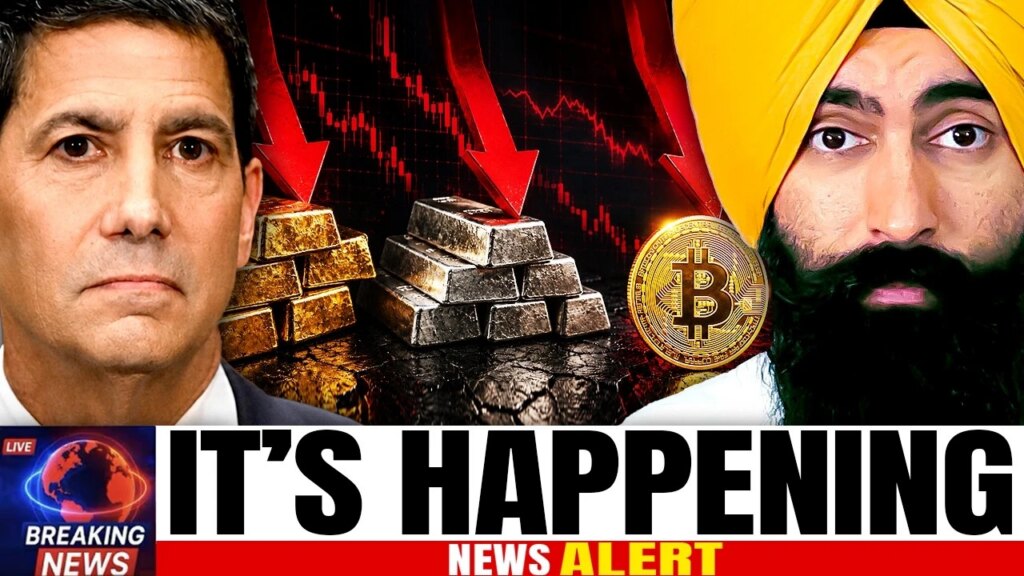
Bitcoin and Commodities Got Crushed by the New Fed Chair. Here’s Why.
Markets had spent months assuming the next chapter of Federal Reserve policy would be easier.
That assumption ran straight into Kevin Warsh.
At his first Federal Reserve meeting in June, Warsh did not deliver the dovish reassurance many investors wanted. The Fed left rates unchanged at 3.50% to 3.75%, but its updated projections showed that more officials now expect at least one rate hike before the end of 2026. Reuters also reported that Warsh emphasized returning inflation to 2% as the central priority, surprising investors who had expected more enthusiasm for rate cuts. (reuters.com; reuters.com)
That was enough to hit some of the market’s favorite inflation and debasement trades almost immediately.
Gold fell as traders increased their expectations for tighter policy and a stronger dollar. Reuters reported on June 23 that gold dropped while the dollar hit a one-year high on rising bets that the Fed could still hike. Silver, which tends to move more violently than gold, fell even harder, down about 5% that day. Bitcoin, meanwhile, came under similar pressure because it too is often treated as a bet against fiat money, easy liquidity, and dollar weakness. (reuters.com)
The selloff made sense for three reasons.
First, gold, silver, and Bitcoin all tend to benefit when investors fear the dollar is being weakened by inflation or easy money. They are not identical assets, but they often share the same macro narrative. Gold and silver are classic hard-money hedges. Bitcoin is the newer, more speculative version of the same anti-debasement trade. If the market suddenly believes the Fed will defend the dollar more aggressively than expected, those assets lose part of the story supporting them.
That is exactly what Warsh changed.
Second, higher rates raise the opportunity cost of owning assets that do not generate cash flow.
If cash, money market funds, or Treasuries are paying more, then the investor has to give up more income to hold gold or Bitcoin instead. That matters especially when policy is moving in a more hawkish direction. Non-yielding assets do not just have to look attractive on their own. They have to look attractive relative to what cash can earn. When the yield on safe assets rises, that becomes a harder argument. (reuters.com)
Third, some of the fear premium began to come out of the market.
Earlier in June, gold and related assets had drawn support from inflation worries and geopolitical stress tied to the Iran conflict. But as oil cooled and U.S.-Iran tensions appeared less likely to spiral immediately, the urgency behind those safe-haven flows began to fade. When fear recedes at the same time the Fed sounds tougher, the pressure on gold, silver, and Bitcoin can become much more intense. (reuters.com)
That does not mean the long-term case for these assets is dead.
It means the short-term setup changed sharply.
This is an important distinction because markets often confuse a macro headwind with a permanent thesis failure. Gold has gone through this before. During the Fed’s tightening cycle in 2022, it struggled as rates rose and the dollar strengthened. Bitcoin fell much more dramatically, dropping roughly 60% that year as cheap money disappeared and speculative appetite collapsed. Yet both later recovered materially from those lows once markets began reassessing inflation, liquidity, and long-term monetary risks. (reuters.com)
That history matters because it shows what these assets actually are.
They are not stable instruments. They are highly sensitive macro trades. Gold is the most established and least speculative of the three, but it still reacts strongly to real yields, dollar strength, and geopolitical fear. Silver behaves partly like gold and partly like an industrial metal, which makes it even more volatile. Bitcoin is the most speculative of all, with its price tied not only to macro conditions but also to technology sentiment, market liquidity, and investor confidence in the idea of digital scarcity itself.
That is why a hawkish Fed chair can hit all three at once.
Warsh did not have to raise rates at his first meeting to cause damage. He only had to make markets believe that rate cuts were no longer the default path. Once that happened, the whole set of assumptions supporting debasement trades weakened. Investors started recalculating. If inflation is still too high, if the Fed is willing to keep policy tight, and if the dollar is no longer expected to soften soon, then the valuation case for gold, silver, and Bitcoin becomes harder in the near term. (reuters.com)
There is another wrinkle here: the market may have moved too fast in both directions.
By early July, Reuters reported that gold was rebounding as weaker jobs data lowered expectations of a near-term rate hike and Warsh’s comments were interpreted as less aggressively hawkish than feared. That reversal is a reminder that these markets are extremely sensitive to shifts in the Fed narrative. A hard-money trade can get crushed one week and rally the next if the rate path changes even slightly. (reuters.com)
That does not make the earlier selloff irrational. It makes it conditional.
Investors in Bitcoin, gold, and silver are not just buying assets. They are making a statement about the future of money, inflation, liquidity, and the dollar. When the Fed suddenly looks more determined to defend the currency and tolerate tighter financial conditions, that statement becomes less comfortable to hold.
This is why the real lesson of Warsh’s debut is not simply that commodities and crypto fell.
It is that the market had gotten used to a world where easier money was always around the corner. Warsh’s first message was that this assumption may no longer be safe. And when that assumption breaks, the assets most dependent on it usually get hit first.
Jaspreet Singh is not a licensed financial advisor. He is a licensed attorney, but he is not providing you with legal advice in this article. This article, the topics discussed, and ideas presented are Jaspreet’s opinions and presented for entertainment purposes only. The information presented should not be construed as financial or legal advice. Always do your own due diligence.