2026 Honda CR-V Review: Which Trim Should You Buy?
This 2026 Honda CR-V review compares all seven trims, two powertrains and their prices to show which version gives buyers the best value.
Review type: Verified trim and specification analysis. No vehicle-specific road-test log was supplied for this assignment, so this article does not claim a first-hand drive.
2026 Honda CR-V Review: Quick Verdict
The 2026 CR-V remains an easy compact SUV to recommend because Honda has resisted turning usefulness into an optional extra. Every trim gets a 9-inch touchscreen, wireless Apple CarPlay and Android Auto, a wireless phone charger and the core Honda Sensing driver-assistance suite. Rear-seat room is generous, the controls are easy to understand, and buyers can choose a conventional turbo engine or a more efficient hybrid.
The catch is that seven trims create several awkward overlaps. The $35,400 EX-L costs only $230 less than the quicker, more efficient Sport Hybrid. The $38,800 TrailSport Hybrid is excellent for bad weather and gravel roads, but it gives up fuel economy and some luxury equipment to achieve that look and purpose. Honda has made a very good CR-V for almost everybody, then hidden the best choices in a small forest of badges.
Best for: Small families and commuters who value space, simple technology and a choice of gas or hybrid power.
Skip if: You need a third row, more than 1,500 pounds of towing, plug-in capability or an unqualified top result in every current IIHS crash test.
Pros
Roomy rear seat and useful cargo area
Strong standard infotainment package
Hybrid reaches up to 40 mpg combined
Sensible controls and broad trim choice
Cons
Hybrid loses cargo space and towing capacity
TrailSport is more trail-themed than rock-crawling
Top trim exceeds $43,000 with destination
Poor result in one updated IIHS crash test
Test Vehicle Snapshot
BodyFive-seat compact SUVGas powertrain1.5-liter turbo, 190 hp, CVTHybrid powertrain2.0-liter two-motor hybrid, 204 hpDriveFront- or all-wheel drive, depending on trimEPA combined29 to 40 mpg, depending on configurationStarting price$30,920 plus $1,395 destinationRoad-test recordNot supplied; verified buyer-focused analysis
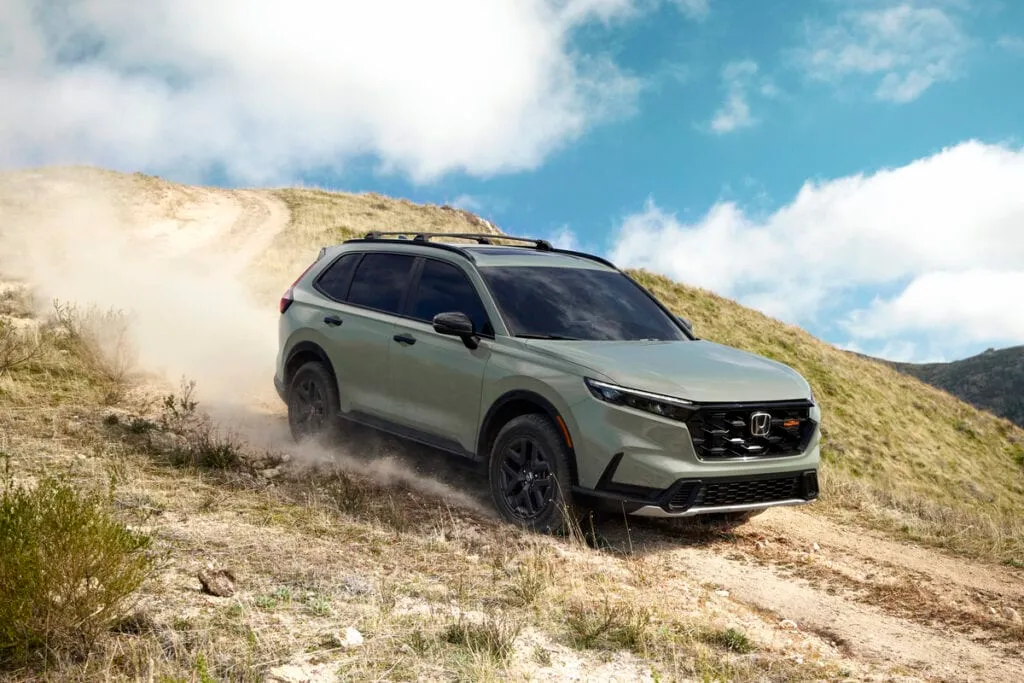
The TrailSport Hybrid adds all-terrain tires and standard all-wheel drive. Photo: Chris Tedesco.
Seven Trims, Three That Stand Out
Honda offers LX, EX, Sport Hybrid, EX-L, TrailSport Hybrid, Sport-L Hybrid and Sport Touring Hybrid trims. These are current manufacturer suggested retail prices before the $1,395 destination charge. Honda’s build-and-price tool lists all-wheel drive as a $1,500 option where it is available.
TrimMSRPEPA combinedBest fitLX$30,92030 FWD / 29 AWDLowest priceEX$33,15030 FWD / 29 AWDBest gas valueSport Hybrid$35,63040 FWD / 37 AWDBest overall valueEX-L$35,40030 FWD / 29 AWDLeather without hybridTrailSport Hybrid$38,80035 AWDSnow and gravelSport-L Hybrid$38,72540 FWD / 37 AWDBest upscale valueSport Touring Hybrid$42,55037 AWDMaximum equipmentPrices and EPA ratings from Honda. AWD is standard on TrailSport Hybrid and Sport Touring Hybrid.
The three standouts are the EX, Sport Hybrid and Sport-L Hybrid. The EX has the comfort equipment most buyers notice. The Sport Hybrid adds performance and major fuel savings for $2,480. The Sport-L then combines the hybrid with leather, parking sensors and a power tailgate without jumping all the way to the Touring price. The CR-V’s popularity is no accident either; it recently took the top spot in U.S. retail registrations.
The CR-V range now spans seven trims and two powertrains. Photo: Chris Tedesco.
LX, EX and EX-L: The Gas Choices
The LX is no punishment box. Its standard 9-inch screen, wireless smartphone integration and charging pad are useful every day. However, it lacks blind-spot information, and the cloth cabin feels more price-led than value-led once destination is added. It works best for a disciplined buyer who will ignore the dealer’s upgrade tour.
The EX is the gas trim to buy. It adds heated front seats, a moonroof, dual-zone climate control, a power driver’s seat, rear USB ports, blind-spot information and rear cross-traffic monitoring. That is a meaningful set of comfort and safety additions for $2,230.
The EX-L brings leather, power front seats with driver’s memory, an eight-speaker audio system, parking sensors and a power tailgate. Those are pleasant upgrades, but its $35,400 price puts it directly beside the $35,630 Sport Hybrid. Unless leather matters more than roughly ten extra combined mpg, the hybrid is the more convincing use of the money.
Every CR-V is practical, but the EX is the sweet spot among gas models. Photo: Chris Tedesco.
Sport, TrailSport, Sport-L and Touring Hybrids
The Sport Hybrid is our overall pick. Its 204-hp system is stronger on paper than the 190-hp turbo, and the front-drive version earns an EPA-estimated 43 mpg city, 36 highway and 40 combined. Add AWD and the combined rating drops to 37 mpg, which is still useful.
The TrailSport Hybrid is a purpose choice, not an automatic upgrade. It gets standard AWD, 18-inch wheels with all-terrain tires, roof rails, a heated steering wheel and a 10.2-inch digital instrument display. Ground clearance is 8.2 inches, the same as other AWD CR-Vs, so the tires and calibration matter more than heroic underbody geometry. Our earlier CR-V TrailSport Hybrid first look explains the rugged additions in detail. Buyers planning more serious trail use should also consider the larger Honda Passport TrailSport.
The Sport-L is the quiet value hero. It starts $75 below the TrailSport, keeps the 40-mpg front-drive option and adds leather, driver’s memory, parking sensors and a power tailgate. Sport Touring adds standard AWD, Bose audio, Google built-in, a heated steering wheel and a hands-free tailgate. It is the complete CR-V, but $43,945 with destination is no longer compact money.
The TrailSport’s all-terrain tires are its most useful mechanical distinction. Photo: Chris Tedesco.
Powertrain, Fuel Economy and Practicality
The 1.5-liter turbo sends 190 hp and 179 lb-ft through a continuously variable transmission. It can tow up to 1,500 pounds and delivers 28/33/30 mpg in front-drive form or 27/31/29 with AWD.
The hybrid combines a 2.0-liter engine with Honda’s two-motor system for 204 total hp. Its traction motor is rated at 181 hp and 247 lb-ft, which is one reason the hybrid is the more appealing specification. Sport and Sport-L reach 40 mpg combined with front-wheel drive or 37 with AWD. The TrailSport’s all-terrain tires trim that to 35 mpg combined. All versions use regular unleaded fuel and carry a 14-gallon tank.
There is a space penalty. Gas models provide 39.3 cubic feet behind the rear seat and 76.5 with it folded; hybrids offer 36.3 and 71.8. Hybrid towing also falls to 1,000 pounds. Rear legroom remains a generous 41 inches either way. Check Honda’s full specifications and EPA rating table before ordering.
Hybrid models trade some cargo and towing capacity for stronger economy. Photo: Chris Tedesco.
Safety Results Need a Careful Reading
Honda Sensing includes forward collision warning, collision mitigation braking, road departure mitigation, adaptive cruise control with low-speed follow, lane keeping assistance and traffic jam assist. Blind-spot information is standard from EX upward but absent on LX.
The IIHS ratings are mixed. The 2026 CR-V earns Good results in the small-overlap front and updated side tests, and its headlights are rated Good. However, it receives a Poor rating in the updated moderate-overlap front test, with the rear-passenger restraints and dummy movement also rated Poor. Vehicle-to-vehicle and pedestrian front crash prevention are both rated Acceptable. That does not erase the CR-V’s strengths, but it deserves more than the usual brochure sentence about safety.
Most driver aids are standard, but blind-spot monitoring starts on the EX. Photo: Chris Tedesco.
Rivals and the Final Recommendation
The Toyota RAV4 remains the obvious cross-shop, particularly in adventure-flavoured hybrid form; our RAV4 Woodland analysis lays out that alternative. The Hyundai Tucson Hybrid counters with a more dramatic cabin, while the Mazda CX-50 appeals to buyers who put steering feel ahead of maximum rear-seat space. Kia’s latest hybrid also deserves attention, especially in front-drive form, as our Sportage Hybrid value analysis explains.
For most buyers, the decision is simpler than Honda’s configurator suggests. Choose the EX if annual mileage is modest and you want the best-value gas CR-V. Choose the Sport Hybrid if efficiency and performance matter more than leather. Choose Sport-L Hybrid if you want both. TrailSport is the snow-and-gravel specialist, and Sport Touring is for the buyer who wants every factory feature and has made peace with the invoice.
Bottom line: The 2026 CR-V is at its best in Sport Hybrid form. It preserves the space, simple technology and everyday usefulness that built the CR-V’s reputation while making the price premium easy to justify. Seven trims are available. Three are particularly sensible. Honda may call that choice; your spreadsheet may call it Tuesday afternoon.
Our pick is the Sport Hybrid; choose TrailSport only when its tires and AWD match your use. Photo: Chris Tedesco.
2026 Honda CR-V FAQ
What is the best 2026 Honda CR-V trim?
The Sport Hybrid is the best overall value. It combines 204 hp, up to 40 mpg combined and the useful equipment fitted to the EX-level cabin for $35,630 before destination.
Is the 2026 CR-V Hybrid worth the extra money?
For drivers covering regular city and suburban mileage, yes. The front-drive Sport Hybrid costs $2,480 more than the EX and improves the combined EPA rating from 30 to 40 mpg. Low-mileage buyers may take longer to recover the premium.
Does the CR-V TrailSport have more ground clearance?
No. Its 8.2 inches matches other AWD CR-V models. TrailSport’s useful differences are standard AWD, all-terrain tires, roof rails and trim-specific calibration and equipment.
How much can a 2026 Honda CR-V tow?
Turbocharged gas models are rated to tow up to 1,500 pounds. Hybrid models are limited to 1,000 pounds.
Which CR-V has the most cargo space?
Gas models have the most room: 39.3 cubic feet behind the second row and 76.5 with it folded. Hybrids provide 36.3 and 71.8 cubic feet.
The CR-V remains a five-seat compact SUV with broad everyday appeal. Photo: Chris Tedesco.