Hyundai History: How Korea Won Over America
Hyundai’s history shows how a risky warranty, distinct brands, and increasingly original cars turned American skepticism into serious respect.
Hyundai history is really a story about trust
The most revealing Hyundai statistic may be the distance between two American sales totals. The brand sold approximately 90,200 vehicles here in 1998. During calendar year 2025, it sold about 901,700. One number belongs to a company many shoppers regarded as a last resort. The other belongs to a mainstream brand operating near record scale.
Hyundai’s Tucson alone generated more than twice the brand’s entire 1998 volume during 2025. Add Kia and Genesis, and Hyundai Motor Group becomes a roughly 7.3-million-vehicle global operation, generally ranked behind only Toyota and Volkswagen Group by sales volume.
Size, however, is the result rather than the explanation. The useful question for today’s shopper is how a company with a damaged reputation persuaded millions of people to give it another chance.
You may also enjoy: Kia’s Best Sellers Reveal What Americans Really Want
You may also enjoy this video:
The answer began with an unusually direct response to consumer distrust. Hyundai introduced its 10-year, 100,000-mile powertrain warranty in the United States in 1998. Instead of asking buyers to overlook the brand’s past, it reduced some of their financial exposure. The Federal Trade Commission’s guidance on auto warranties is still useful here: coverage has limits, exclusions and eligibility requirements, so shoppers should read the actual terms rather than the advertising slogan.
Hyundai’s American sales rose to approximately 164,000 vehicles in 1999. That increase cannot be credited to one program alone, but the warranty helped make a skeptical shopper’s decision feel less reckless. It was the automotive equivalent of saying, “If you don’t trust us yet, we’ll carry more of the risk.”
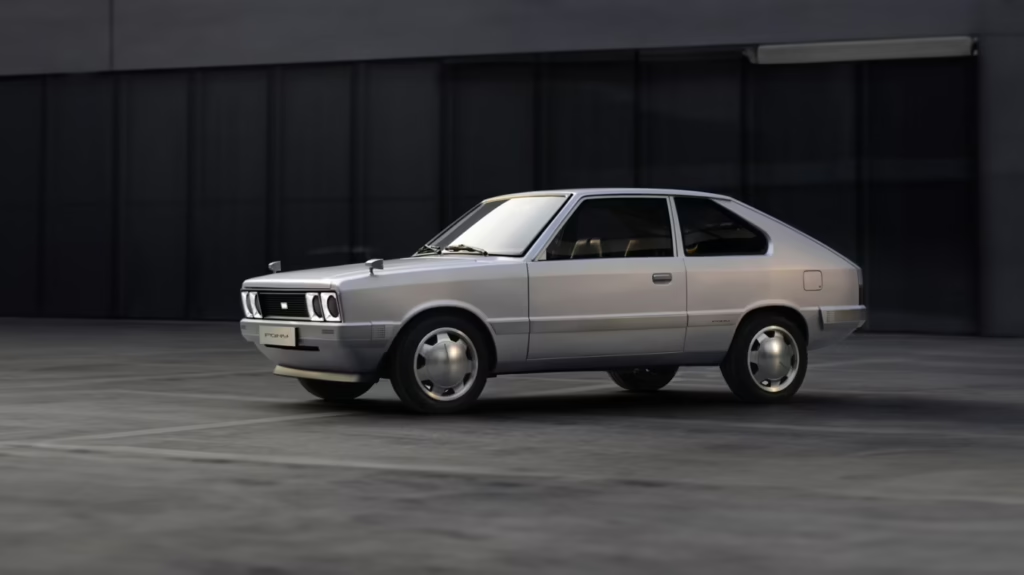
The original Hyundai pony imported into the United States
The warranty opened the door, but products kept it open
A generous guarantee can bring somebody into a showroom once. It cannot create decades of growth unless the cars improve. Hyundai invested in design, engineering, production and quality while gradually moving away from the idea that a Korean vehicle’s primary purpose was to undercut a Japanese one.
That evolution is important for used-car shoppers. The Hyundai badge alone does not establish reliability, and neither does the length of the original warranty. Buyers should investigate the particular model year, powertrain, recall history and service record. They should also remember that headline warranty coverage may differ for a subsequent owner.
You may also enjoy: Hyundai’s $26 Billion U.S. Gamble
Hyundai, Kia and Genesis also stopped behaving like three trim levels of one company. Kia developed the most youthful and assertive personality. Hyundai became the mainstream technology and design laboratory. Genesis pursued restrained luxury with enough visual confidence to sit beside a Mercedes-Benz or Lexus without appearing to have arrived through the catering entrance.
That separation gives shoppers meaningful choices, but the retail experience still needs attention. Genesis can build a persuasive luxury vehicle while leaving buyers to determine whether their local sales and service operation delivers luxury-brand treatment. The product has advanced more quickly than every dealership environment carrying it.
2026 Hyundai Santa Fe
Original electric cars changed the conversation
The Ioniq 5, Ioniq 6, Kia EV6 and EV9 mattered because they were not timid electric adaptations of familiar gasoline vehicles. They gave the group recognizable design signatures and practical uses for dedicated EV architecture. The federal FuelEconomy.gov explanation of all-electric vehicles also highlights the ownership tradeoffs: efficient drivetrains and reduced routine maintenance arrive with charging-time, range and battery-cost considerations.
You may also enjoy: 2026 Hyundai Ioniq 5 Sales Surge After Big Price Cuts
The buyer lesson is not that every Korean EV is automatically the sensible choice. Hyundai’s aggressive Ioniq 5 pricing illustrates how rapidly the market can change, while used values, insurance rates and charging access can alter the ownership calculation. The Department of Energy explains that most modern EV batteries use lithium-ion chemistry, but battery design, thermal management and warranty coverage differ by manufacturer and model.
Hyundai Motor Group’s electric cars nevertheless forced competitors to notice. The Kia Telluride won World Car of the Year in 2020, followed by the Ioniq 5 in 2022, Ioniq 6 in 2023, EV9 in 2024 and EV3 in 2025. Five victories in six award cycles suggest more than an occasional lucky product.
You may also enjoy: 2027 Hyundai Ioniq 9 Calligraphy Black Ink
Hyundai historical original Excel
Hyundai History now carries higher expectations
Success has removed the benefit of low expectations. Hyundai and Kia must answer for recalls, theft-related problems and inconsistent dealer experiences just as established manufacturers must. Shoppers should check official safety ratings and recall information for the exact vehicle rather than assuming that one award or brand reputation applies across an entire lineup.
The group does have substantial safety recognition. The Insurance Institute for Highway Safety’s current Top Safety Pick listings include vehicles from Hyundai, Kia and Genesis. Those awards remain model-, build-date- and equipment-specific, which is why the details matter more than a sweeping advertising claim.
You may also enjoy: Genesis GV80 Review: Quiet Luxury With Teeth
The next phase is being built partly in America. Hyundai has announced a $26 billion U.S. investment plan through 2028, encompassing vehicle production, steel, technology and related operations. Local manufacturing can reduce some supply and tariff exposure, but factories alone will not settle questions about software quality, charging, affordability or future resale values.
For buyers, that means Hyundai Motor Group deserves consideration without receiving a free pass. Compare transaction prices, warranty eligibility, insurance quotes, safety results and local dealer service. A strong brand transformation does not make every model the correct purchase.
You may also enjoy: Genesis Wants to Scare BMW With 22 New Vehicles
The greatest achievement in Hyundai history is therefore not becoming large. It is changing the burden of proof. Thirty years ago, Hyundai had to convince Americans that its cars deserved to be taken seriously. Today, rivals must explain why a Hyundai, Kia or Genesis should not be on the shopping list. That is a far more difficult transformation than selling a cheap car.