How Landlords Are Using AI to Lease Faster, Collect Rent and Keep Tenants Longer
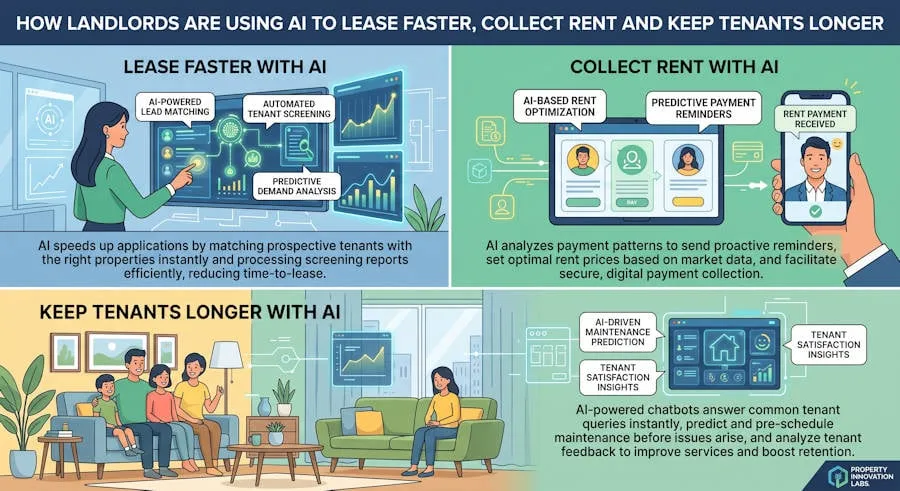
Property management has always been a high-volume business. But the operational demands on landlords and property managers have grown considerably as tenant expectations rise and portfolio complexity increases. Staffing costs make it difficult to absorb that volume through headcount alone, and the most time-consuming tasks tend to be the most repetitive: maintenance routing, renewal follow-up, prospect communication, reporting, and rent collection.
That is where AI tools have found traction. Adoption across the property management sector has accelerated as operators look to automate the predictable, routine work that consumes hours each week while improving accuracy and consistency. Across portfolio sizes, these capabilities can influence lead acquisition, resident retention and day-to-day operations. Here are five areas where AI can have the greatest impact, from maintenance triage to performance reporting.
Maintenance Request Triage
According to the National Apartment Association, maintenance quality is one of the top factors in non-renewal decisions — a SatisFacts survey found that 27% of residents who chose not to renew cited apartment condition and maintenance as the primary reason. Faster triage addresses that directly.
Every incoming maintenance request (a leaky faucet, a broken HVAC unit, a pest complaint) traditionally requires someone to read it, categorize it, and route it to the right vendor or technician. For a property with hundreds of units, triage alone can consume a significant portion of a manager’s day.
AI tools now handle that first step automatically. The system reads the request, assigns a priority level (emergency, urgent or routine), routes it to the appropriate contact and sends an automated acknowledgment to the resident.
Lease Renewal Outreach
A 60-day renewal window usually requires an initial offer, one or two follow-ups, and a final decision prompt. For a manager handling 200 units, that’s hundreds of individual touchpoints a year: most of them templatable, all of them time-sensitive, and many of them missed because no one had bandwidth to track the calendar closely enough.
Turnover is expensive. The National Apartment Association estimates that a single unit turn costs between $1,000 and $5,000 in direct make-ready expenses. When factoring in vacancy loss, marketing and administrative costs, total turnover costs average close to $4,000 per unit. Systematic renewal outreach is one of the most direct ways to protect against that.
Automated platforms monitor lease expiration dates and trigger renewal sequences at 90-, 60- and 30-day intervals without a manager initiating each step.
Prospect Communication and Lead Response
Speed-to-lead is one of the clearest drivers of leasing conversion. Prospects often contact several properties at once, so the difference between a response within minutes and one that arrives an hour later can determine whether the conversation continues.
AI-powered leasing assistants keep that conversation moving around the clock. They can answer common questions about pricing, availability and pet policies, qualify prospects based on factors such as move-in date and budget, schedule tours and continue following up when a lead goes quiet.
Concerns about automated conversations feeling impersonal are understandable. A well-designed system combines prompt, accurate answers with a timely handoff to the leasing team when human involvement matters most.
Yardi Chat IQ, for example, supports this process across chat, email, text and voice. It uses verified property data and conversation history to qualify and nurture leads, recommend follow-up actions, support lease conversion and assist with renewal outreach.
Portfolio Performance Reporting
Pulling a weekly or monthly performance report across multiple properties can involve exporting data from several systems, cleaning up spreadsheets, and summarizing results by hand. For managers overseeing larger portfolios, that can mean hours spent preparing the numbers before the analysis even begins.
Modern reporting tools can automate much of that work, and the most effective setups tend to separate three distinct functions rather than collapsing them into one.
The first is scheduled data delivery, pushing reporting-ready data to a BI platform like Microsoft Power BI on a recurring basis, typically with prebuilt dashboards teams can adapt to their needs. The second is continuous replication, copying database tables in real time to environments like Snowflake, Amazon AWS, or Microsoft Azure, giving technical teams direct access to current data for custom analysis. The third is conversational querying, letting managers ask questions about live operational, financial, and market data in plain language, without assembling a spreadsheet first.
Each function handles a different part of the reporting workflow. Scheduled delivery supports recurring reports, replication feeds real-time data into external environments, and conversational access helps teams investigate specific questions as they arise.
When all three are in place, manual reporting work drops significantly and performance changes become easier to catch before they compound.
Rent Collection Reminders and Delinquency Follow-Up
Chasing late rent is one of the most uncomfortable parts of property management – and one of the most operationally important. Sending pre-due-date reminders, issuing late notices, and escalating through a delinquency workflow requires consistent execution that tends to slip when a team is stretched thin. The result is a patchwork process where some residents get timely follow-up and others do not, creating both revenue risk and fair treatment concerns.
Automated rent collection systems send reminders before the due date, generate late notices after the grace period, and escalate based on days past due. Major property management platforms handle these workflows inside the same system where leases and payments are already managed, keeping the record clean and the process auditable.
The operational value here is consistency. Delinquency follow-up breaks down not from negligence but from competing priorities. Automated workflows execute the same sequence regardless of how busy the team is, which means early-stage outreach reaches residents when it is still likely to be effective.
The Bottom Line
None of these tools replace the judgment and hands-on experience that property management requires. Lease negotiations, resident disputes and investment decisions still depend on experienced people. What AI changes is the baseline: routine tasks that consume time without adding insight get handled automatically, freeing staff for work that actually requires their expertise.
Most modern property management platforms already include some version of these capabilities. The difference lies in how deeply they are connected. Yardi has Virtuoso, a massive native AI ecosystem that is highly integrated across the platform. It serves as an intelligent layer across the portfolio, using AI agents and specialized tools to automate or support repetitive work spanning core property operations, accounting, leasing, maintenance, CRM and resident communications.
For operators still managing these workflows in silos, that level of integration is worth examining.