Would You Rather Have More Money in Your 80s or More Memories in Your 60s?
Retirement planning usually asks one question above all others: Will your money last for the rest of your life? Financial projections are built around that goal, showing portfolio balances stretching into your 80s, 90s, or beyond. The assumption is that the stronger the ending balance, the more successful the retirement plan.
But there is another question that deserves just as much attention: How many of those years will you actually be healthy enough to enjoy the money? Lifespan measures how long you live, while health span measures how long you remain in relatively good physical and cognitive condition. A retirement strategy that maximizes wealth at age 90 while sacrificing healthy years in your 60s may look excellent on a spreadsheet and still produce the wrong life.
Lifespan and Health Span Are Not the Same Thing
Life expectancy is the number most people instinctively think about when planning retirement. You might retire in your 60s and assume you could live into your 80s or 90s, which means the portfolio may need to support several decades of spending. That is an essential part of retirement planning.
Health span is different. It refers to the period of life spent in relatively good health, before chronic illness, disability, or cognitive decline materially limits what you can do. The episode highlights a striking gap between average lifespan and average healthy years, illustrating why living longer does not necessarily mean having more years available for ambitious travel, sports, hobbies, or other physically demanding experiences.
Those are population averages rather than predictions for any one person. Someone who reaches retirement in excellent health may remain active for decades, while another person’s health could change unexpectedly much sooner. The point is not to predict the exact age when your health changes, but to acknowledge that healthy years are finite too.
Reaching 60 Changes the Longevity Calculation
Average life expectancy at birth can also be misleading for someone already approaching retirement. If you have already reached 60, you have survived many of the risks incorporated into life-expectancy-at-birth statistics. That means your remaining expected lifespan may stretch much further than the headline national average suggests.
This matters because retirement planning has to protect against two very different risks. One is running out of money because you live a very long time. The other is spending too much of your healthier life working simply because you are afraid of the first risk.
A good plan has to respect both possibilities. You need enough financial resources to support a long retirement, but you also need to recognize that the most active years of that retirement may occur near the beginning rather than the end.
Traditional Retirement Planning Focuses Heavily on the End
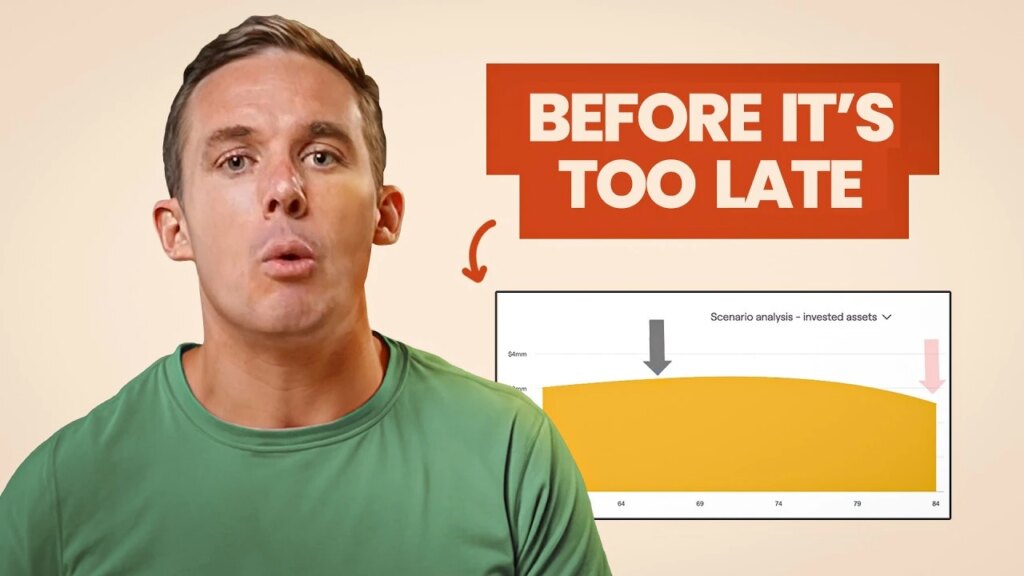
Most retirement projections naturally draw your attention toward the far right side of the chart. Advisors and retirees look at age 85, 90, or 95 and ask whether the portfolio still has money remaining. A large ending balance feels reassuring because it protects against longevity, poor markets, unexpected expenses, and the possibility of leaving money to children or grandchildren.
There is nothing wrong with wanting that security. The mistake is allowing terminal portfolio value to become the primary definition of a successful retirement. A portfolio is not supposed to win an endurance contest; it is supposed to support your life.
The early years of retirement can have a very different purpose from the later years. When you are healthier and more energetic, spending may be higher because you travel, participate in hobbies, visit family, and pursue experiences that require mobility and stamina. A retirement plan should recognize that reality rather than assume every year of retirement will look the same.
The Best Retirement Years May Come First
Many retirees naturally spend more during the first decade after leaving work. Those years are sometimes called the “go-go” years because people are physically capable of doing the things they postponed while building careers and raising families. Later retirement may become slower as energy and mobility change.
That pattern suggests that perfectly level retirement spending may not always reflect real life. Someone might reasonably spend more between ages 62 and 72 on travel and experiences and less later when daily life becomes simpler. The financial plan can be built around that expected pattern rather than treating higher early spending as irresponsible.
The danger comes when someone postpones those experiences in order to create an even larger future portfolio. Money saved for a trip at 68 is not automatically equivalent to money spent on that trip at 82 if health no longer allows you to take it.
Another Year of Work Has a Cost
Working another year usually improves the financial plan. You earn another salary, contribute more to retirement accounts, delay portfolio withdrawals, potentially increase Social Security benefits, and give existing investments more time to compound. From a purely financial perspective, continuing to work can be extremely difficult to argue against.
But those benefits are not free. Another year of work also consumes another year of your life, including thousands of hours that could have been spent with family, traveling, exercising, developing friendships, or doing whatever you hoped retirement would make possible. That cost is much harder to measure because there is no account statement showing the time you gave up.
This is where retirement planning can become distorted. Financial benefits are visible and measurable, while the cost to health, relationships, energy, and time is often invisible. Because one side has numbers attached to it, people can mistakenly treat it as the only side that matters.
The Highest Salary of Your Life Can Be the Hardest to Leave
The temptation to keep working can become strongest right when retirement becomes financially possible. People in their early or mid-60s may be earning more than they ever have, receiving large bonuses, maximizing retirement contributions, and watching stock compensation continue to vest. Walking away can feel financially irrational.
That is especially true for someone who spent decades climbing professionally. One more year may add tens or even hundreds of thousands of dollars to net worth. Another year also feels safer because the portfolio becomes larger and the retirement date moves closer to Social Security or Medicare.
But the right question is not whether another year makes you wealthier. It almost certainly will. The question is whether becoming wealthier is still worth what that year requires from the rest of your life.
Work Can Absolutely Be Worth Continuing
This is not an argument that everyone should retire as early as possible. Work can provide purpose, relationships, intellectual challenge, structure, and genuine enjoyment. Someone who wakes up energized by their career may gain more than money from continuing.
In that situation, work may actually support health and social connection rather than detract from them. There is no reason to leave a fulfilling career merely because a financial plan says retirement is possible. Financial independence creates the option to retire; it does not create an obligation.
The more difficult case is someone who has enough money but no longer enjoys the job. If work is producing chronic stress, damaging health, preventing meaningful time with loved ones, or consuming the energy needed for everything else, the calculation changes. Financial independence is supposed to give that person the ability to make a different choice.
Ask What Delaying Retirement Could Cost You
Every additional working year has an opportunity cost. It might mean missing time with grandchildren while they are still young enough to want to spend entire days with you. It could mean losing a year when you and your spouse are both physically capable of taking the trip you have talked about for decades.
It might also mean delaying attention to your own health. Exercise, sleep, stress reduction, medical care, and hobbies are often the first things sacrificed during demanding careers. Someone may reach retirement with a stronger portfolio but a weaker body.
These costs do not prove that retirement should happen immediately. They simply belong on the same balance sheet as the salary, bonus, pension credits, and retirement contributions gained by continuing to work.
Health Compounds Too
Investors understand compounding intuitively. Money invested today can grow for decades, which is why early saving is so valuable. But the same concept can be applied outside finance.
Exercise today can improve mobility and strength years from now. Time invested in a marriage or friendship can deepen that relationship over decades, while hobbies pursued consistently can become important sources of identity and purpose after work ends. Neglect compounds too.
Someone who spends every available hour optimizing financial wealth may unintentionally allow other forms of wealth to deteriorate. By the time the portfolio reaches the ideal number, rebuilding health or relationships may be far more difficult than earning another dollar.
Relationships Do Not Have a Financial Scorecard
One reason money receives so much attention is that progress is easy to track. You can see another 401(k) contribution, another stock vest, another bonus, or another $100,000 added to the portfolio. Financial success constantly provides measurable feedback.
Relationships do not. There is no quarterly statement showing whether you are becoming closer to your spouse, children, grandchildren, or friends. There is no account balance showing whether you have developed enough purpose, community, or interests to support a fulfilling retirement.
That can cause people to overinvest in the thing they can measure and underinvest in the things they cannot. A retirement plan should compensate for that bias by intentionally considering health, relationships, time, and purpose alongside financial assets.
Money Only Has Value When It Serves Something
More money is valuable when it creates additional security or makes desired experiences possible. A larger portfolio can allow someone to retire, travel, help children, donate to charity, or absorb unexpected healthcare costs. Financial resources clearly matter.
But after financial independence has been reached, the marginal value of additional wealth can begin to decline. Increasing a portfolio from $2.5 million to $2.8 million may technically improve the plan, but it may not materially improve the life the portfolio supports. The same year used to earn that extra $300,000 could potentially have enormous personal value.
That is why “more” should not automatically be equated with “better.” More money is better only when it serves something worth purchasing with the time required to earn it.
Financial Independence Should Change the Question
Before financial independence, the question is often straightforward: How can I save enough to make retirement possible? Work and accumulation remain necessary because the resources do not yet support the desired lifestyle. Financial security has to come first.
Once financial independence has been achieved, the question changes. Instead of asking how much more you can accumulate, ask what continuing to work is buying and what it is costing. The answer becomes much more personal.
Someone may decide another three years of work will substantially improve security and is worth the trade. Another person may discover that the financial improvement is relatively small while the personal cost is enormous. Both can be rational decisions because the purpose of planning is not to maximize one number for everyone.
Create a Financial Independence Number
This is where a real financial plan becomes important. You need some way to know whether you actually have enough before treating work as optional. That requires estimating retirement spending, income sources, investment withdrawals, taxes, healthcare, inflation, and longevity.
The objective is not to identify a magical number that guarantees nothing can ever go wrong. No amount of money can provide perfect certainty. The goal is to determine whether your resources can reasonably support the life you want under a range of realistic scenarios.
Once that threshold has been reached, the conversation changes dramatically. You can continue working because you want to rather than because fear tells you that you must.
Retirement Should Be Designed Around Your Healthiest Years
A strong retirement plan should consider when you expect to spend money, not merely how much you expect to spend. If travel, golf, hiking, extended family visits, or other active pursuits are priorities, those activities may deserve more financial resources during the beginning of retirement.
That could mean intentionally spending more between 60 and 70 and less between 80 and 90. It could mean retiring earlier even though doing so reduces the final portfolio balance. The plan can still be financially responsible while prioritizing years when money can produce the greatest improvement in quality of life.
This is not permission to ignore longevity risk. It is recognition that saving every possible dollar for your final decade can be just as unbalanced as spending recklessly at the beginning.
The Biggest Retirement Risk May Not Be Running Out of Money
Financial planning naturally emphasizes the risk of outliving your assets. That risk is real and deserves careful management. But retirees face another risk that receives far less attention: reaching the end of life with plenty of money but too many experiences postponed until they were no longer possible.
That outcome does not show up as failure in traditional planning software. The portfolio survived, perhaps even grew substantially, and the probability-of-success calculation looked excellent. Yet the plan may still have failed to support the life the person wanted.
A better definition of retirement success includes both financial security and effective use of time. The portfolio should last, but the retiree should also live.
Redefine Wealth Before You Decide When to Retire
Financial wealth is only one form of wealth. Time, health, relationships, purpose, hobbies, and freedom all contribute to quality of life, and each can become more scarce as people age. Retirement planning should recognize those assets even when they cannot be assigned precise dollar amounts.
The correct mix will be different for everyone. Someone who loves work may choose to keep building financial wealth because the job simultaneously provides purpose and social connection. Someone whose job has become exhausting may rationally choose to accept a smaller ending portfolio in exchange for more healthy time.
The important part is making the decision deliberately. Continuing to work forever should not become the default simply because maximizing money is easier to measure than maximizing life.
Would You Rather Have More Money in Your 80s or More Memories in Your 60s?
There is no universal answer to that question. Some people genuinely need additional years of income before retirement is financially secure, while others are already financially independent and simply struggle to walk away from the highest salary they have ever earned. The distinction matters.
The purpose of a financial plan is not to make you the wealthiest person possible at age 90. It is to help you use money to support a life that includes security, relationships, purpose, experiences, and the freedom to spend your healthiest years intentionally.
If another year of work meaningfully strengthens a plan that still needs strengthening, keep building. If the plan already works and the job is costing you health, time, relationships, and energy, then another year is not free. The most important retirement calculation may be understanding what you are sacrificing today to create money you may never need tomorrow.
You should always consult a financial, tax, or legal professional familiar about your unique circumstances before making any financial decisions. This material is intended for educational purposes only. Nothing in this material constitutes a solicitation for the sale or purchase of any securities. Any mentioned rates of return are historical or hypothetical in nature and are not a guarantee of future returns.
Past performance does not guarantee future performance. Future returns may be lower or higher. Investments involve risk. Investment values will fluctuate with market conditions, and security positions, when sold, may be worth less or more than their original cost.