2027 Honda Civic Review: Which Trim Is Worth Your Money?
2027 Honda Civic review: The new Sport-L adds luxury, but the 200-hp hybrid offers a better argument for commuters watching fuel costs.
By Nik J. Miles | November 23, 2026
I’ve always believed a sensible car should make its strongest argument before the salesperson starts explaining optional equipment. Honda’s Civic has traditionally been quite good at that. It’s reasonably sized, uses comparatively little fuel and doesn’t require the sort of parking space normally reserved for a small commercial building.
For 2027, Honda has made the purchasing decision more interesting. There’s a new Sport-L trim with leather seats, extra comfort equipment and a price that sits just $1,200 below the Sport Hybrid.
That’s a rather awkward position for a gasoline-powered car when the hybrid produces 50 additional horsepower and delivers considerably better fuel economy.
It also means the most interesting question about the new Civic isn’t what Honda has changed. It’s which version actually deserves your money.
You may also like this video:
2027 Honda Civic Review: My Buying Verdict
My recommendation is the Sport Hybrid sedan for most buyers who can afford its $29,695 starting MSRP. It offers 200 horsepower, an EPA combined rating of 49 mpg and enough additional equipment to make it feel like a worthwhile step above the base model.
The LX remains the financially sensible alternative if keeping the purchase price down is the overriding priority. And the new Sport-L makes a decent case for shoppers who prefer leather upholstery and power-adjustable front seats to additional power and efficiency.
My reservation about the Sport-L is straightforward. When the hybrid sits only $1,200 above it, choosing the gasoline engine becomes a much more deliberate decision.
Best for: Commuters, small families, first-time new-car buyers and anyone who wants excellent fuel economy without charging a vehicle.
Skip if: You need all-wheel drive, frequently transport bulky cargo or regularly carry enough dogs to require a dedicated luggage compartment and a negotiating committee.
Pros
- 200-horsepower hybrid with an EPA combined estimate of 49 mpg in sedan form.
- A genuinely affordable LX starting price relative to the rest of the Civic range.
- Useful standard Honda Sensing driver-assistance technology.
- Choice of sedan and more versatile hatchback body styles.
- New Sport-L gives gasoline buyers access to more premium equipment.
Cons
- No all-wheel-drive option in the ordinary Civic lineup.
- Sport-L gasoline buyers sacrifice substantial efficiency compared with the hybrid.
- Desirable premium technology is concentrated in the Sport Touring Hybrid.
- A Civic sedan cannot accommodate bulky items as easily as a crossover or hatchback.
Editorial note: This is a specifications-based 2027 Civic buying analysis. No firsthand 2027 Civic road-test notes or original Test Miles performance measurements were supplied for this article.
2027 Honda Civic Price and Trim Comparison
Honda has resisted turning the Civic into a single expensive specification. The sedan still offers five distinct trims, and the price differences reveal how the company expects customers to make their decisions.
| 2027 Civic Sedan | Starting MSRP | EPA Combined MPG |
|---|---|---|
| LX | $24,995 | 36 |
| Sport | $26,995 | 34 |
| Sport-L | $28,495 | 34 |
| Sport Hybrid | $29,695 | 49 |
| Sport Touring Hybrid | $32,695 | 49 |
All five sedan prices exclude Honda’s $1,295 destination charge, taxes and registration. Premium paint, dealer accessories and financing expenses can increase the actual amount paid.
The Sport Hybrid therefore carries a manufacturer-suggested total price of $30,990 including destination, before other charges.
It’s the number I would use when comparing the Civic with a Toyota Corolla Hybrid or another compact car. Comparing one manufacturer’s base MSRP with a competitor’s destination-inclusive figure is a particularly efficient way to produce a thoroughly misleading bargain.
One interesting detail: the Sport-L sedan starts at $28,495 and the Sport Hybrid at $29,695. The difference is only $1,200, yet the powertrains offer fundamentally different ownership experiences.
For many customers, that’s where the decision will be made.
The New Sport-L Has a Problem Called the Hybrid
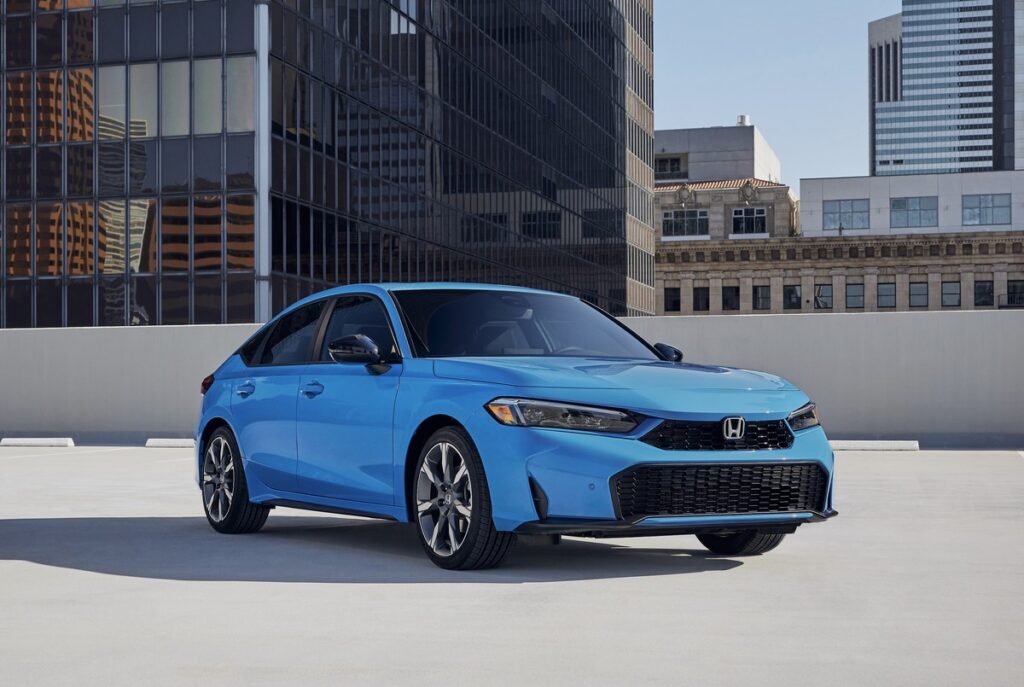
The Sport-L is Honda’s principal addition for 2027. It slots between the gasoline Sport and the Sport Hybrid, providing a more luxurious cabin without requiring customers to buy an electrified powertrain.
Its equipment includes leather seating surfaces, heated front seats, an eight-way power driver’s seat, a four-way power passenger seat and dual-zone automatic climate control. Honda also upgrades the door trim, center armrest and instrument-panel detailing.
None of this is trivial. A heated seat on a freezing morning is worth considerably more to an owner than an elaborate animated welcome screen.
But Honda has complicated the Sport-L’s argument by placing it directly beneath the hybrid.
The gasoline Sport-L makes 150 horsepower. The Sport Hybrid produces 200 horsepower, and its official combined economy jumps from 34 mpg to 49 mpg in the sedan.
The Sport-L also isn’t simply a cheaper version of the hybrid with identical equipment. Buyers must compare the complete equipment lists. If leather, power-adjustable seats and premium cabin details are essential, the Sport-L could be more appealing than the standard Sport Hybrid.
For me, however, power and fuel efficiency are two benefits I’d use every time I drive. Leather upholstery isn’t automatically enough to outweigh them.
Why I’d Choose the 200-Horsepower Civic Hybrid
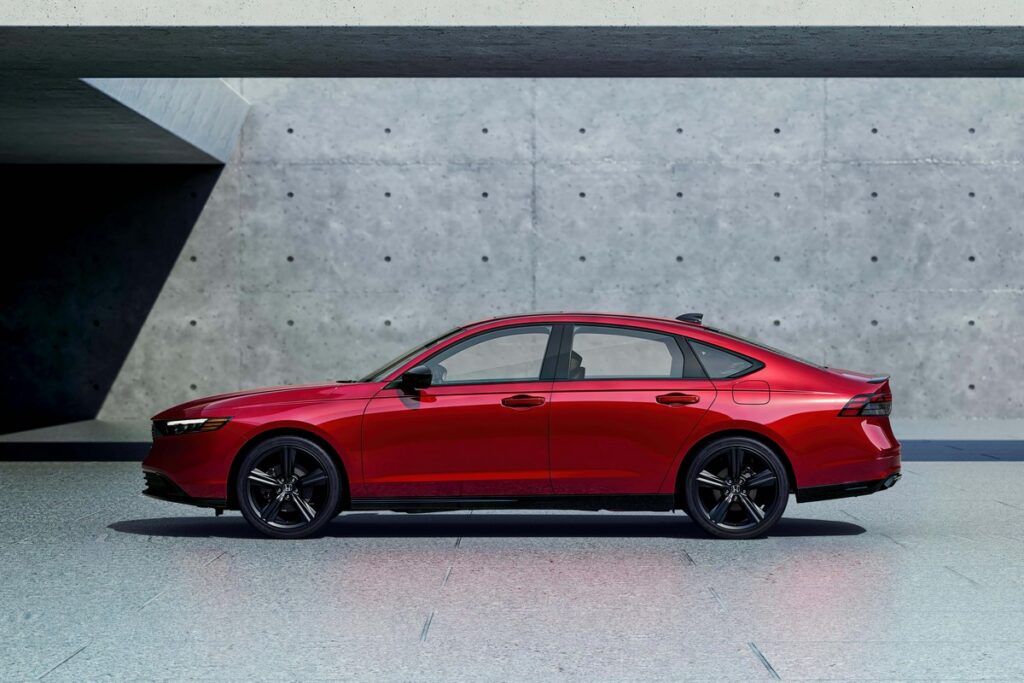
Honda’s two-motor hybrid system produces 200 horsepower in the 2027 Civic. The manufacturer’s published specifications list 232 pound-feet of electric-motor torque.
That torque figure belongs to the electric motor, not a separate combined-system torque rating. The distinction is important when comparing hybrid vehicles with conventional gasoline models.
The gasoline Civic uses a 2.0-liter four-cylinder engine producing 150 horsepower, connected to a continuously variable transmission.
The hybrid uses a different transmission arrangement, described by Honda as a direct-drive unit, rather than the conventional gasoline model’s CVT.
Both versions drive the front wheels.
On paper, the hybrid’s extra 50 horsepower gives it a substantial advantage. Exactly how that translates into acceleration, refinement and response on unfamiliar roads needs a proper comparative road test.
What we can confirm is that the hybrid offers more total system power while using substantially less gasoline in standardized EPA testing.
The Civic Sport Hybrid sedan is rated at 50 mpg city, 47 highway and 49 combined. Those figures are impressive for a conventional compact car that requires no external charging.
With a traditional hybrid, the driver simply fills the tank. There’s no home charging equipment to install, no public charger to find and no separate electricity bill to calculate.
For someone moving out of an older gasoline-only vehicle, that simplicity is a major attraction.
How Much Fuel Could the Hybrid Actually Save?
Let’s use a typical annual driving example rather than promising a precise saving for every owner.
At 12,000 miles per year, a Civic Sport-L achieving its EPA combined estimate of 34 mpg would consume approximately 353 gallons of gasoline.
A Sport Hybrid achieving 49 mpg would use approximately 245 gallons.
That’s about 108 gallons saved annually.
At $3.50 per gallon, the difference is roughly $378 per year. At $4 per gallon, it rises to approximately $432.
These are calculations based on EPA combined ratings, not measured Test Miles fuel-economy results. Your mileage, gasoline prices and driving conditions will affect the outcome.
The $1,200 difference in starting MSRP between the Sport-L and Sport Hybrid could be offset by fuel savings in around three years under the $3.50 example, before accounting for other ownership-cost differences.
Someone driving only 5,000 miles annually will see a much smaller financial benefit. Someone commuting 20,000 miles will see a larger one, assuming the same relative fuel consumption.
This is why I would never recommend buying a hybrid purely because the badge says hybrid. The numbers need to work for the person paying the bill.
Interior Space: The Civic Is Still a Proper Small Car
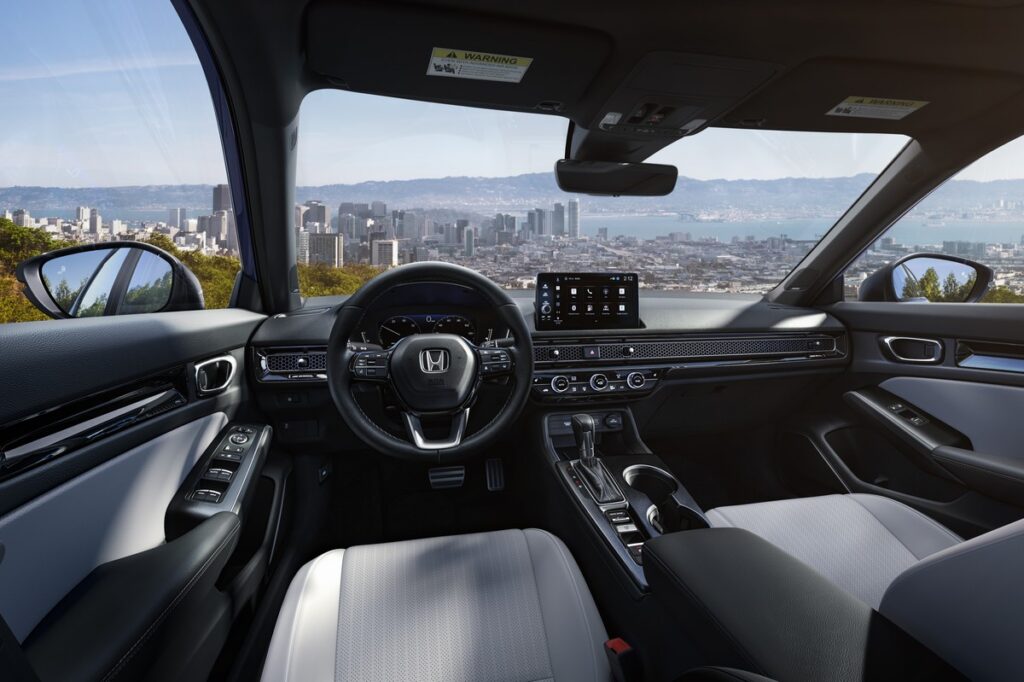
Honda lists 42.3 inches of front legroom and 37.4 inches in the rear of the 2027 Civic sedan. The manufacturer also specifies 14.8 cubic feet of trunk capacity.
Those figures suggest the Civic deserves consideration from buyers who need a compact vehicle but don’t want to surrender the entire rear seat to a pair of shopping bags.
The sedan is 184.8 inches long, which keeps it considerably more manageable than a large SUV. Its 107.7-inch wheelbase also provides useful space within the footprint of a compact vehicle.
I would still recommend physically testing the back seat before purchasing, especially if tall adults travel regularly or rear-facing child seats are required.
Published legroom numbers cannot fully explain seat shape, front-seat positioning or how much clearance remains after the driver has adjusted the seat.
Buyers regularly transporting large dogs, bicycles or bulky equipment should inspect the hatchback. Its larger rear opening is a practical advantage even when a sedan’s trunk looks respectable on paper.
And if you’re regularly transporting several large dogs, I would stop pretending a Civic is the right tool. Even Honda’s engineers are entitled to a day off.
You may also enjoy: 2027 Honda CR-V Review: Why I’d Buy One Now.
Honda S+ Shift Makes the Expensive Hybrid More Interesting
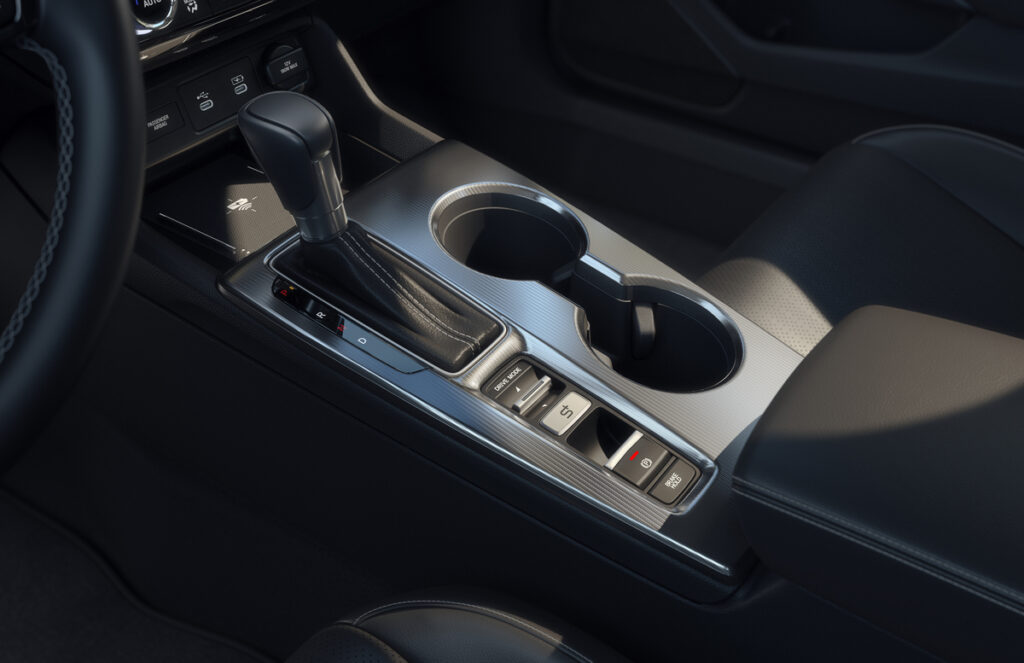
For 2027, Honda has brought its S+ Shift system to the Civic Sport Touring Hybrid.
It’s technology first used on the new Prelude, designed to recreate some of the involvement associated with a traditional performance transmission.
The system simulates gear changes and rev-matched downshifts, adds virtual gear holding and adjusts engine sounds to accompany the experience.
It does not install a conventional manual transmission inside the Civic hybrid. Rather, it changes how the hybrid powertrain communicates its performance to the driver.
That sounds entertaining, and potentially quite clever, but I’m not convinced everyone buying a fuel-efficient Civic needs it.
Some customers will enjoy the additional drama. Others will be quite content to travel 40 miles without being invited to imagine a gearbox that isn’t physically there.
The Sport Touring Hybrid sedan begins at $32,695 before destination, $3,000 above the Sport Hybrid.
That extra money also brings more premium equipment, so S+ Shift should be viewed as part of the upper trim’s package rather than as a standalone $3,000 feature.
My advice is to try the system before allowing it to determine your purchasing decision.
You may also enjoy: 2027 Honda Civic Type R: Honda Fixed the Right Things.
Safety and Technology: Start With the Basics
Every 2027 Civic includes the Honda Sensing suite of driver-assistance technologies.
That brings collision-mitigation braking with pedestrian detection, adaptive cruise control, lane-keeping assistance, forward-collision warnings and road-departure mitigation.
Sport models also include blind-spot monitoring with rear cross-traffic alerts.
These systems can help drivers recognize hazards and reduce the consequences of some mistakes, but they do not replace driver attention.
I would rather have a well-calibrated automatic emergency braking system than a screen capable of displaying animated fish. Preferably Honda agrees.
The technology choices are also worth checking carefully. Honda reserves features such as Google built-in, premium audio and its more sophisticated displays for higher trims.
Buyers who rely on wireless smartphone integration or built-in navigation should verify the exact equipment on the window sticker. Not every Civic offers the same arrangement.
The sensible approach is to identify the technology you actually use rather than automatically buying the biggest available screen.
Independent safety assessments from IIHS and NHTSA should be checked for the specific model and model year before drawing conclusions about crash-test performance.
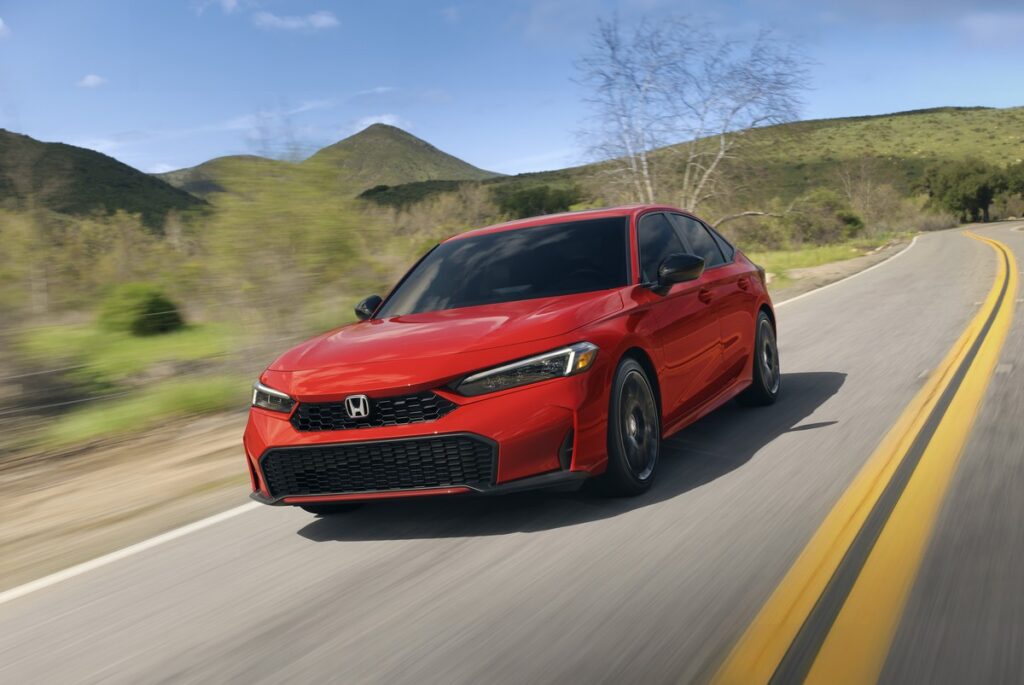
2027 Civic Sedan or Hatchback?
Honda continues to offer the normal Civic in two body styles, and there are meaningful price and fuel-economy differences.
The hatchback range begins with the Sport at $28,195, followed by the Sport-L at $29,695, Sport Hybrid at $30,895 and Sport Touring Hybrid at $33,895.
Those prices exclude the $1,295 destination charge.
The Civic Sport Hybrid hatchback carries an EPA combined estimate of 47 mpg, compared with 49 mpg for the hybrid sedan.
The difference is modest enough that I would make the decision based primarily on cargo needs.
The sedan is a sensible choice for a driver who carries passengers and conventional luggage. The hatchback is more attractive for someone who regularly loads awkwardly shaped items through the rear opening.
Honda builds the hatchback in Indiana and the sedan in Canada, using established North American manufacturing operations.
Buyers concerned about vehicle origin should review the actual window sticker, since sourcing and final assembly are different questions.
2027 Honda Civic Versus Toyota Corolla and Honda CR-V
The Toyota Corolla is the Civic’s obvious direct rival. Both nameplates appeal to drivers who want straightforward transportation, efficient powertrains and manageable dimensions.
For a budget-focused buyer, I would compare the Civic LX against a similarly equipped gasoline Corolla, then compare Civic Sport Hybrid against a Corolla Hybrid with the desired equipment.
The Corolla Hybrid also offers an available all-wheel-drive configuration, something the ordinary 2027 Civic does not.
The Honda CR-V belongs in a different part of the conversation. Its higher ride height, larger cargo area and SUV format make it more useful for families with substantial equipment or regularly changing passenger requirements.
But a Civic buyer who doesn’t need that space can avoid paying for a larger vehicle and may benefit from the compact car’s fuel economy.
That’s particularly relevant to younger buyers whose actual requirements are two front seats, occasional passengers and a modest amount of luggage.
Buying more vehicle than you need is still spending money, even when the larger vehicle has a particularly attractive sales brochure.
You may also enjoy: 2026 Honda Civic Review: Hybrid Is the Smart Buy.
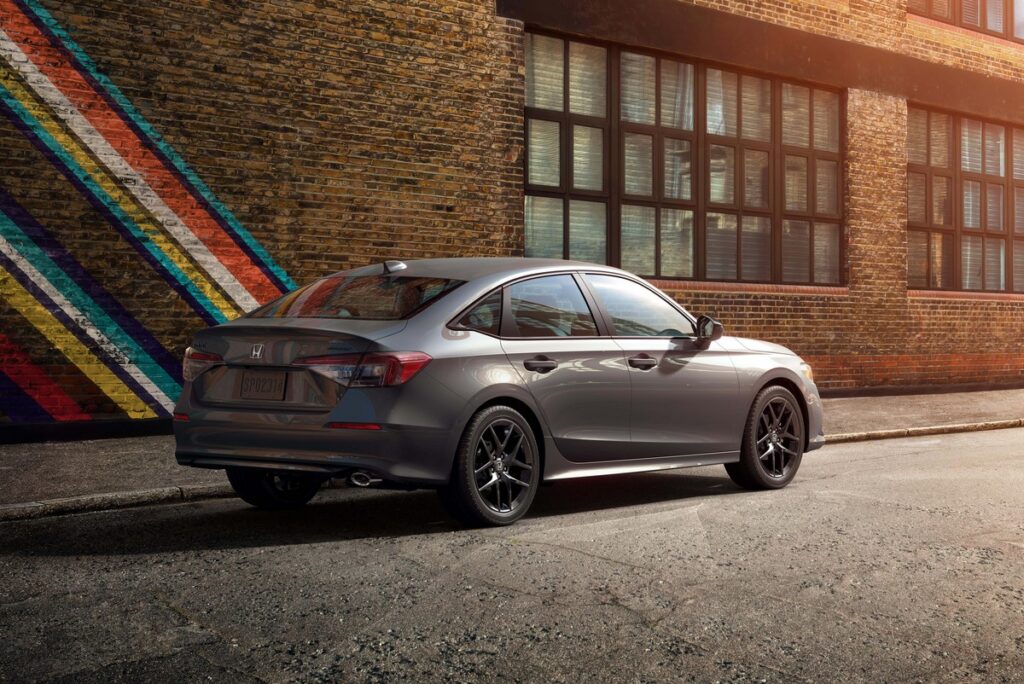
Final Verdict: Buy the Hybrid, Unless You Have a Good Reason Not To
The 2027 Civic doesn’t need to reinvent Honda’s compact-car formula. Its combination of sensible dimensions, gasoline and hybrid choices, standard driver-assistance equipment and a relatively attainable entry price already gives shoppers plenty to work with.
The Sport-L is a welcome addition because it acknowledges that some buyers want a more comfortable gasoline car without paying for the most expensive model.
But its $1,200 gap to the Sport Hybrid also exposes an uncomfortable truth about the Civic lineup.
The hybrid is extraordinarily difficult to ignore.
For that relatively small premium, shoppers get a 200-horsepower powertrain and substantially better EPA fuel economy. They do give up some of the Sport-L’s premium seating equipment, so the decision isn’t automatic.
Still, if I were spending my own money and expected to drive a normal American annual mileage, the Sport Hybrid sedan is where I would start.
The LX makes sense for a strict budget. The Sport-L is worth considering if its interior equipment matters more to you than hybrid efficiency. The Sport Touring Hybrid is for buyers who want the complete technology package.
For most people, though, I would save the additional luxury expenditure and put the savings toward something more useful.
Such as gasoline. Although, with the hybrid, you won’t need nearly as much of it.
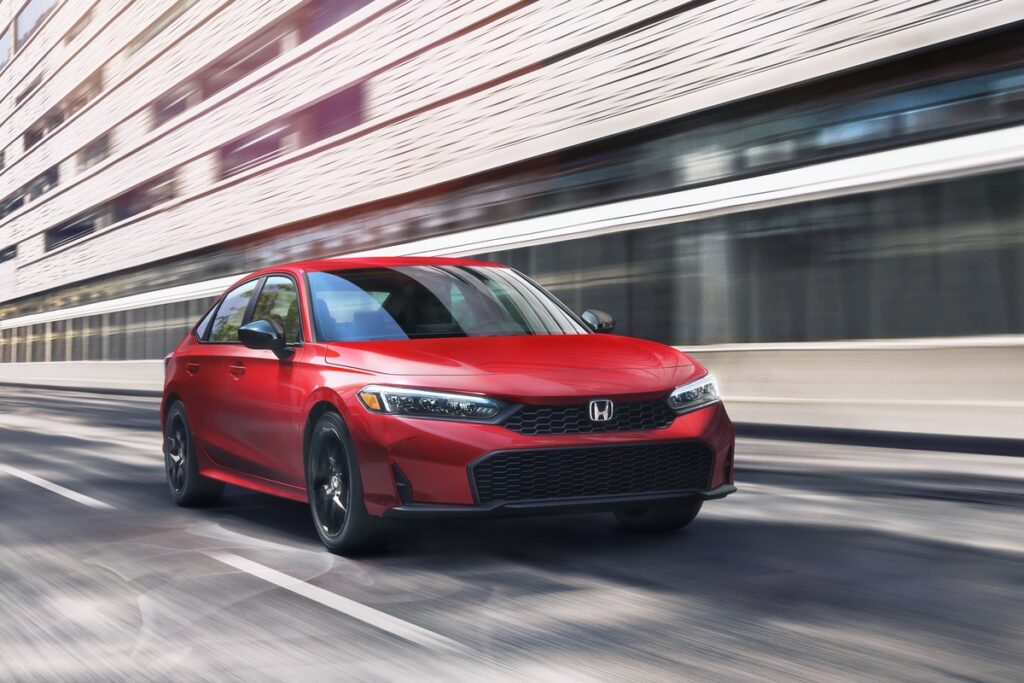
2027 Honda Civic Frequently Asked Questions
How much does the 2027 Honda Civic cost?
The 2027 Honda Civic sedan starts at $24,995 for the LX, excluding Honda’s $1,295 destination charge. The Sport begins at $26,995, Sport-L at $28,495, Sport Hybrid at $29,695 and Sport Touring Hybrid at $32,695. Dealer charges, taxes, registration and optional equipment may increase the final price.
Is the 2027 Civic Hybrid worth buying?
For higher-mileage drivers, it makes a strong financial case. The sedan earns an EPA combined estimate of 49 mpg, compared with 34 mpg for the gasoline Sport-L. It also produces 200 horsepower versus 150. Buyers should still compare the different seating equipment and calculate potential fuel savings using their own driving mileage.
Does the 2027 Honda Civic need to be plugged in?
No. The regular Civic Hybrid uses Honda’s two-motor gasoline-electric hybrid system. It does not require external charging. Drivers fill the gasoline tank as they would in an ordinary vehicle, while the hybrid system manages electric assistance and battery energy automatically during operation.
Does the 2027 Honda Civic offer all-wheel drive?
No. The ordinary 2027 Civic sedan and hatchback are front-wheel-drive vehicles. Buyers who require all-wheel drive for regular snow travel or other conditions should consider alternatives, including selected versions of the Toyota Corolla Hybrid or an appropriately equipped compact crossover.
What’s new on the 2027 Honda Civic?
The biggest mainstream addition is the Sport-L trim, offering leather seating surfaces, heated front seats, power-adjustable front seats and dual-zone climate control with the gasoline engine. Honda has also introduced S+ Shift technology on the Sport Touring Hybrid, providing simulated gear changes and a more interactive driving experience.
Should I buy the Civic sedan or hatchback?
Choose the sedan if its traditional trunk meets your cargo needs and you want the lower-priced hybrid configuration. Choose the hatchback if you regularly load larger or awkwardly shaped objects. The 2027 Sport Hybrid sedan is rated at 49 mpg combined, while its hatchback counterpart is rated at 47 mpg combined.
Sources: Honda’s November 2026 Sport-L announcement, Honda’s 2027 Civic launch announcement, and Honda’s official sedan specifications.