Trump Just Saved the Stock Market
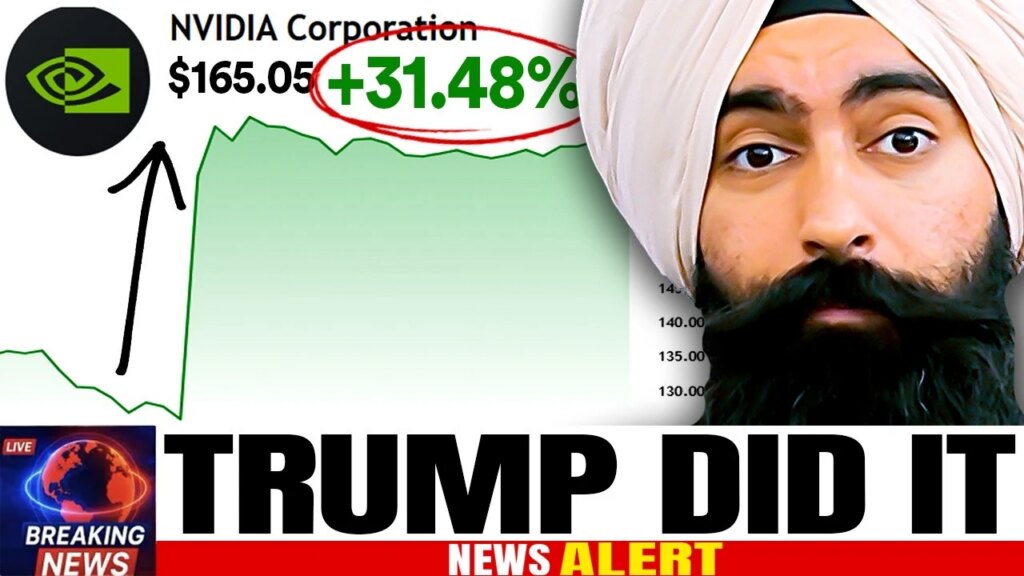
The stock market just demonstrated how quickly fear can turn into optimism. After Nvidia CEO Jensen Huang resigned in November, concerns about the future of the world’s dominant AI-chip company contributed to a sharp technology selloff. Less than two weeks later, Nvidia reinstated Huang following discussions that included input from senior U.S. government officials, while President Donald Trump said he had personally pushed the board to bring him back.
Investors responded dramatically. Nvidia shares jumped more than 30% on the day of Huang’s return, while the S&P 500 gained about 4.7% and the Nasdaq climbed more than 6%. The speed of the reversal illustrates one of the video’s central arguments: markets can move enormously even when the underlying economy has not changed nearly as quickly.
AI Has Become Too Important to Ignore
Nvidia is no longer simply another semiconductor company. The episode describes it as a central piece of the AI ecosystem because its chips power much of the industry’s infrastructure and the company has invested heavily throughout the AI economy.
That importance also affects investors who may not own Nvidia directly. Major technology companies now represent an unusually large portion of broad market indexes. As of late 2026, the ten largest S&P 500 companies represented more than 37% of the index, while technology alone accounted for roughly 37%. That concentration means developments involving a handful of enormous companies can have an outsized effect on retirement accounts and index funds.
The episode argues that this is why Huang’s departure and return mattered far beyond Nvidia. Investors were not simply evaluating one CEO. They were reassessing confidence in an AI investment boom that has become increasingly important to corporate spending, markets, and the broader economy.
The Market and the Economy Are Not the Same Thing
One of the most useful distinctions in the transcript is between the stock market and the economy. Markets price what investors believe will happen in the future, while the economy reflects what is actually happening with employment, spending, corporate profits, inflation, and growth.
Those two can move in different directions. Investor expectations can change within hours, while inflation, interest rates, government spending, or corporate earnings may barely change at all.
That is why making long-term investment decisions based entirely on the day’s biggest headline can be dangerous. A dramatic selloff can create panic, while a sudden rally can produce fear of missing out. Neither emotion necessarily tells an investor what a company or portfolio will be worth years from now.
Panic Can Create Opportunity
The video’s investing philosophy starts with a simple idea: continue investing instead of trying to predict every market move. Market declines are inevitable, and waiting for the perfect moment to buy can leave investors constantly guessing about whether prices will fall further.
The more opportunistic strategy is to recognize that panic can sometimes push prices below what long-term investors believe assets are worth. The episode describes the sequence as panic leading to overselling, overselling creating opportunity, and opportunity potentially producing profits.
That does not mean every falling stock is a bargain. A declining company can continue declining for good fundamental reasons. The lesson is to have enough financial flexibility to evaluate opportunities during downturns instead of being forced into emotional selling.
Look for Where the Money Is Going Next
The transcript also encourages investors to watch for what it calls “market shifts.” These occur when consumer behavior, technology, government spending, or broader economic changes redirect large amounts of money toward new industries.
AI is an obvious current example. Massive spending on chips, data centers, electricity, software, and infrastructure has created winners far beyond the companies producing AI chatbots. Government policy can also accelerate those shifts when national priorities direct capital toward industries such as semiconductors, energy, defense, or infrastructure.
The point is not to chase whatever investment happens to be popular. It is to understand where demand and spending are changing before deciding whether that shift creates an attractive long-term opportunity.
Know What Kind of Investor You Are
The episode ultimately separates investors into three broad goals: growth, income, and preservation. Someone decades from retirement who wants maximum long-term growth may tolerate significant volatility. A retiree depending on investments to fund living expenses may have a very different definition of a good investment.
Income investors may prioritize reliable dividends and cash flow, while preservation-focused investors may be more concerned about avoiding devastating losses. The same stock can therefore be appropriate for one investor and completely wrong for another.
That distinction matters especially with companies like Nvidia. A volatile AI stock may offer significant growth potential, but that does not automatically make it appropriate for someone primarily concerned with retirement income or protecting accumulated wealth.
The lesson from Nvidia’s extraordinary reversal is not that Trump, Huang, or any single person can permanently “save” the stock market. It is that today’s market is heavily influenced by a relatively small group of technology and AI companies, making investor sentiment capable of changing remarkably quickly.
Long-term investors cannot control those headlines. They can control whether they panic, whether they stay diversified, how much risk they take, and whether their investments match what they are actually trying to accomplish. The investors who understand those differences may be better positioned to treat market volatility as information rather than a reason to abandon their plan.