The Viral Retirement Chart Is Fake and It’s Warping How People Think About Aging
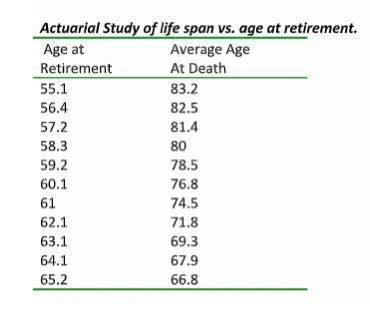
Don't fall for this chart
The internet loves a clean story. Especially one that confirms a fear many people already carry: work is killing us. That’s why a viral chart claiming “retire at 50 and live to 86, retire at 65 and die at 66” spreads so quickly. It feels emotionally true. It taps into burnout, exhaustion, and the quiet suspicion that modern life is built to grind people down until they drop.
There’s just one problem. The chart is fake.
Not “debate it in the comments” fake. Not “some experts disagree” fake. It’s the kind of fake that falls apart the second anyone asks the most basic questions: Where did the data come from? What population was studied? What methodology was used? Who reviewed it?
And once the chart falls apart, it reveals something even more important: retirement age isn’t the magic lever that controls lifespan. Health, income, stress, and purpose are.
The Retirement Chart That Went Viral (and Why It’s Wrong)
The meme-style chart usually appears in some version of the same story:
Retire at 50 → live to 86
Retire at 55 → live to 83
Retire at 60 → live to 78
Retire at 65 → die around 66
It’s dramatic. It’s simple. It’s also not based on credible research.
One of the biggest red flags is that the chart rarely includes a source. No study name. No author. No journal. No country. No time period. No sample size. No explanation. Just a neat visual that reads like science and spreads like gossip.
This chart was publicly discredited years ago. Boeing addressed it back in 2004 and stated it was incorrect and not based on factual data. Boeing also reviewed outcomes from nearly 5,000 retirees and found their retirees lived longer than the national average, regardless of retirement age. In other words, the idea that “retire later = die immediately” simply didn’t show up in real-world data.
A chart that makes a bold claim without showing its work is not research. It’s narrative packaging.
What Real Research Actually Says About Retirement and Longevity
Here’s the uncomfortable truth: retirement age does not reliably determine life expectancy.
Retirement age often reflects what’s happening inside someone’s life, not what’s going to happen next. That distinction matters.
A U.S. Social Security working paper found that men who retire early often do so because of poor health, and that poor health is a major reason for earlier death. In that context, early retirement isn’t the cause of shorter life. It’s the symptom of something already going wrong.
Other large reviews looking at retirement and mortality have found mixed results. In some cases, retiring earlier appears linked to worse outcomes. In others, retiring later appears linked to better outcomes. But once researchers adjust for health differences, the retirement-age effect often shrinks or disappears.
That’s because healthier people can keep working longer. They don’t retire late because work gives them extra life. They retire late because they already have more life in them.
Boeing’s internal analysis found no meaningful correlation between retirement age and life expectancy among its retirees. That alone is enough to destroy the meme’s claim of a direct cause-and-effect relationship.
Retirement Doesn’t Automatically Make People Happier
The chart’s popularity isn’t just about fear of dying. It’s about the fantasy that retirement is a happiness switch. Work stops. Life begins. Stress disappears. Joy returns.
But real retirement experiences aren’t that clean.
A 2024 meta-review found retirement improved life satisfaction in 32% of studies, worsened it in 47%, and had no significant effect in 21%. That’s not a universal happiness upgrade. That’s a mixed bag.
Some people thrive the moment they leave work. Others lose their structure, identity, social connection, and sense of purpose in the first year. Some feel relief. Some feel grief.
A major difference is why someone is still working. Research suggests people who work past retirement age because they enjoy it tend to report higher life satisfaction than those who work because they have to. That’s the dividing line: choice versus pressure.
Retirement Can Improve Mental Health. But It Can Also Create New Risks
Retirement can be great for mental health, especially for people leaving high-stress jobs.
A 2023 meta-analysis found retirement is associated with less depression and better perceived health. That’s a real benefit, and it makes sense. Chronic stress has consequences, and removing the source of stress can improve daily well-being quickly.
But the same research also noted potential downsides. Cognitive engagement can decline when people lose routines that force them to problem-solve, interact, and stay mentally active. Physical health outcomes were mixed, because retirement can either create time for better habits or create time for worse ones.
Retirement is not a guaranteed health boost. It’s a life transition. What someone builds after work ends is what determines whether it becomes healthier or hollow.
What Actually Predicts Longevity (It’s Not a Date on the Calendar)
If retirement age isn’t the main driver, what is?
The biggest predictors of longevity and quality of life aren’t mysterious. They’re just less viral.
Income and access to care
Higher income often means better access to healthcare, lower daily financial stress, and more flexibility to manage health problems early instead of late.
Job quality
A toxic job can absolutely harm health. High stress, poor sleep, long commutes, workplace conflict, and lack of autonomy all add up.
But meaningful work can do the opposite. It can provide purpose, identity, and community.
Daily health habits
Sleep, nutrition, movement, alcohol intake, stress management, and consistency matter more than the retirement age itself. A person can retire at 55 and still destroy their health with sedentary routines and isolation.
Social connection
Strong relationships are among the most consistent predictors of healthy aging. Retirement can improve this if someone leans into community. It can also break it if someone disappears.
Purpose
Purpose is the quiet engine of long-term health. People don’t just need free time. They need a reason to wake up.
Genetics and personal history
Some outcomes are simply not negotiable. Family health history and genetics play a major role, and no retirement strategy can erase that reality.
The Better Question Isn’t “When Should You Retire?”
The better question is: what are you retiring to?
Retirement should not be treated like an escape hatch. It should be treated like a design project.
A strong retirement plan isn’t just a number. It’s a structure. It’s a lifestyle blueprint. It’s how time will be spent, who it will be spent with, and what will replace the purpose that work used to provide.
Ask the questions that actually matter:
- Is the current job harming health?
- Is there enough financial stability to step away without panic?
- Is there a plan for community, routine, and mental stimulation?
- Is there something meaningful waiting on the other side of work?
Because the truth is, people don’t just retire from something. They retire into something.
The Bottom Line
The viral retirement chart is not real research. It’s a story designed to spread, not a conclusion designed to hold up. Retirement age is not a direct dial for life expectancy, and believing it is can lead people to make emotional decisions based on fear instead of facts.
What matters more than the age on a retirement form is the health, purpose, relationships, and daily habits someone carries into the next chapter.
Retirement isn’t a finish line. It’s a transition. And the people who live the best in retirement aren’t the ones who simply stop working the earliest. They’re the ones who build a life worth waking up to after work is gone.
All writings are for educational and entertainment purposes only and does not provide investment or financial advice of any kind.