Jeep Just Cut Options on the 2026 Grand Cherokee and That Might Be Good News for Buyers
Shopping for a midsize SUV has quietly become exhausting.
Over the past decade, automakers responded to consumer demand by adding more trims, more engines, more packages, and more overlapping features. What buyers wanted was clarity. What they got was complexity.
For 2026, Jeep is taking the opposite approach.
The new Jeep Grand Cherokee lineup has been simplified to just three core trims Laredo, Limited, and Summit while adding a new turbocharged engine producing 324 horsepower. Instead of expanding the options list, Jeep is bundling popular features and reducing decision fatigue.
In a segment packed with choices, that move could matter more than the horsepower bump.
Why This Matters Now
The midsize SUV category is one of the most competitive in America. Buyers are cross-shopping vehicles like the Toyota Grand Highlander, Ford Explorer, Honda Pilot, Hyundai Palisade, and Kia Telluride. The differences often come down to small feature gaps buried deep in spec sheets.
Jeep appears to be betting that buyers are tired of decoding trim hierarchies.
For 2026, the biggest mechanical update is the new 2.0-liter Hurricane 4 Turbo engine. It produces 324 horsepower and 332 lb-ft of torque. More importantly, 90% of that torque is available between 2,600 and 5,600 rpm meaning stronger real-world acceleration when merging or towing.
Jeep estimates up to a 529-mile driving range and a class-leading 6,200-pound tow rating with the turbo engine. For families hauling boats, campers, or trailers, that’s serious capability.
The traditional 3.6-liter V6 remains available on the base Laredo for buyers who prefer naturally aspirated engines.
Even base models now include:
- Active Lane Management
- Blind-Spot Monitoring
- Rear Cross Path Detection
- Automatic Emergency Braking
- 12.3-inch infotainment screen
That level of standard equipment reduces the need to “trim up” just to get basic safety and tech.
How It Stacks Up Against Rivals
Most competitors have expanded complexity:
- Toyota offers multiple hybrid and turbo variations
- Ford mixes turbo engines and hybrid options
- Hyundai and Kia layer numerous packages across trims
Jeep is narrowing choices instead.
The Limited trim adds heated second-row seats, ambient lighting, leatherette upholstery, and a nine-speaker Alpine system. Higher trims bring Nappa leather, ventilated seats, air suspension, Quadra-Trac II 4×4, and a 19-speaker McIntosh audio system one of the largest available in the class.
For buyers needing three rows, the Grand Cherokee L continues with best-in-class second-row legroom and strong cargo space behind the third row.
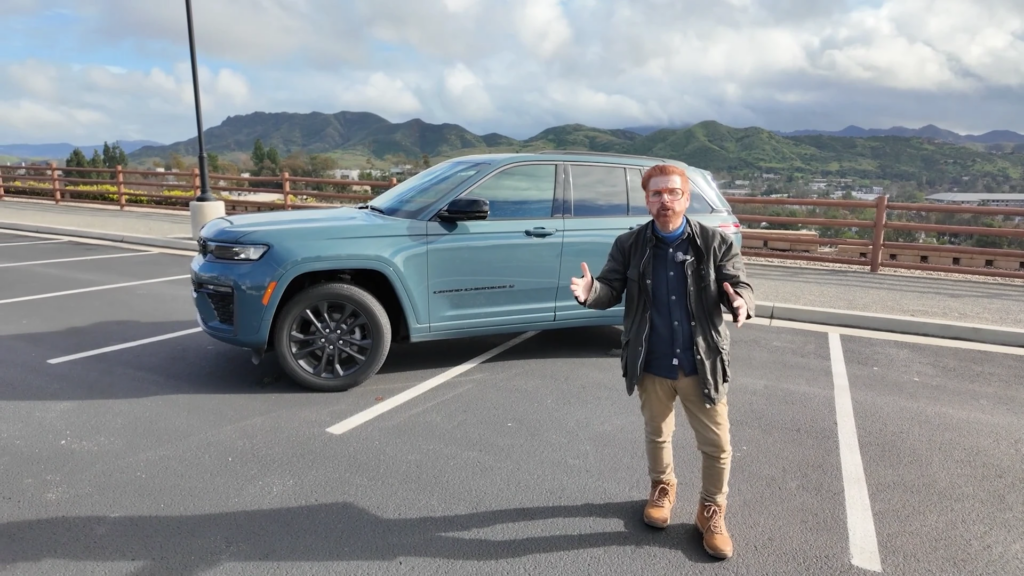
Exterior updates are subtle: revised grille, updated lighting, and new colors including Steel Blue, Copper Shino, and Fathom Blue.
Production remains in Michigan, with engines built at Stellantis’ Dundee plant and assembly in Detroit.
Who This Is For
The 2026 Grand Cherokee is aimed at buyers who want:
- Strong towing capability
- Real mid-range power
- Clear trim structure
- Modern tech without package confusion
- Everyday family usability
It’s ideal for drivers who occasionally tow, commute long distances, or want confidence in winter weather with available 4×4 systems.
It may not appeal to shoppers who prefer highly customizable builds or those emotionally attached to larger displacement engines.
The Bigger Picture
The most interesting change is not the turbocharged power bump it’s the philosophy.
Car buying has become complicated. Electrification, subscription features, and expanding trim structures have increased friction in the purchasing process.
Jeep is testing a different strategy: fewer trims, bundled features, stronger baseline equipment.
If buyers respond positively, other manufacturers may follow.
The 2026 Grand Cherokee arrives in late 2025, with pricing expected closer to launch.
Sometimes innovation isn’t about adding more.
Sometimes it’s about removing the clutter.