2026 Recession Alert: War, AI Disruption, and Wall Street Stress Are Raising Economic Risks
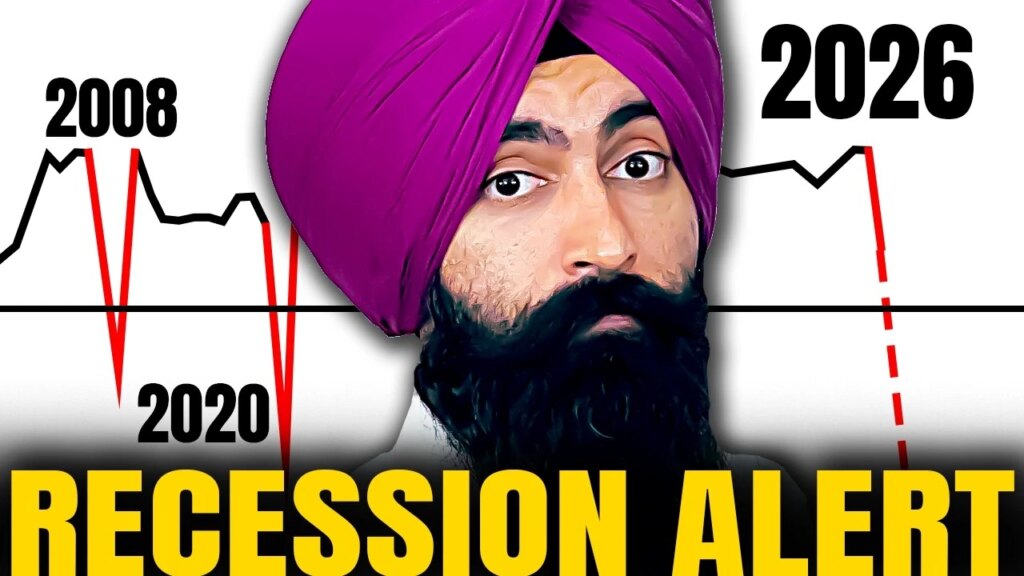
The U.S. economy is facing an unusual convergence of forces.
Geopolitical tensions are pushing energy prices higher. Artificial intelligence is reshaping the job market faster than previous technological revolutions. Meanwhile, parts of Wall Street’s credit markets are showing signs of stress.
Individually, each of these trends would present meaningful economic challenges. Together, they form what some analysts describe as a potential perfect storm for markets and the broader economy.
Understanding how these forces interact is essential for investors trying to navigate the next decade of economic change.
The Economic Impact of Conflict in the Middle East
One of the most immediate concerns comes from rising geopolitical tensions involving Iran.
Iran controls the Strait of Hormuz, one of the most strategically important shipping routes in the global energy system. Roughly 20% of the world’s oil supply passes through this narrow waterway.
Any disruption to traffic in the strait could significantly restrict global oil supply.
That risk is already influencing markets. Oil prices have climbed toward $100 per barrel, and analysts warn that sustained prices at that level could push U.S. gasoline prices close to $4 per gallon.
Higher energy prices ripple through the entire economy. Transportation costs rise, manufacturing expenses increase, and consumers pay more for everyday goods.
The result is renewed inflation pressure, which has already been one of the biggest economic challenges of the past several years.
War Spending and the National Debt
Military conflicts also carry a financial cost beyond the battlefield.
Defense spending can stimulate certain sectors of the economy, particularly defense contractors and manufacturing industries tied to military supply chains.
But increased military spending also adds to federal deficits.
The United States is already carrying historically high levels of government debt. In 2025, interest payments on federal debt surpassed military spending for the first time in history.
As interest rates remain elevated, those payments continue to grow.
Funding additional military operations through borrowing or money creation raises concerns among economists about long-term inflation and fiscal stability.
Artificial Intelligence and the Future of Work
While geopolitical risks dominate headlines, another powerful force is reshaping the economy: artificial intelligence.
AI systems are advancing at a pace that is far faster than most previous technological shifts.
Some estimates suggest that 11.7% of U.S. labor, representing roughly $1.2 trillion in wages, could be replaced or significantly altered by AI within the next five years.
Historically, major technological revolutions unfolded gradually.
The industrial revolution took nearly a century to reshape labor markets. The widespread adoption of electricity and mass production took several decades. Even the internet took more than 20 years to fully transform commerce and communication.
AI is moving at a much faster pace.
Since the public launch of tools like ChatGPT in late 2022, businesses have rapidly integrated AI into operations ranging from customer service to software development and marketing.
Short-Term Disruption, Long-Term Opportunity
The economic effects of AI are complex.
On one hand, automation can dramatically increase productivity. Companies may be able to produce the same output with fewer workers, lowering costs and boosting profits.
On the other hand, reduced labor demand could temporarily lower wages or employment in certain sectors.
For example, a company that previously required 10,000 employees may be able to operate with 6,000 workers once AI systems automate certain tasks.
This shift could create short-term economic disruptions before new industries and job categories emerge.
Historically, technological revolutions ultimately created more jobs than they destroyed. But the transition period often involves economic volatility.
Signs of Stress in Wall Street’s Credit Markets
Another area drawing concern among investors is the private credit market.
Private credit funds have grown rapidly over the past decade by lending money directly to companies that cannot easily borrow from traditional banks.
These funds often promise investors returns between 8% and 15%, making them attractive alternatives to traditional bonds.
But higher interest rates are now exposing weaknesses in some of these loans.
Reports suggest that roughly 40% of companies receiving private credit loans had negative cash flow when they borrowed. As borrowing costs increase, some of those companies are struggling to repay their debt.
Several major asset managers—including Blackstone, BlackRock, and Blue Owl—have responded by restricting withdrawals from certain funds to prevent investor runs.
While these measures are designed to stabilize the funds, they have also raised concerns about potential contagion across financial markets.
The Dollar’s Global Role
Another important factor shaping the U.S. economy is the role of the U.S. dollar as the world’s reserve currency.
Since the end of World War II, the dollar has served as the primary currency used for global trade, particularly in energy markets.
This position gives the United States enormous economic influence. It also allows the government to finance deficits more easily by issuing debt that global investors are willing to hold.
However, some countries are gradually exploring alternatives.
Nations within the **BRICS economic bloc including Brazil, Russia, India, China, and South Africa have begun increasing gold reserves and experimenting with non-dollar trade agreements.
While the dollar remains dominant, any decline in global confidence could weaken its value and contribute to inflation at home.
Lessons From Past Economic Cycles
Economic turbulence is not new.
The 1970s oil shocks, triggered by Middle Eastern conflicts, led to a prolonged period of inflation and economic instability in the United States.
Yet even during that difficult decade, investors who positioned themselves strategically were able to build significant wealth.
Periods of uncertainty often create opportunities for long-term investors who focus on durable trends rather than short-term market swings.
Investment Opportunities During Economic Change
Many investors respond to economic uncertainty by diversifying their portfolios across multiple sectors and asset classes.
Some strategies that investors consider during volatile periods include:
- Gold as a hedge against inflation and currency risk
- Broad market ETFs tracking the S&P 500
- Global equity funds providing international diversification
- Dividend-focused funds for stable income
- Sector-specific investments tied to emerging trends
Industries tied to defense, artificial intelligence, robotics, and commodities may see increased investment as geopolitical tensions and technological shifts reshape the economy.
Another common strategy involves consistent long-term investing, sometimes referred to as “Always Be Buying.”
Rather than attempting to time markets perfectly, investors steadily accumulate assets through market cycles.
Over decades, this approach has historically produced strong long-term results.
Navigating an Uncertain Economic Future
The U.S. economy now sits at the intersection of several powerful forces.
Geopolitical tensions are affecting energy markets. Artificial intelligence is transforming labor markets. Credit markets are showing signs of stress. And questions about government debt and global currency dynamics continue to emerge.
None of these trends alone guarantees economic crisis.
But together they create an environment where careful planning and strategic investing become more important than ever.
Periods of uncertainty often feel unsettling in the moment. Yet history shows that they can also become the starting point for the next generation of economic opportunity.
Jaspreet Singh is not a licensed financial advisor. He is a licensed attorney, but he is not providing you with legal advice in this article. This article, the topics discussed, and ideas presented are Jaspreet’s opinions and presented for entertainment purposes only. The information presented should not be construed as financial or legal advice. Always do your own due diligence.