BMW Just Solved the Biggest EV Problem and the New i3 Proves It
BMW Finally Fixed the Electric Car, The New i3 Proves it. BMW has spent the better part of a decade trying to convince drivers that its electric future would feel just as engaging as its combustion past. The early efforts were clever, occasionally brilliant, but never quite complete.
The original i3 was innovative, yes, but it lived in a niche. The i4 and iX proved BMW could build competent electric vehicles, but they didn’t fully capture the brand’s core identity. Now, something has shifted. The all-new BMW i3, built on the Neue Klasse platform, feels less like an experiment and more like a conclusion. It’s the moment where BMW stops adapting to electric and starts defining what its electric cars should be.
A Name Reclaimed, A Segment Redefined
At first glance, the name alone raises eyebrows. The original i3 was a compact city car, almost rebellious in its design and intent. This new i3 is something entirely different. It’s a full-size sedan, roughly in the footprint of a 3 Series, but lower, sleeker, and more purposeful. BMW isn’t revisiting the past here. It’s reclaiming the name and redefining it.
The numbers make that clear. With 469 horsepower and 476 lb-ft of torque, the i3 50 xDrive enters serious performance territory. Built on an 800-volt architecture, it supports DC fast-charging speeds of up to 400 kilowatts, placing it among the fastest-charging
EVs available.
BMW also claims a 30 percent improvement in both range and charging speed over its previous EV generation, a meaningful leap that directly addresses one of the biggest ownership concerns.
Charging That Changes Behavior
Electric vehicle ownership has always been less about range and more about how quickly you can recover it. Faster charging fundamentally changes how drivers plan journeys. Shorter stops. More flexibility. Less compromise.
The i3’s high-speed charging capability, combined with route-based preconditioning and intelligent navigation, positions it as a genuinely practical long-distance EV. And then there’s bidirectional charging.
This system allows the i3 to power a home, external devices, or even feed energy back into the grid. It transforms the vehicle into more than transportation. It becomes part of a broader energy ecosystem.
The “Heart of Joy” and the Rise of Software-Defined Driving
At the center of the i3’s driving experience is BMW’s new control system, known as the “Heart of Joy.” It processes inputs up to ten times faster than previous systems, coordinating steering, braking, and acceleration in real time.
Paired with four high-performance computing units, BMW’s so-called “Superbrains,” the system delivers roughly twenty times the computing power of earlier architectures.
This isn’t just about speed. It’s about cohesion. The car responds in a way that feels predictive rather than reactive, aligning more closely with driver intent.
Design That Serves Efficiency
Dimensionally, the i3 sits in familiar territory. It’s 15 feet 7 inches long, just over 6 feet wide, and under 5 feet tall, with a 9-foot 6-inch wheelbase. The focus here is on aerodynamic efficiency.
A sealed underbody, shortened overhangs, and carefully sculpted surfaces all contribute to improved airflow. These changes don’t just improve efficiency on paper. They extend real-world range.
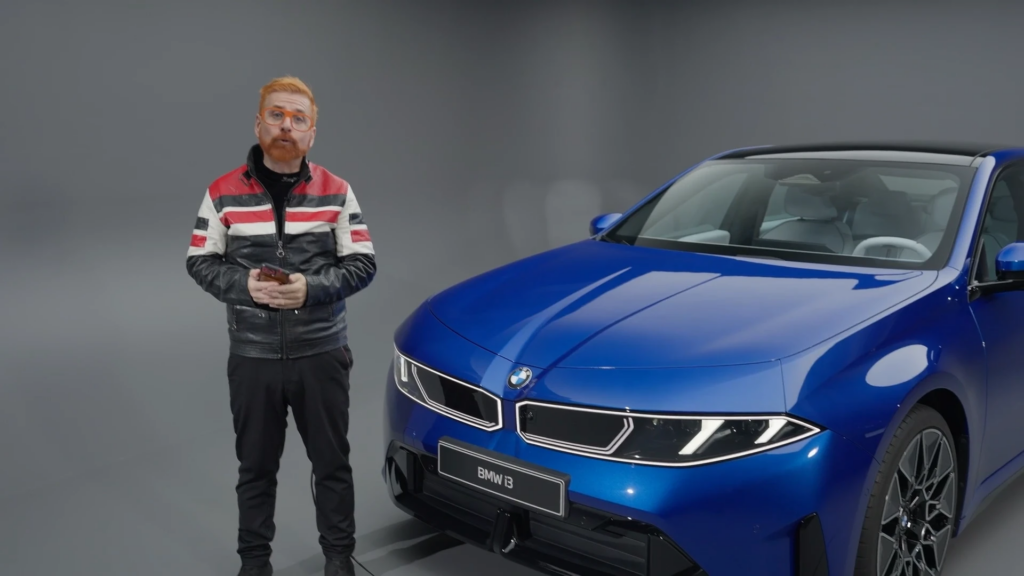
Visually, BMW maintains its identity while evolving. The front end retains the brand’s signature look but replaces traditional elements with illuminated graphics, including the “Iconic Glow” grille. At the rear, slim horizontal taillights emphasize width and stability, reinforcing a clean, modern aesthetic.
A Cabin Built Around Clarity
Inside, the i3 adopts a minimalist approach that prioritizes usability. A 17.9-inch central display anchors the cabin, while a Panoramic Vision head-up display projects key information across the windshield.
The optional 3D head-up display adds an augmented layer, projecting navigation cues and hazards directly into the driver’s field of vision. Controls are simplified through BMW’s “Shy Tech” interface, which hides buttons until they’re needed, reducing visual clutter without sacrificing functionality.
BMW integrates sustainability into the i3 without turning it into a marketing exercise. The front bumper uses approximately 30 percent recycled plastic. Seat fabrics are made from 100 percent recycled PET yarn. Structural components incorporate recycled aluminum, and even under-hood elements include reclaimed marine plastics.
Driving Dynamics That Still Feel Like BMW
Despite its technological focus, the i3 remains grounded in driving dynamics. The dual-motor setup combines a rear permanent magnet motor with a front asynchronous motor, balancing efficiency and performance.
BMW’s tuning delivers quick steering, near-perfect balance, and a suspension system that adapts in real time. The available Adaptive M Suspension sharpens responsiveness without sacrificing comfort.
Regenerative braking has also been refined. The “Soft-Stop” system smooths deceleration, addressing one of the more common criticisms of EV driving feel.
Battery Integration and Real-World Range
The i3 uses a pack-to-body battery design, integrating the battery directly into the vehicle structure. This improves rigidity, safety, and packaging efficiency.
While official range figures are still pending, expectations are set at over 350 miles depending on configuration. Combined with faster charging and improved efficiency, this positions the i3 as a strong contender for both daily use and long-distance travel.
How It Stacks Up
In a competitive landscape, the i3 holds its ground:
• Tesla Model 3: Faster charging and improved perceived build quality
• Hyundai Ioniq 6: Stronger driving dynamics and refinement
• Polestar 2: Comparable performance, but less advanced charging and computing integration
The i3’s strength lies in balance rather than dominance in a single category.
A Platform That Defines the Future
Production begins in Munich in 2026, with BMW planning a fully electric transition for the plant by 2027. The i3 is just the beginning. Around 40 new or updated models will follow on the Neue Klasse platform. This is not just a product launch. It’s a strategic reset.
The new BMW i3 answers a question that has lingered over the brand’s electric ambitions. Can an EV still feel like a BMW? The answer appears to be yes.
Not because it imitates the past, but because it translates BMW’s core principles of balance, precision, and driver engagement into a new context. In a market often defined by extremes, the i3 stands out by focusing on cohesion. It doesn’t try to be everything. It tries to be right.