How Solar Energy Is Reshaping Property Values Across the Market
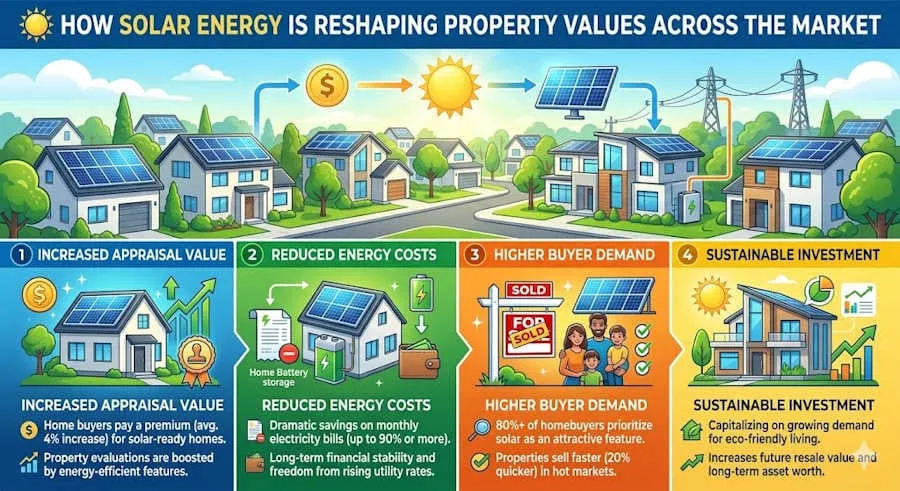

The real estate market has always been driven by a familiar set of factors location, square footage, school districts, and curb appeal. But a new force is quietly climbing to the top of every buyer’s checklist: solar energy. From suburban neighborhoods to rural retreats, properties equipped with solar solutions are commanding stronger prices, attracting more offers, and spending fewer days on the market.
This shift isn’t a trend. It’s a transformation, and understanding it could be the smartest move you make as a homeowner, investor, or buyer.
The Numbers Don’t Lie: Solar Adds Real Dollar Value
Multiple studies confirm what savvy real estate professionals have suspected for years — solar panels meaningfully boost home values. A landmark study by Lawrence Berkeley National Laboratory found that homes with solar energy systems sold for a premium of approximately $15,000 more than comparable non-solar homes. Zillow research echoed this, reporting that homes with solar installations sold for roughly 4.1% more than equivalent properties without them.
That’s not pocket change. On a $400,000 home, a 4.1% premium translates to more than $16,000 in added value, often exceeding the original cost of the solar system itself.
The reasons are intuitive once you break them down:
- Lower utility costs make the home more financially attractive month to month.
- Energy independence appeals to buyers wary of rising electricity rates.
- Environmental alignment resonates strongly with a growing segment of eco-conscious buyers.
- Modern infrastructure signals a well-maintained, forward-thinking property.
Why Buyers Are Prioritizing Energy-Efficient Homes
Today’s homebuyers are doing more homework than ever. They’re calculating total cost of ownership, not just the mortgage payment but the full monthly financial picture, including utilities. A home with a solar array that offsets 80–100% of electricity costs is effectively offering a built-in discount that compounds year after year.
This calculation becomes even more compelling as electricity rates continue to rise across the country. According to the U.S. Energy Information Administration, residential electricity prices have climbed steadily over the past decade, with no signs of reversing. A home that insulates its owner from those increases is a home that holds its value — and then some.
Beyond the monthly bill, buyers are also thinking about resilience. Power outages, extreme weather events, and grid instability have pushed energy backup solutions into the mainstream conversation. Properties that pair solar installations with battery storage systems are increasingly viewed as premium assets. Many homeowners and prospective buyers who are exploring this space often start by researching the best portable power stations to understand how portable and home backup energy solutions compare — and it’s through that research journey that many discover the broader world of solar-integrated home systems.
The Solar Spectrum: Rooftop Panels to Whole-Home Systems
Not all solar setups are created equal, and the real estate market is beginning to price them accordingly. Here’s a quick breakdown of the most common configurations buyers encounter:
1. Grid-Tied Rooftop Solar
The most common setup. Panels feed electricity into the home, and excess energy goes back to the grid, often earning credits through net metering programs. These systems are clean, relatively low-maintenance, and the most widely understood by buyers and appraisers alike.
2. Solar + Battery Storage
Pairing solar panels with a home battery system (like the Tesla Powerwall or similar products) dramatically increases a property’s energy resilience. Homes with this combination can operate through grid outages, a feature that adds measurable value in regions prone to hurricanes, wildfires, or extreme storms.
3. Solar-Ready Infrastructure
Even homes without active panels are seeing value gains if they’ve been wired and prepared for future solar installation. Buyers recognize that a solar-ready home lowers the cost and complexity of going solar later.
4. Portable and Supplemental Solar Solutions
Not every property is suited for a full rooftop installation. In these cases, think condos, older homes with shade-heavy lots, or rural properties: portable solar and power station setups are filling the gap. Buyers and owners exploring these options frequently turn to portable power station reviews to evaluate which units offer the best balance of capacity, portability, and value before making a purchase. This segment of the market is growing fast, and it’s starting to influence how buyers think about energy independence even in non-traditional solar contexts.
Regional Variations: Where Solar Adds the Most Value
Solar’s impact on property values isn’t uniform across the country. Several factors shape how much premium a solar home commands in any given market:
Sun Exposure and Climate
States with high solar irradiance, such as California, Arizona, Texas, Florida, and Colorado, naturally see stronger returns on solar investment. More sunlight means more energy production, which means bigger savings and faster payback periods.
Local Electricity Rates
Solar adds the most value where electricity is expensive. In states like California, Hawaii, and New York, where utility rates are significantly above the national average, the financial case for solar is especially compelling, and buyers are willing to pay for it.
Net Metering Policies
States with favorable net metering policies allow homeowners to sell excess energy back to the grid at retail rates. These policies make solar systems more lucrative and, by extension, more attractive to buyers. States that have scaled back net metering have seen a corresponding cooling in solar enthusiasm.
Market Awareness and Competition
In markets where solar adoption is already high, buyers expect it. In emerging markets, early adopters often capture the largest premiums simply because the supply of solar-equipped homes is low relative to growing demand.
What This Means for Sellers
If you’re preparing to list a property with a solar installation, there are strategic steps you can take to maximize the value it adds:
Document everything. Provide potential buyers with a full history of energy production data, utility bills before and after installation, and any warranties on panels and inverters. Transparency builds trust and justifies pricing.
Understand your system’s ownership structure. Owned solar systems add more value than leased ones. If your panels are under a lease or power purchase agreement (PPA), buyers will need to assume that contract, which can complicate or diminish the premium. If possible, consider paying off the system before listing.
Highlight the financial story. Work with your real estate agent to clearly articulate the monthly savings, the system’s remaining lifespan, and the payback period. Frame solar not as a feature, but as a financial advantage baked into the property.
Get a solar-aware appraisal. Not all appraisers are equally equipped to value solar installations. Seek out appraisers who have experience with the PV Value tool or who have completed training through appraisal organizations that recognize renewable energy assets.
What This Means for Buyers
If you’re shopping for a home and solar is on your radar, or even if it isn’t yet, here’s how to evaluate a solar-equipped property with clear eyes:
- Verify the system size and output. A 5 kW system and a 12 kW system are vastly different in terms of energy production and value. Request production records.
- Check the age and condition of the panels. Most solar panels carry 25-year performance warranties. A system installed 20 years ago is a different asset than one installed last year.
- Understand the inverter situation. Inverters typically need replacement every 10–15 years. Factor this into your cost analysis.
- Ask about battery storage. A home with battery backup has a meaningfully different value proposition than one without it. If there’s no battery, ask whether the system is compatible with one.
The Investor Angle: Solar as a Portfolio Strategy
Real estate investors are increasingly viewing solar not just as a feature to preserve, but as a strategy to deploy. Adding solar to a rental property can reduce operating costs, justify higher rents, and attract tenants who prioritize sustainability, a demographic that tends to be stable, long-term, and financially reliable.
In some markets, investors are also targeting older homes or undervalued properties specifically to retrofit them with solar, then repositioning those properties at a premium. The spread between the cost of installation and the increase in value or rental income can create compelling returns.
The Bigger Picture: A Market in Transition
The solar energy revolution isn’t happening in isolation. It’s part of a broader shift in how society thinks about energy, infrastructure, and long-term resilience. As climate concerns grow, grid reliability becomes more unpredictable, and energy costs continue to rise, properties that generate their own power aren’t just more valuable — they’re more future-proof.
For homeowners, buyers, sellers, and investors alike, solar is no longer a niche consideration. It’s becoming a baseline expectation in a market that rewards foresight.
At The Solar Lab, we believe that understanding this landscape is the first step toward making smarter decisions, whether you’re sizing up a rooftop system, comparing whole-home battery backups, or just beginning to explore what energy independence looks like for your specific situation.
The market is shifting toward the sun. The question is whether you’re positioned to move with it.