Best Full-Size Truck in America for 2026: The Honest Buyer’s Guide
There is a moment every truck buyer reaches, usually late at night with a configurator open and a coffee going cold, where the simple question turns complicated: what is the best truck in America? On paper, it should be easy. Numbers exist. Specs exist. Prices are printed in bold. And yet, the deeper you go, the less obvious the answer becomes.
Because the truth is, trucks are not built to win a single argument. They are built to solve different problems. And in 2026, the half-ton segment is less about a single winner and more about choosing the right kind of capability for the life you actually lead.
This is the 2026 full-size truck buyer’s guide, and the contenders are the familiar heavyweights: Ford F-150, Ram 1500, Chevrolet Silverado 1500, GMC Sierra 1500, and Toyota Tundra. Five trucks, five philosophies, and no shortage of opinions.
Let’s start with something grounding. Price.
The entry point into this world still matters, even if the trucks themselves have become more luxurious than some executive sedans. The Chevrolet Silverado opens the door at $36,900, making it the most affordable way into a full-size truck. The GMC Sierra, effectively its more polished sibling, starts at $38,300. Ford’s F-150 sits in the middle at $39,330. Toyota’s Tundra begins higher at $41,260, and Ram tops the entry list at $42,025.
On paper, Chevrolet wins the value argument immediately. But that does not make it the best truck. It simply makes it the cheapest way in. And in trucks, as in life, cheapest and best are rarely the same thing.
Move to warranty, and the tone shifts quickly.
Ram delivers a headline figure that is difficult to ignore: a 10-year or 100,000-mile powertrain warranty. In a segment where long-term ownership is often the plan, that is not a detail. It is a statement. The rest of the field remains more traditional. Ford, Chevrolet, GMC, and Toyota all offer 3 years or 36,000 miles of basic coverage, and 5 years or 60,000 miles on the powertrain. Toyota adds two years or 25,000 miles of complimentary maintenance and roadside assistance, which is useful, but it does not match the long-term reassurance Ram provides.
If you are the type of buyer who keeps a truck well beyond the finance term, Ram’s warranty alone is enough to put it at the top of your shortlist.
Then comes capability, where trucks earn their reputation.
Ford’s F-150 continues to dominate this part of the conversation. With a maximum towing capacity of 13,500 pounds and a payload rating of 2,440 pounds, it remains the benchmark for what a half-ton truck can do. It is not loud about it. It simply delivers. For buyers who regularly tow large trailers or carry serious weight, Ford provides the clearest answer.
The GM trucks follow closely behind. The Silverado offers up to 13,300 pounds of towing and 2,260 pounds of payload, while the Sierra comes in just slightly lower on towing at 13,200 pounds. Ram delivers 11,610 pounds of towing and a strong 2,360-pound payload, and Toyota rounds out the group with 12,000 pounds of towing and 1,850 pounds of payload.
The hierarchy is clear, but not dramatic. Ford leads. Chevrolet and GMC are close. Ram surprises with payload strength. Toyota remains capable, but not dominant. And for most buyers, all of these numbers exceed real-world needs.
Where things get interesting is efficiency.
There is a popular assumption that hybrid trucks dominate fuel economy. In reality, the most efficient trucks in this group are the diesel-powered GM twins. The GMC Sierra diesel achieves up to 23 miles per gallon in the city, 29 on the highway, and 26 combined. The Chevrolet Silverado diesel delivers similar numbers at 23 city, 28 highway, and 25 combined.
Hybrid options from Ford and Toyota are efficient in their own right, but when it comes to steady highway driving and long-distance efficiency, diesel remains remarkably effective. For buyers who spend long hours on the interstate, that matters more than the technology headline.
Ownership, however, is not just about fuel. It is about what happens over time.
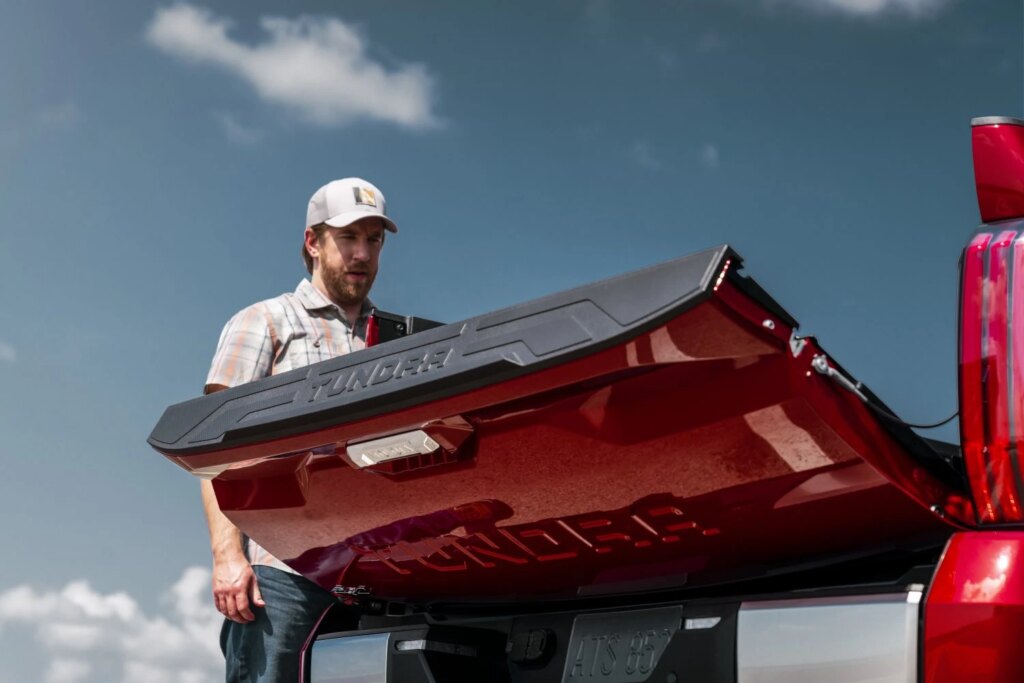
Toyota has built its reputation on that idea, and the Tundra continues to reflect it. With an estimated resale value of 59.9 percent after five years, it leads the segment in retaining value. That is not glamorous, but it is financially meaningful. Depreciation is one of the largest costs of ownership, and Toyota manages it better than most.
Reliability is more nuanced. Different studies produce different rankings. Some place the Tundra at the top, others highlight the Silverado’s strong dependability, and Ram points to favorable results in recent quality studies. The takeaway is not that one truck is flawless, but that none of them are weak. This is a mature segment where major failures are rare and competition has pushed quality upward across the board.
Inside the cabin, the conversation becomes more personal.
Ram claims best-in-class rear-seat legroom at 44.8 inches in its Crew Cab configuration. For families, dog owners, or anyone who regularly carries passengers, that matters. It transforms the truck from a tool into a space people actually want to spend time in.
GMC, on the other hand, focuses on front-seat comfort and material quality. The Sierra offers generous headroom and legroom up front, paired with a level of refinement that pushes it toward the premium end of the market. It feels considered, not just capable.
Toyota takes a different approach. The Tundra’s interior is practical, comfortable, and well-equipped, but it avoids unnecessary theatrics. It is designed to work, not to impress at first glance.
Technology adds another layer of distinction.
Ford approaches technology as a tool. Features like Pro Access Tailgate and Pro Power Onboard, which can deliver up to 7.2 kilowatts of power, are designed to solve real-world problems. This is technology that earns its place.
Ram leans into experience. With over 50 inches of combined available screen space, including a large central touchscreen and optional passenger display, it delivers a cabin that feels modern and immersive.
GMC balances both, offering premium hardware with a 13.4-inch touchscreen and a 12.3-inch digital driver display. Toyota, meanwhile, focuses on usability. Its standard safety systems and practical features are designed to be used every day without a learning curve.
Sales figures reinforce one reality.
Ford still leads the market. In the first quarter of 2026, the F-Series recorded 159,901 sales. Chevrolet’s Silverado followed with 128,818 units, GMC’s Sierra added 75,607, Ram reported 59,828 for the 1500, and Toyota’s Tundra accounted for 34,616.
Volume does not equal perfection, but it does reflect trust. And Ford has earned that trust over decades.
Choice is the final piece of the puzzle.
Chevrolet offers a wide range of Silverado models, while Ford stretches the F-150 across everything from basic work trucks to high-performance off-road machines. Ram emphasizes comfort and design. GMC leans into premium positioning. Toyota keeps its lineup focused and logical.
Each brand is solving a different equation.
So what is the best truck in America?
The honest answer is that there is no single winner. The best truck depends on what you need it to do.
If you want the lowest entry price, Chevrolet makes the strongest case. If you value long-term warranty coverage and a comfortable interior, Ram stands out. If your priority is towing and payload, Ford remains the benchmark. If you want a premium experience with strong capability, GMC delivers. And if you are thinking about long-term ownership, resale value, and reliability, Toyota offers a compelling argument.
The segment works because it does not force a single answer. It allows for different priorities, different lifestyles, and different definitions of value.
In the end, the job comes first. The truck comes second.
And that is exactly how it should be.