Polestar Says It’s Not Backing Down on EVs, Even as Other Brands Slow Their Electric Plans

At a time when several automakers are quietly softening their electric vehicle ambitions, Polestar is taking the opposite stance.
The Swedish EV brand says it is “all in” and intends to grow.
In a direct statement about the company’s future, Polestar leadership expressed confidence that the brand will survive, expand in North America, and continue doubling down on electric vehicles, even as competitors recalibrate.
That confidence comes during a turbulent moment for EV adoption in the United States. Charging concerns persist. Pricing remains sensitive. Federal policy continues to shift. Tariffs and manufacturing geography complicate supply chains. Several legacy brands have delayed EV targets or leaned harder into hybrids.
Polestar is not changing course.
Record Sales and a Bigger Bet
Polestar reported a record global sales year with approximately 60,000 vehicles delivered. The company is targeting low double-digit growth on top of that performance.
In a year filled with EV uncertainty headlines, that projection stands out.
The brand’s strategy centers on flexibility. Polestar describes its production model as “asset-light,” meaning it partners within the broader Volvo and Geely network rather than owning every manufacturing facility outright.
Vehicles are built in South Carolina with Volvo, in South Korea, and in Europe. That geographic spread allows the company to adjust more easily to trade or policy shifts.
In today’s global automotive environment, flexibility is survival.
The Polestar 7 Is the Real Test
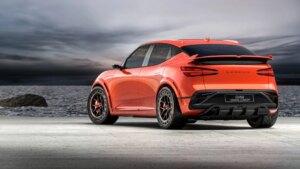
The company’s next major step is the Polestar 7 a C-segment SUV roughly the size of a Toyota RAV4. This is not a halo sports sedan. It’s a volume play.
That matters.
The compact luxury SUV segment is one of the largest and most competitive globally. If Polestar is going to scale meaningfully, it needs presence where buyers already are.
The Polestar 7 represents that pivot toward mainstream volume without abandoning brand identity.
How Polestar Differs From Other EV Brands
Polestar occupies a unique position in the EV market.
It evolved from Volvo’s performance arm into a fully electric standalone brand. It maintains close collaboration with Volvo but operates independently in design and positioning.
Where Volvo leans into comfort and safety tradition, Polestar emphasizes driver engagement and performance feel.
The brand argues that electric excitement goes beyond straight-line acceleration. Steering response, handling balance, and braking feel remain core to its identity.
Even controversial design decisions like removing the rear window on the Polestar 4 and replacing it with a digital rear-view system reflect a willingness to challenge convention in pursuit of aerodynamics and interior space improvements.
That approach signals confidence, but it also carries risk in a cautious consumer environment.
Why This Matters for the U.S. Market
The U.S. auto market still moves roughly 15–16 million vehicles annually. Even if EV growth moderates, the overall opportunity remains significant.
Several automakers have slowed EV rollouts or rebalanced toward hybrids. Polestar’s strategy is to hold position while others retreat.
That can be advantageous.
When competitors hesitate, market share becomes available. But execution becomes critical. Product, pricing, dealer support, and service accessibility must match ambition.
Polestar says it plans to launch four new vehicles within three years. Confirmed additions include the Polestar 7 and new variants of the Polestar 4.
The goal is scale without dilution.
Who This Is For
Polestar appeals to buyers who want:
- A premium EV without traditional luxury brand conventions
- Performance feel beyond acceleration numbers
- Scandinavian design with a sharper edge
- A brand committed fully to electrification
It is not targeting pickup truck buyers or heavy-duty segments. The focus remains SUVs and performance-oriented electric crossovers.
The Bigger Picture
The EV market is not collapsing. It is maturing.
Growth has slowed from early exponential phases, but adoption continues. The next phase favors brands that can control costs, adapt production geography, and offer compelling products in high-volume segments.
Polestar’s message is clear: no retreat, no hybrid hedge, no pivot away from electrification.
Whether that confidence translates into long-term success will depend on how effectively the next generation of products lands with American buyers.
But in a market defined by caution, clarity itself becomes a signal.
Polestar is not signaling retreat.