The New S-Class Is Mercedes’ Answer to Tesla’s Hype
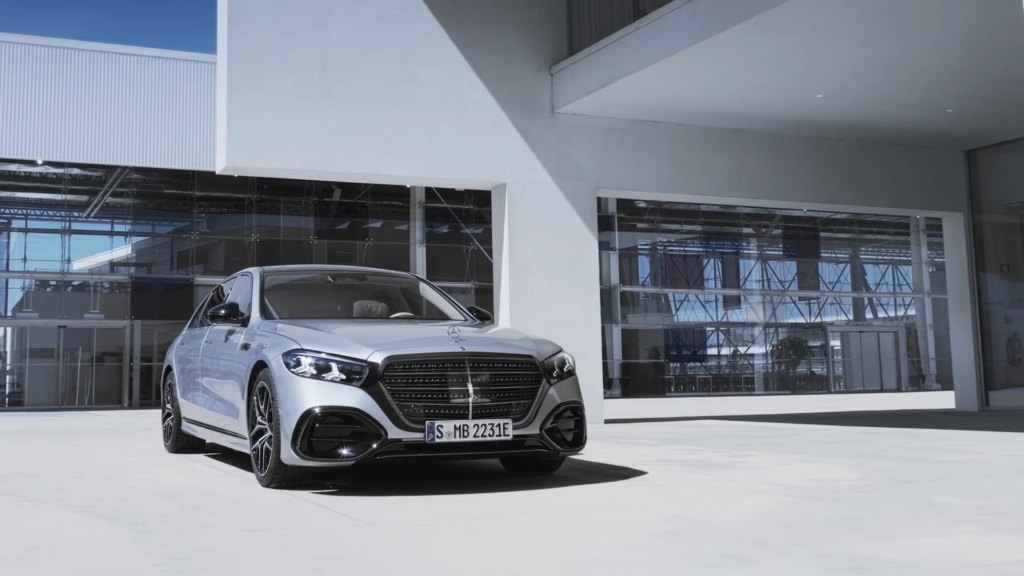
I’m in Stuttgart, Germany, next to a car that always does the same trick: it shows you where the industry is heading before the industry admits it’s going there. The Mercedes-Benz S-Class isn’t important because it’s expensive or elegant or because it’s what successful people order when they’re bored of making decisions. It’s important because Mercedes treats the S-Class like a laboratory with leather seats. Whatever works here gets copied—slowly, quietly—into the rest of the lineup until it becomes normal.
And this new S-Class refresh is not a polite tidy-up. More than half the car has been re-engineered—around 2,700 components. That’s an absurd amount of effort for something the casual eye might describe as “looks… similar.” But that’s the point. Mercedes didn’t rebuild it to look new. They rebuilt it to think differently.
The center of that thinking is MB.OS: a vehicle-wide operating system that runs everything from infotainment to suspension to lighting to driver assistance. In other words, this isn’t a car with computers. This is a computer that happens to be a car—politely.
Why does this matter right now?
Because the definition of luxury is changing, and “more screens” isn’t the answer anymore.
For a decade, the industry has been hypnotized by the Tesla approach: make the cabin minimal, put everything on a big screen, update it over the air, and let the software vibe do the heavy lifting. It worked—brilliantly—because it made cars feel modern in the way phones feel modern.
But the next stage is harder. Real luxury isn’t just a nicer interface. It’s a vehicle that reduces your workload before you notice you had any. And that’s where the S-Class still has a particular advantage: Mercedes doesn’t only digitize the parts you touch. It digitizes the parts you don’t think about.
With MB.OS, software doesn’t just control the entertainment and navigation. It governs mechanical systems. It changes how the car rides, steers, and responds to the road itself. Tesla has always been strong at the “screen” part of the modern car. Mercedes is aiming at something more systemic: the whole vehicle behaving like one coordinated organism.
Take the lighting. These headlights throw light nearly 2,000 feet down the road and cut energy use by fifty percent. The clever part isn’t just brightness—it’s communication. Mercedes’ DIGITAL LIGHT uses micro-LEDs to project warnings and guidance onto the pavement. Lane guidance. Warnings. Even snowflake alerts. Most headlights illuminate. These instruct.
Then there’s maneuverability, which is where luxury cars usually embarrass themselves in parking garages. Rear-wheel steering is standard at 4.5 degrees or optional at ten, shrinking the turning circle to just 35.4 feet. It makes a long car feel oddly short at low speed, then more stable at high speed. That isn’t a gimmick. It’s geometry doing the heavy lifting.
And the suspension is quietly one of the most telling details, because it’s the part of the car that decides whether you arrive feeling fresh or feeling punished. This system reads potholes before you hit them using cloud data shared by other cars. Mercedes stores road data for up to fourteen days, so speed bumps and rough pavement trigger pre-emptive damping. Tesla reacts. This prepares.
That’s why it matters now: we’re moving from “software as a feature” to “software as the car.”
How does it compare to rivals or alternatives?
If Tesla is the disruptive startup mentality—fast, clever, constantly evolving—Mercedes is the industrial-grade version of the same idea, engineered with a longer attention span.
Tesla’s screen-centric philosophy tends to consolidate everything into one interface. It’s clean. It’s modern. It’s also a single point of friction when you’re busy, tired, and just want the car to behave without negotiating with menus.
Mercedes’ approach is more like a systems engineer’s revenge. MB.OS is not just a user experience layer. It’s a foundation tying together infotainment, chassis, comfort systems, lighting, and driver assistance. The payoff is that the car can coordinate itself: it can change suspension behavior based on known road conditions; it can use lighting to communicate information to you; it can blend navigation and augmented reality to reduce your mental workload rather than impress your passengers.
Powertrain choice is another philosophical split. You can still buy this S-Class with a V8 making 530 horsepower and 553 pound-feet of torque, hitting sixty in 3.9 seconds—quietly, like it’s slightly embarrassed about being quick. Mercedes also pairs combustion engines with 48-volt mild-hybrid systems, smoothing power delivery instead of chasing headline acceleration numbers.
And then there’s the plug-in hybrid: 576 horsepower with the ability to drive silently when you want. That flexibility matters because real people live complicated lives. Sometimes you want electric serenity. Sometimes you want range and convenience. Mercedes isn’t demanding ideological purity. It’s offering a menu.
Inside, the S-Class plays a different game than most rivals. Tesla tends to prioritize the driver’s relationship with the interface. Mercedes treats every seat like it matters. Rear passengers get dual 13.1-inch screens and detachable remotes. The screens support Zoom, Teams, and Webex, turning the back seat into a mobile boardroom rather than a tolerated afterthought. The rear seats recline to 43.5 degrees and offer massage, ventilation, and heating—economy class would like a word.
Audio is another tell. Optional Burmester sound delivers 1,750 watts through thirty-nine speakers, with tactile transducers that vibrate the seats so bass is felt, not just heard. Tesla sounds good. This feels smug.
Even the air you breathe gets the Mercedes treatment. The cabin air refreshes every ninety seconds and filters particles down to PM2.5. Tesla’s filtration is strong, but Mercedes integrates air quality with seating, climate zones, and memory profiles. That’s the broader pattern: less “feature,” more “system.”
Safety is similarly comprehensive. Up to fifteen airbags are available, including rear airbags and inflatable beltbags. And PRE-SAFE Impulse Side can raise the car during a side impact to redirect crash forces—software and physics working together in a way that feels very Mercedes: quietly dramatic, deeply engineered, and not interested in applause.
Then there’s the voice assistant. The MBUX assistant runs ChatGPT-based AI and remembers conversational context. Tesla executes commands. Mercedes holds a conversation—and doesn’t interrupt. That “doesn’t interrupt” part matters more than it sounds, because a car that listens properly reduces friction in small moments, and small moments become the ownership experience.
Navigation uses Google Maps with real-time 3D traffic visualization, and the system blends mapping, sensors, and augmented reality to help you make decisions without draining your attention. Again: the goal is not to impress your passengers. It’s to reduce your cognitive load.
Who is this for and who should skip it?
This S-Class is for the person who likes technology, but doesn’t want to babysit it.
It’s for the executive who spends too much time in cars and wants the cabin to behave like a calm, predictable space—clean air, comfortable seating, low fatigue. It’s for the driver who wants performance without drama, speed without noise, and capability without the car shouting about it.
It’s also for anyone who’s slightly tired of the modern trend where “innovation” means “we removed buttons and made you learn gestures.” Mercedes is clearly trying to keep things advanced while still making the experience feel adult.
You should skip it if what you truly want is the simplest possible relationship with a car—one interface, one philosophy, one way of doing things—and you enjoy living inside that ecosystem. You should also skip it if your main priority is maximum novelty-per-dollar. The S-Class is not designed to feel like a gadget. It’s designed to feel finished.
And if your driving life is mostly short urban hops, and you rarely use the rear seats, and you don’t care about long-haul comfort, you may be paying for engineering you’ll never fully exploit. The S-Class is at its best when the car is doing a lot of life with you: commuting, traveling, working, carrying people, smoothing chaos.
What is the long-term significance?
The S-Class has always been Mercedes’ way of placing a bet on what “normal” will look like in a few years.
The significance of this refresh is that it’s treating software as the foundation of the vehicle, not an added layer. MB.OS running across infotainment, chassis systems, lighting, and driver assistance is the direction the industry is heading. In time, more cars will behave like coordinated platforms rather than collections of separate modules.
Lighting that communicates. Suspension that prepares rather than reacts. Steering that changes the character of a long car in a tight city. Cabin systems that integrate air quality, comfort, and memory profiles as one experience. Driver assistance that feels like it’s reducing workload instead of adding supervision. This is the future Mercedes is trying to normalize.
And that’s why this flagship still matters. Tesla can feel fast, clever, and young. The S-Class feels finished. It feels like the difference between a brilliant beta and a refined final draft.
I’ll put it simply: if you want to know what Mercedes will be selling in five years, this car is already doing it. Quietly. Confidently. And with the kind of engineering thoroughness that makes you suspect the Germans still don’t do subtle halfway.