Why Fully Autonomous Cars Still Come With Major Limitations in the U.S.
I don’t think software-defined vehicles are interesting because they’re clever. I think they’re interesting because they finally admit something we’ve all known for a while: modern cars stopped being finished products the day they left the factory.
Mercedes isn’t shouting about this. It isn’t wrapping it in startup language or pretending it invented the idea of over-the-air updates. What it’s doing instead is more unsettling and more important. It’s rebuilding the car around software, affecting electric vehicles, combustion cars, and everything in between. And it’s doing it at scale, not as a pilot, not as a concept, but as something customers are already driving.
That’s why this matters right now. Not because of one feature, or one model, or one AI assistant, but because Mercedes is trying to change how cars grow up after you buy them.
Why does this matter right now?
If you own a car today, you already live with software. It controls how your phone connects, how your driver assistance behaves, how your navigation updates, and sometimes how your powertrain responds. The problem is that most cars still treat software as an accessory instead of the backbone.
Mercedes is now flipping that around.
The shift to a software-defined vehicle means the car’s core behavior can evolve continuously. Not just maps and media, but driving logic, energy management, automation behavior, and user interaction. This isn’t about novelty. It’s about relevance over time.
For buyers, this means a car that improves rather than stagnates. For manufacturers, it means responsibility doesn’t end at delivery. And for the industry, it signals the end of the idea that a model year defines capability.
That matters whether you’re leasing, buying, or simply trying to figure out whether your next car will feel outdated in three years.
How does it compare to rivals or alternatives?
Tesla has conditioned people to expect software updates. Rivian has followed with a similar mindset. Several Chinese manufacturers have gone even further, moving fast and iterating aggressively.
What Mercedes is doing differently is integration.
Instead of focusing on one powertrain or one market, Mercedes is building a cross-platform system designed to work across EVs, hybrids, and internal combustion vehicles. That alone puts it in a different category from most competitors, who still silo their software strategies.
The other difference is tone. Mercedes isn’t trying to be playful or provocative. It’s trying to be dependable. Updates are structured, versioned, and planned. Safety remains rule-based where regulation demands it. Driving behavior is shaped to feel recognizably Mercedes.
That may not excite everyone. Some competitors move faster or take bigger risks. But Mercedes is betting that consistency, trust, and refinement matter more at scale than spectacle.
Who is this for and who should skip it?
This approach is for people who plan to keep their cars longer than a lease cycle. It’s for drivers who value gradual improvement over dramatic reinvention. It’s also for buyers who want advanced technology without feeling like unpaid beta testers.
If you want the sharpest, newest feature the moment it exists, there are brands that move faster. If you dislike the idea of your car changing after purchase, this won’t appeal either.
But if you want a car that feels current five years from now, not frozen in the moment it was built, this strategy starts to make a lot of sense.
What is the long-term significance?
Zoom out, and this isn’t really about Mercedes. It’s about how the car industry finally catches up with how technology actually works.
The software-defined vehicle turns ownership into an ongoing relationship. It also blurs the line between product and service. Cars become platforms. Capability becomes fluid. And the real competition shifts from horsepower and trim levels to update quality, system stability, and trust.
Mercedes isn’t claiming perfection. What it’s claiming is commitment. And that may end up mattering more than any single feature.
Evolution of Mercedes’ Software-Defined Vehicle (SDV) Platform
Mercedes didn’t arrive here overnight. The foundation was laid with earlier generations of the E-Class, where software features began rolling out across the United States, Europe, and China. Those deployments weren’t flashy, but they were critical.
They generated real-world usage data at scale. They exposed edge cases. They showed how customers actually interact with systems, not how engineers expect them to.
That data now underpins the current SDV architecture. Instead of building in isolation, Mercedes is iterating based on millions of miles of lived experience. That’s the unglamorous work that makes everything else possible.
3. Current System Rollout Status
The most precise proof point is the CLA.
CLA models equipped with the new system are already in customer hands across Europe, with data flowing in from both Europe and China. This isn’t a closed test. It’s live, active, and evolving.
The core system, internally referred to as the “Brain,” is scheduled to reach customers within weeks. More importantly, Mercedes has confirmed that this architecture is not limited to electric vehicles.
Starting in spring 2026, internal combustion and hybrid models, including GLS, GLC, and S-Class, will begin rolling out with the same SDV foundation. The S-Class reveal is scheduled for January 2026, with production and sales ramping shortly after.
That matters because it signals intent. This isn’t a side project. It’s the future of the lineup.
4. Key Features and Experience Domains
a. Voice and Conversational AI
The voice system now combines multiple layers: the latest Gemini language model, a Mercedes-specific agent, and Microsoft ChatGPT integration.
The idea isn’t novel. It’s coverage.
One agent handles general conversation. Another focuses on real-time tasks like navigation and destination search. Over time, the system improves through usage data, with text-to-speech updates and expanded domains planned for 2026.
It’s less about sounding clever and more about being useful without frustration.
b. Navigation and Spatial Intelligence
Navigation integrates Google Maps for real-time traffic and points of interest, layered with cloud-based intelligence. The goal is simple but ambitious: remove the need for a smartphone.
By combining trusted mapping data with vehicle context, Mercedes aims to make navigation feel native rather than bolted on.
c. Content Orchestration and Ambient Experience
This is where things get quietly interesting.
Ambient lighting, seat controls, and sound are coordinated by an AI agent that can suggest adjustments based on context. Not commands, but proposals. Subtle, optional, and reversible.
It’s an attempt to make the cabin feel responsive without being intrusive.
d. EV Range and Charging Optimization
Real-time data from all CLA vehicles feeds into charging intelligence. That includes correcting charging station locations, predicting performance based on climate and temperature, and improving range accuracy.
The goal isn’t optimism. It’s trust. Reducing range anxiety by aligning expectation with reality.
5. Autonomous Driving Technology Evolution
a. System Architecture and Experience
Mercedes has transitioned from rule-based systems to AI-driven, end-to-end learning. Collaboration with Nvidia provides the hardware and software backbone.
The results show up in small but meaningful ways: smoother automated parking, improved lane behavior, and more natural highway driving.
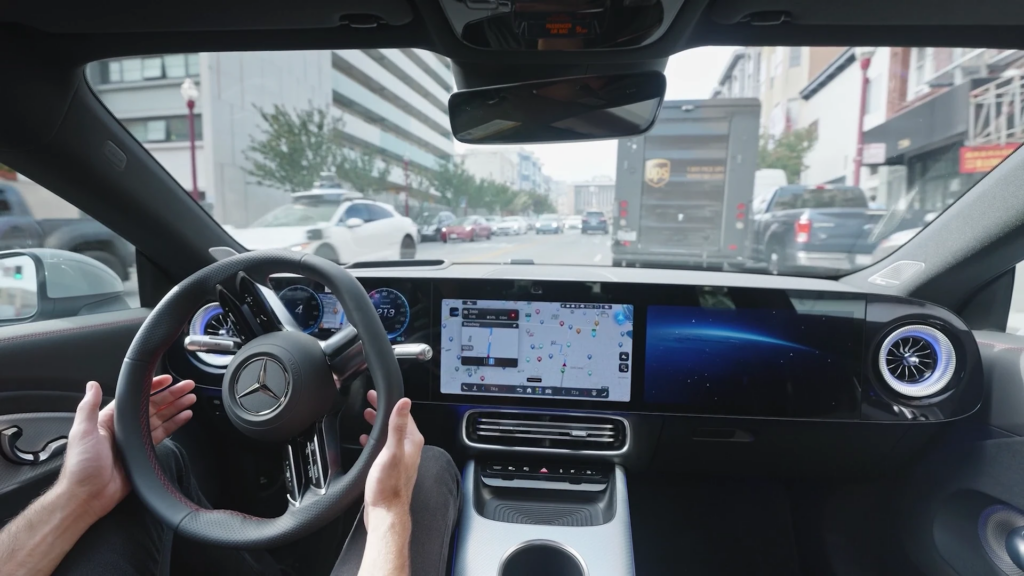
Level 2 automation now supports urban, point-to-point driving in pilot environments like downtown San Francisco and parts of China. On highways, the experience approaches Level 3 behavior, including automated exits and overtaking.
b. Future Initiatives and Level 4 Aspirations
At the Abu Dhabi F1 race, Mercedes announced a Level 4 robotic taxi pilot with partners Nvidia, Momenta, and V-Rive. This remains a pilot, not a public deployment.
Still, it signals where the technology is heading, even if timelines remain deliberately conservative.
6. System Rollout to Internal Combustion Engine (ICE) Vehicles
The groundwork for cross-powertrain compatibility has been in place for years. Hardware abstraction means the software platform is largely agnostic to what’s under the hood.
That allows rapid rollout once production begins, starting spring 2026.
7. Safety, Compliance, and Differentiation
Safety-critical systems remain rule-based to meet regulatory requirements. Driving behavior, however, is AI-driven.
Mercedes layers its own brand values on top of partner technology, shaping comfort distances, safety margins, and overall driving character.
This is where differentiation lives. Not in raw capability, but in how it feels.
8. Investment, KPIs, and Benchmarks
While specific investment figures were not disclosed, Mercedes tracks performance through detailed KPIs: takeover rates, autonomous distance, parking efficiency, voice response times, recommendation accuracy, and OTA rollout speed.
The company positions itself as the first legacy automaker with a fully integrated, cross-platform SDV operating at scale.
9. Over-the-Air (OTA) Update Strategy and Community Feedback
Mercedes plans four major OTA releases per year, supported by smaller updates. Versions are clearly labeled and already deployed since the European launch in late summer 2025.
Feedback has shifted from interviews to real-time usage data. Community engagement is expanding through forums and modern channels, while dealers remain focused on hardware.
Software updates are designed to be one-click, customer-executed experiences.
10. Technology Ownership vs. Partnership Strategy
Mercedes owns the full CI/CD pipeline, operating system, interfaces, security, and update mechanisms. This allows flexibility in choosing and overriding partners.
In Western markets, partners include Google, Microsoft, and Nvidia. In China, local partners are used. Mercedes applies its own UX and safety layers across all integrations.
11. Platform Integration vs. Vertical Integration Debate
Mercedes acknowledges that full vertical integration is rare. Its strategy focuses on owning integration and experience while leveraging best-in-class partners.
That balance may prove more sustainable than trying to do everything alone.
In the end, the most interesting thing about Mercedes’ software-defined vehicle strategy is how un-dramatic it is. No promises of perfection. No reinvention theatre. Just a quiet admission that cars now live long after delivery, and someone has to take responsibility for that.
Mercedes is stepping up. Carefully. Methodically. And for once, that restraint might be the most radical move of all.