Why Living Off Dividends Alone Can Backfire in Retirement

There’s a popular idea in retirement planning that sounds incredibly appealing: build a portfolio that pays enough dividends so you never have to touch your principal. Live off the income, preserve your wealth, and avoid the stress of market fluctuations.
On the surface, it feels safe. Responsible, even.
But when you actually run the numbers and understand how markets work that strategy can quietly put your retirement at risk.
The Math Behind the Dividend Myth
Let’s start with a simple goal. Say you want to generate $72,000 per year in retirement income.
If you invest in a high-yield stock paying around 9.5%, you’d need roughly $758,000 to hit that target. That sounds efficient.
Now compare that to a broad market portfolio like the S&P 500, which yields closer to 1.1%. To generate the same $72,000 purely from dividends, you’d need over $6 million.
This is where many investors stop and think: “Clearly, high dividend stocks are the answer.”
But that conclusion ignores a critical piece of the equation total return.
Income Isn’t the Same as Growth
Dividend yield is only one part of your return. The other part is price appreciation.
Companies that pay very high dividends often do so because they don’t have strong growth opportunities. Instead of reinvesting profits to expand the business, they distribute that cash to shareholders.
That can create steady income, but it often comes at the cost of long-term growth.
Meanwhile, companies like Amazon, Nvidia, or Meta have historically paid little to no dividends. Instead, they reinvest profits into expansion, innovation, and market dominance driving stock price growth over time.
If your portfolio is heavily tilted toward high-yield stocks, you may generate more income today, but you could sacrifice growth that’s essential for sustaining your retirement over decades.
The Hidden Risk of High-Yield Stocks
High dividend yields don’t just limit growth they can also signal risk.
Stocks yielding 6% to 10% are often concentrated in specific sectors like utilities, REITs, and business development companies (BDCs). These sectors can perform well under certain conditions, but they also share similar vulnerabilities.
If one of those sectors struggles, your entire income strategy can be affected.
This is called concentration risk, and it’s one of the biggest dangers of relying solely on dividend income. Owning multiple high-yield stocks doesn’t necessarily mean you’re diversified if they all behave the same way in a downturn.
Over time, many high-dividend portfolios have underperformed broader market indexes, particularly over 10- to 15-year periods.
Why Dividends Alone Limit Flexibility
Another issue is control.
Dividends are paid on a fixed schedule quarterly, monthly, or annually. You don’t control when they arrive or how much you receive beyond your initial investment choices.
In retirement, flexibility matters. You may need more income one year for travel or healthcare, and less the next. A dividend-only strategy doesn’t adapt easily to those changes.
And there’s another detail many investors overlook: when a dividend is paid, the stock price typically adjusts downward by the same amount.
You’re not creating new wealth. You’re simply receiving part of your existing investment back in a different form.
A Better Approach: Total Return
Instead of focusing solely on dividends, a more effective strategy is to focus on total return the combination of income and growth.
This approach allows you to build a diversified portfolio that includes both dividend-paying stocks and growth-oriented investments. Over time, the portfolio grows, and you can generate income by selling shares when needed, in addition to collecting dividends.
This gives you two major advantages:
First, better long-term growth potential.
Second, more control over when and how you generate income.
Building Stability With a Reserve Strategy
One of the biggest concerns retirees have is selling investments during a market downturn. That’s a valid concern—but it’s also solvable.
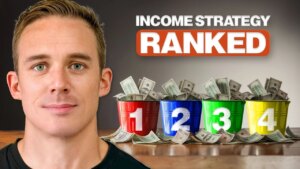
A common strategy is to create a reserve, sometimes called a “bucket” or “cash buffer.”
For example, if you have a $1 million portfolio and need $40,000 per year, you might set aside $200,000 in safer, short-term investments like bonds or cash equivalents. That covers about five years of income.
This reserve allows you to avoid selling stocks when markets are down. Instead, you draw from the reserve while giving your growth investments time to recover.
It’s a simple concept, but it dramatically reduces sequence of returns risk the danger of withdrawing money during a downturn early in retirement.
Diversification Is More Than Just Owning More Stocks
True diversification isn’t about the number of holdings. It’s about how those holdings behave.
A well-constructed retirement portfolio should include exposure across multiple sectors, asset classes, and geographies. That might include U.S. stocks, international equities, bonds, and alternative investments.
This reduces the impact of any single market event and creates a more stable foundation for long-term income.
Your Portfolio Is a Tool, Not a Trophy
One of the biggest mindset shifts in retirement planning is understanding that your portfolio is meant to be used.
It’s not a museum piece to be preserved indefinitely. It’s a tool designed to support your lifestyle.
That means it’s okay to draw from it strategically. In fact, that’s the entire point.
By focusing on total return, maintaining reserves, and staying diversified, you can create a plan that supports both your income needs and long-term financial security.
The Bottom Line
Living off dividends alone might sound like the safest path in retirement, but it often leads to unnecessary risk, limited growth, and reduced flexibility.
A better approach is to focus on total return combining income, growth, and strategic withdrawals to create a sustainable plan.
Because retirement isn’t just about preserving wealth. It’s about using it wisely to support the life you’ve worked to build.
You should always consult a financial, tax, or legal professional familiar about your unique circumstances before making any financial decisions. This material is intended for educational purposes only. Nothing in this material constitutes a solicitation for the sale or purchase of any securities. Any mentioned rates of return are historical or hypothetical in nature and are not a guarantee of future returns.
Past performance does not guarantee future performance. Future returns may be lower or higher. Investments involve risk. Investment values will fluctuate with market conditions, and security positions, when sold, may be worth less or more than their original cost.