Why the Job Market Feels Broken, Even When Companies Say They’re Hiring
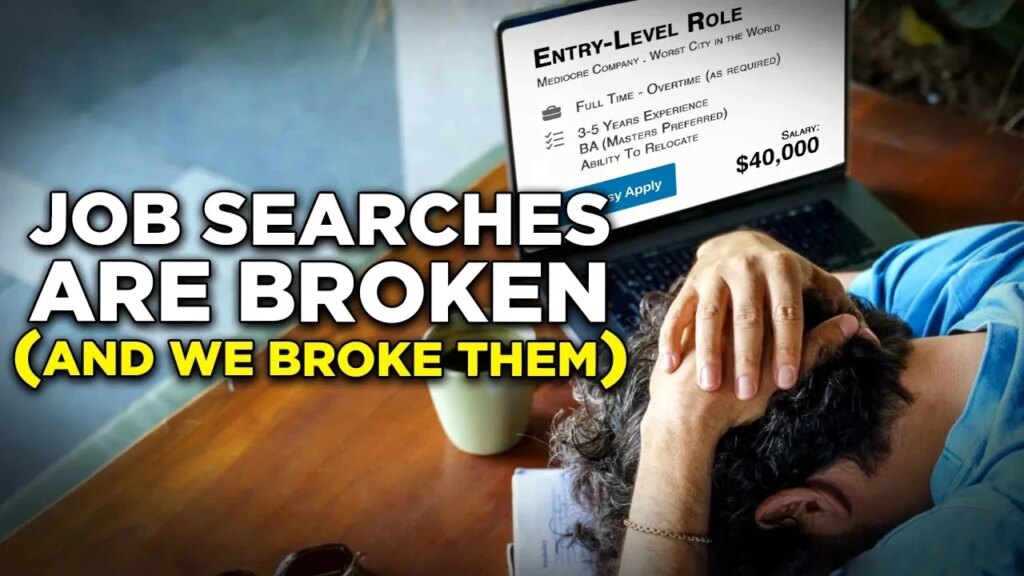
The modern job market presents a contradiction that is becoming increasingly difficult to ignore. Employers continue to report active hiring, job boards remain full, and yet millions of applicants find themselves stuck in a cycle of applications, rejections, and, more often than not, silence.
For job seekers, the experience is not just frustrating it is disorienting. Submitting dozens, sometimes hundreds, of applications without a response has become normalized. One applicant cited submitting more than 60 applications without landing a role, a scenario that would have been considered unusual a decade ago but now feels routine.
What has changed is not simply the number of jobs or applicants. It is the structure of hiring itself.
The Rise of the Algorithmic Gatekeeper
At the center of this shift is technology. Applicant Tracking Systems (ATS) and artificial intelligence tools have transformed hiring into a process driven less by human judgment and more by algorithmic filtering.
Resumes are no longer read first by people. They are scanned by software that searches for keywords, ranks candidates, and often eliminates applicants before a hiring manager ever sees their name.
On the surface, this improves efficiency. Companies can process thousands of applications quickly and at lower cost. But that efficiency comes at a cost of its own. When applying becomes easier, often just a few clicks, the volume of applications surges. And as volume increases, acceptance rates fall, creating a feedback loop where candidates apply to more jobs to compensate for lower odds of success.
The result is a system that feels both automated and impersonal. Candidates are evaluated by systems they don’t fully understand, optimized for criteria they can only guess at.
Why “Entry-Level” No Longer Means Entry-Level
Compounding the issue is the steady inflation of job requirements. Roles labeled as “entry-level” now frequently demand multiple years of experience, specialized skills, and a track record that few early-career candidates can realistically possess.
From an employer’s perspective, these requirements are often defensive. Listing extensive qualifications provides legal cover, creates flexibility in candidate selection, and helps filter large applicant pools. It also reflects a broader reality: hiring is expensive, and companies are increasingly risk-averse.
Recruitment involves direct costs job postings, recruiter fees, and HR time that can accumulate quickly. In that context, employers aim to minimize uncertainty, even if it means setting unrealistic expectations.
But for candidates, the effect is exclusionary. The ladder into the workforce appears intact, yet the first rung has effectively been raised.
The Quiet Preference for External Hires
Another structural tension lies in how companies approach internal versus external hiring. While internal candidates often outperform external hires due to familiarity and lower onboarding costs, promoting from within creates cascading vacancies that must also be filled.
In periods of economic uncertainty, many organizations opt for the simpler path: hiring externally. It is faster, more predictable, and avoids the operational complexity of reshuffling existing teams.
Ironically, some companies even design job descriptions in ways that discourage internal applicants, preserving flexibility while maintaining the appearance of open competition.
Experience vs. Adaptability
The emphasis on experience has also become increasingly detached from actual performance outcomes. Research from institutions such as Harvard and Universidad Autónoma de Madrid suggests that years of experience are not a strong predictor of job success, particularly in non-technical fields.
Yet hiring managers continue to rely heavily on experience as a proxy for competence. It is a familiar metric, even if it is an imperfect one.
This creates a disconnect in a rapidly changing economy where adaptability, problem-solving, and communication often categorized as “soft skills” are becoming more valuable than static experience.
Candidates who can demonstrate these skills in interviews may outperform more experienced peers, but only if they make it past the initial screening filters.
The Economics of Job-Hopping
Against this backdrop, one of the more counterintuitive realities of the labor market has emerged: loyalty is often less financially rewarding than mobility.
Workers who change jobs every two years can earn significantly more, up to 50% more over time, than those who remain with a single employer.
This reflects how companies allocate compensation. External hires are often brought in at market rates, while internal raises tend to lag behind. As a result, switching roles becomes one of the most effective strategies for increasing income and accelerating career growth.
It also explains why employers place increasing value on diverse experience. Candidates who have worked across industries or roles are often seen as more adaptable, even if their experience is less linear.
A System Under Strain
The broader implication is that the hiring system is no longer optimized for alignment between employers and candidates. It is optimized for scale.
Technology has made it easier to apply, but harder to stand out. Employers have more data, but less direct engagement. And both sides are operating in a system that rewards efficiency over connection.
For job seekers, this means success increasingly depends on understanding how the system works optimizing resumes for algorithms, applying strategically rather than broadly, and focusing on roles where skills, not just credentials, can be demonstrated.
For employers, it raises a more fundamental question: whether a process designed to filter candidates at scale is inadvertently filtering out the very qualities creativity, adaptability, and judgment that modern organizations need most.
Until that balance is addressed, the job market will continue to feel broken not because opportunities don’t exist, but because the path to them has become harder to navigate.
All writings are for educational and entertainment purposes only and does not provide investment or financial advice of any kind.