Your Next Car Will Do Almost Everything… And Transport You
Cars aren’t what they used to be. A quarter-century ago, a new model launch meant bigger engines or sleeker lines. Now the story is about screens that descend from ceilings, seats that adjust posture while judging your slouch, and built-in apps that turn a vehicle into a rolling lifestyle accessory.
Manufacturers are chasing a new ideal: it isn’t horsepower, it’s holistic experience. That shift shows a broader trend in the industry: sedans and SUVs must now justify their existence not on torque curves, but on emotional comfort, convenience, and a bit of showmanship. In a crowded marketplace where electric drivetrains are becoming common and emissions targets are stiffening, experience becomes the differentiator. Buying a “car” today often means buying a mobile living room, or at least a respectable imitation.
The new automotive toolkit: screens, seats, spa-modes, and remote parking
Take the case of what was once a luxury sedan: it now offers a 31-inch 8K screen that folds down from the roof for back-seat entertainment. That’s not a back-seat DVD player, we’re talking full-on cinema mode, with automatic blinds, mood lighting, streaming apps, and suspension tuned for comfort. It’s less “car” and more “air-suspended mini-theatre.”
Doors open and close by themselves. Not as a gimmick, as a statement: you allegedly can’t be bothered with doorknobs. The car becomes your valet.
Parking anxiety? There’s an SUV that lets you exit the vehicle, tap your phone, and watch it reverse itself into a tight slot, which, if nothing else, spares you the usual dings and partner-eye rolls. Remote-control parking: more toy than necessity… until you desperately need it.
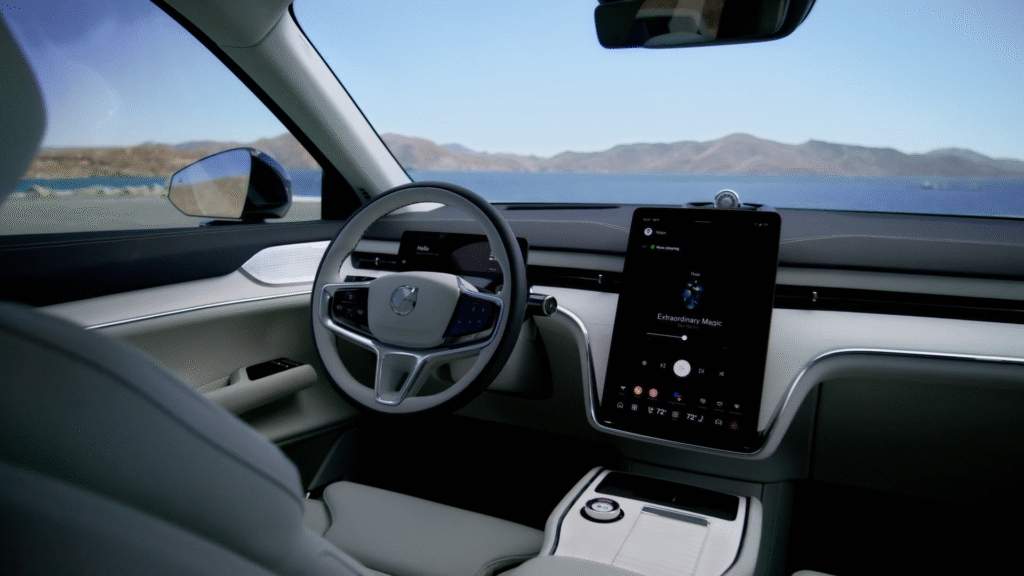
Inside, other brands lean into calm. One luxury marque dials the cabin back to a low-noise, softly lit, minimal-distraction mode. Adjusted climate, ambient lighting, soothing materials, and even massage seats that cradle your spine after a punishing commute. The idea: the car isn’t just transport; it’s a sanctuary.
Smarter still: posture-adjusting seats that subtly shame you into sitting up straight. Ergos, airbags, and cushioning combine to relieve fatigue on long drives. And Scandinavia’s finest have pitched their cabins as “living rooms that move,” complete with minimalist interiors, tactile materials, and built-in driver monitoring that (humorously) tattles if you nod off.
Who is this for, and who should probably wait?
If you loathe mundane commutes, dread tight parking lots, or have ever cursed the bland upholstery on your current crossover, these new cars are for you. Families, frequent travelers, urban dwellers, and busy professionals will appreciate a vehicle that’s more lifestyle asset than appliance.
If you’re buying a car as a tool, to tow heavy loads, rock-climb mountains, or laugh in the face of potholes, some of these “soft-car” compromises might bruise your sensibilities. You might care more about durability than damped suspension, more about leaf-springs than lumbar support.
Similarly, if you prize simplicity, easy maintenance, and budget-minded pragmatism, the expense and feature-bloat may not land kindly. After all, every built-in screen, sensor, or app is one more potential glitch, one more update, one more thing that might age poorly.
How does it compare to rivals?
Here’s the modern lineup, not in engine size or 0–60 times, but in what kind of vehicle they aspire to be:
- Valet-style luxury sedan, the one with automatic doors, ceiling screens, and cabin mood lighting. Perfect for those who want subtle status without shouting “look at me.”
- Wellness-mode SUV, calm interiors, massage seats, ambient lighting, and minimal noise. Ideal for long commutes or city traffic where patience is optional.
- Remote-parking SUV, for people who treat parallel parking like a high-stakes performance. Bonus: no more scraped bumpers, fewer awkward maneuvers.
- Lifestyle electric / utility-powered EV, think vehicle-to-home juice for blackouts, power tools, or spontaneous camping. Not just transport; a backup generator on wheels.
- Tech-centric crossover, screens, streaming, games, connectivity, for those who treat their car like a second smartphone, only bigger and with seat belts.
If you’re picking between these and older-school cars, the decision isn’t about speed or towing capacity. It’s about whether you value experience, convenience, and tech-driven comfort over mechanical purity.
What is the long-term significance?
This shift suggests the automobile is evolving. Cars are no longer just vehicles; they’re ecosystems. As automakers push more of the lifestyle, comfort, and convenience envelope, the traditional determinants, engine performance, mechanical reliability, simple practicality, may become secondary.
Future buyers will ask different questions. Not “How fast is it?” but “How smart is it?” Not “How much can it tow?” but “How much can it soothe?” Resale value may increasingly depend on how well the tech and comfort features age, both in hardware and software. A car that updated itself overnight last year might be obsolete today if firmware support expires.
Maintenance could shift, too. Dealers may be replaced with software update centers. Maybe “refuels” will become “recharges”, or “refresh” cycles. As the car becomes software-driven, reliability will depend less on wrenches and more on code.
At the same time, this evolution risks alienating purists. There will always be drivers who seek the raw connection, the steering, the engine roar, the tactile feedback, and who see infotainment screens and auto-parking as distractions. For them, modern cars might feel overly curated, too safe, too polite.
But for many, this new breed of car will redefine convenience, comfort, and companionship. For daily commutes, long road trips with a dog in the back, or errand-heavy suburban life, these cars are ready.
Final thought
The engine no longer sells the car. The experience does. Your next car might not just move you. It might soothe you, entertain you, park itself, work for you, and yes, occasionally get you where you need to go.
If you’re done with merely driving, it’s time to start living, on four wheels.