2026 Chevrolet Traverse Review: Start With the LT
This 2026 Chevrolet Traverse review explains why the LT delivers the best family value, how much space you actually get, and when the Z71 makes sense.
By Nik J. Miles
There is a rather expensive habit developing among American families. They need three rows of seats, so they immediately begin shopping for enormous full-size SUVs.
Before spending Tahoe money, I would suggest looking at the 2026 Chevrolet Traverse.
It can seat up to eight people, carry a considerable amount of luggage and tow 5,000 pounds when properly equipped. It also has an enormous touchscreen, available hands-free driving assistance and a starting price substantially below Chevrolet’s full-size SUVs.
The question is whether you actually need anything more.
My recommendation is the LT. It provides the Traverse’s core family advantages without charging thousands extra for expensive wheels, decorative trim and equipment that may rarely get used.
This is a researched vehicle analysis using Chevrolet’s published specifications and independent safety data. No original 2026 Traverse driving log or Test Miles performance measurements were supplied.
You may also like this video:
2026 Chevrolet Traverse Review: The Buyer Verdict
Best for: Families needing a genuinely useful third row, generous luggage space, a powerful gasoline engine and a lower entry price than a full-size SUV.
Skip if: Your priority is hybrid fuel economy, you regularly tow more than 5,000 pounds, or you want a compact vehicle for crowded city streets.
Pros
Up to eight seats on a properly configured LT.
22.9 cubic feet of cargo room behind the third row.
328-horsepower turbocharged engine standard across the lineup.
17.7-inch touchscreen included on the entry model.
IIHS Top Safety Pick recognition.
Cons
No hybrid powertrain.
Large exterior dimensions make maneuverability important.
Upper trims are considerably more expensive.
Super Cruise requires an eligible configuration and ongoing service access.
Updated IIHS frontal testing revealed some rear-occupant restraint concerns.
Why the Traverse LT Is the Smart Purchase
Chevrolet offers four main Traverse trims: LT, Z71, High Country and RS.
The entry LT starts at an advertised $40,800 before destination charges and options. That buys a turbocharged 2.5-liter engine, eight-speed automatic transmission, seating for seven or an available eight, a 17.7-inch touchscreen and a power liftgate.
In other words, the essentials are already there.
Move up to the $48,900 Z71 and Chevrolet adds an advanced twin-clutch all-wheel-drive system, all-terrain tires, off-road suspension, underbody protection and hill-descent control.
Those additions are useful if you regularly encounter rough access roads, slippery surfaces or difficult terrain. For a family whose most demanding expedition involves the supermarket car park, they are rather less necessary.
The High Country starts at $55,100. It adds premium interior details, power-folding rear seats and standard Super Cruise equipment with an included service plan.
The RS costs $55,400 and concentrates on distinctive styling, large black wheels, red interior accents and premium equipment.
Both are attractive propositions for buyers who want a more luxurious Traverse. They also cost roughly $14,000 more than the basic LT.
That is a substantial amount of money to spend before considering whether the family actually benefits from the upgrades.
I would begin with the LT, then add all-wheel drive if the climate and roads justify it.
Chevrolet’s published September 2026 pricing places an LT AWD at $44,795 including destination. At that level, the Traverse remains a compelling alternative to more expensive three-row SUVs.
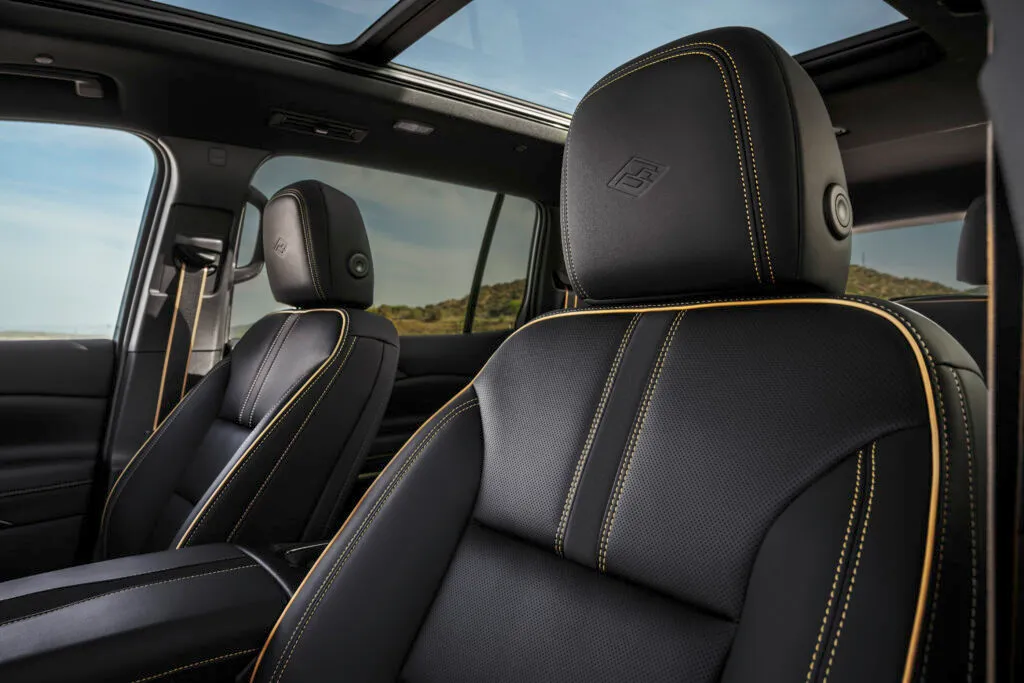
Seat detail of 2026 Chevrolet Traverse High Country with Jet Black with Natural Tan interior. Preproduction model shown, actual production model may vary.
The Third Row Is the Reason to Buy This Chevrolet
Large touchscreens attract attention in showrooms. Third-row access becomes considerably more important after the third week of school runs.
The Traverse measures approximately 204.5 inches long and has a 121-inch wheelbase. Chevrolet has used those dimensions to create a cabin with considerable passenger space.
The LT offers a choice between second-row captain’s chairs and an available bench seat. Captain’s chairs provide seven-passenger seating, while the optional bench increases capacity to eight.
The Z71, High Country and RS are seven-passenger configurations.
For families, deciding between seven and eight seats should come before choosing the exterior color.
A second-row bench provides one more passenger position, which can be essential for larger households. Captain’s chairs leave a pathway between them that can make accessing the third row more convenient.
Chevrolet’s Smart Slide seating mechanism is designed to simplify access to the back. Higher trims offer additional powered seat-folding functions.
The important test is how those mechanisms work with your actual passengers and child seats.
Bring the child restraints to the dealership. Install them, move the seats and check whether children can enter the third row without disturbing an installed restraint.
Published dimensions cannot answer every practical question about a family’s seating arrangement.
The same applies to taller adults. Sit in the third row with the second-row seat positioned for a real passenger, not pushed forward to make the showroom demonstration look impressive.
Our 2026 Toyota Grand Highlander review provides another perspective on three-row family space and trim value.
Don’t Be Fooled by the 98-Cubic-Foot Cargo Figure
Chevrolet advertises a maximum cargo volume of 98 cubic feet.
That is impressive, but it requires folding the rear seating rows. Unless your family has suddenly decided to travel separately, another number matters more.
Behind the third row, the Traverse provides 22.9 cubic feet of luggage space.
Fold the third row and capacity increases to 56.6 cubic feet. Fold both rear rows and you reach the advertised 98-cubic-foot maximum.
Seating configurationCargo capacityBehind third row22.9 cu. ft.Behind second row56.6 cu. ft.Maximum with rear rows folded98 cu. ft.
The 22.9-cubic-foot figure is useful for families traveling with all three rows occupied. It gives the Traverse a reasonable amount of storage without requiring passengers to surrender their seats.
But cargo volume is only part of the equation.
A folded stroller might fit without difficulty, while a large dog crate could be too tall or awkwardly shaped for the opening.
For anybody transporting large dogs, the height of the cargo floor and the available depth are important. Older animals may also need a ramp.
Chevrolet’s AutoSense liftgate is another feature worth examining. The system recognizes an approaching key holder and opens automatically under the appropriate conditions.
That could be genuinely useful when carrying shopping, luggage or a crate.
The Traverse is also worth comparing with our 2026 Chevrolet Tahoe review, especially if your household regularly needs significant cargo space while every passenger seat remains occupied.
Rear badge of 2027 Chevrolet Traverse High Country in Mosaic Black Metallic. Preproduction model shown, actual production model may vary.
What the Turbocharged Engine Means for Drivers
The 2026 Traverse uses a 2.5-liter turbocharged four-cylinder engine producing 328 horsepower and 326 pound-feet of torque.
Power goes through an eight-speed automatic transmission to the front wheels or an available all-wheel-drive system.
That sounds like a relatively small engine for a vehicle carrying three rows of passengers.
Displacement alone, however, does not determine performance.
The turbocharger allows the engine to produce considerable output from its four cylinders. In fact, the current engine makes more advertised horsepower than the 3.6-liter V6 used in the previous generation.
What matters in daily use is how smoothly the power arrives, how the transmission responds when overtaking and how the vehicle behaves when fully loaded.
Those are questions I would want to answer in an original road test rather than making claims from an engine specification sheet.
The Z71 has additional equipment for rougher terrain, including its twin-clutch AWD system and specialized suspension tuning. Buyers should expect its tires and chassis configuration to behave differently from a standard LT.
The RS and High Country use large 22-inch wheels. They certainly create visual drama, but I would compare ride comfort and replacement tire costs before paying extra for them.
There is little satisfaction in buying the fashionable wheels and then becoming intimately familiar with every pothole in town.
Chevrolet gives the Traverse a maximum towing rating of 5,000 pounds with its included trailering equipment.
That may accommodate a modest camper, small boat or recreational trailer, provided the actual loaded trailer and vehicle remain within their ratings.
Check payload, tongue weight and the exact vehicle’s certification labels before towing.
Close front 3-4 view of 2027 Chevrolet Traverse High Country in Polar White Tricoat. Preproduction model shown, actual production model may vary.
Fuel Economy Is Where the Traverse Has a Weakness
Chevrolet lists 20 mpg city and 26 mpg highway for the front-wheel-drive Traverse.
These are published official figures, not economy measured by Test Miles.
The absence of a hybrid is significant.
For a family driving substantial distances in stop-and-go traffic, a properly chosen hybrid could reduce fuel consumption considerably.
The Toyota Grand Highlander Hybrid therefore deserves attention from buyers who prioritize operating costs.
The Traverse’s advantage is that it provides a strong standard gasoline engine and useful capacity without requiring a more expensive powertrain option.
But shoppers should calculate the difference over several years.
For example, at 12,000 annual miles, a hypothetical vehicle returning 22 mpg combined would consume approximately 545 gallons of fuel.
A hypothetical alternative returning 34 mpg combined would require about 353 gallons.
At an assumed $4 per gallon, that represents roughly $770 in annual fuel expense difference.
This is an illustration, not an official Traverse-versus-competitor EPA comparison. Actual costs depend on drivetrain, published ratings, fuel prices and individual driving conditions.
The calculation explains why a hybrid deserves consideration even when its purchase price is higher.
Interior view from second row of 2026 Chevrolet Traverse High Country with Jet Black with Natural Tan interior. Preproduction model shown, actual production model may vary.
Chevrolet Has Made Technology a Major Selling Point
Every Traverse includes a 17.7-inch central touchscreen and an 11-inch digital instrument display.
Those screens make an immediate impression, particularly in the least expensive model.
Chevrolet integrates Google-based connected technology, including compatible navigation services and applications. Availability of particular services, including connected features and voice assistance, should be checked against the vehicle’s software and subscription terms.
The large display could be particularly useful for navigation and camera views.
It is worth spending time with the interface before buying, however. A big screen is not automatically a convenient screen.
Try adjusting common settings, changing audio sources and using navigation while the vehicle is stationary. Check which functions remain available without a paid service plan.
The most important optional technology may be Super Cruise.
On compatible roads, this hands-free assistance system can help with steering, speed and following distance while monitoring the driver’s attention.
Chevrolet says its compatible road network exceeds 585,000 miles across the United States and Canada.
High Country and RS include Super Cruise through the Enhanced Driving Package and receive a three-year OnStar service arrangement under Chevrolet’s published terms.
Super Cruise does not make the Traverse autonomous. Drivers remain responsible for watching the road and taking control when required.
Ask the dealer to demonstrate the system and explain the cost of continued service after the included period.
For buyers who regularly undertake long highway journeys, the technology may justify some of the extra expense of the upper trims. For somebody driving five miles to school and back, perhaps not.
The Traverse Has a Strong Safety Record, With Qualifications
The Insurance Institute for Highway Safety awarded the 2026 Chevrolet Traverse its Top Safety Pick designation.
The SUV received a Good rating in the small-overlap frontal crash test and a Good rating in the updated side-impact evaluation.
Its updated moderate-overlap frontal result was Acceptable.
The evaluation identified a Marginal result for rear-passenger restraint performance and dummy movement in that test, despite stronger scores in several other occupant-protection categories.
For a family vehicle, the rear-seat findings are worth understanding.
The standard vehicle-to-vehicle front crash prevention system received a Good rating. Pedestrian front crash prevention was rated Acceptable.
The LATCH child-seat anchor arrangement earned Good for ease of use, while the seat-belt reminder evaluation was Marginal.
These results are more informative than simply seeing a safety award on a brochure.
Chevrolet also includes a substantial collection of safety assistance features, such as forward collision alert, reverse automatic braking, blind-zone warnings and lane-departure assistance.
The systems have operating limitations, and none removes the driver’s responsibility to remain attentive.
Readers can examine the individual crash-test results directly through the IIHS 2026 Chevrolet Traverse evaluation.
Traverse vs. Tahoe, Grand Highlander and Atlas
The Chevrolet Tahoe is the obvious alternative for somebody who wants a larger, truck-based SUV.
It offers greater towing capability, different engine choices and substantial passenger and cargo accommodation.
It also costs considerably more.
The Tahoe makes sense when its additional capability is required. For ordinary family use, the Traverse may provide nearly everything buyers actually need without the expense associated with a full-size truck-based vehicle.
The Toyota Grand Highlander presents a different challenge.
Its available hybrid powertrains make it attractive to fuel-conscious households, while its three-row configuration competes directly for family buyers.
Anyone who spends considerable time commuting should compare the total purchase and fuel expenses of the two vehicles.
The 2027 Volkswagen Atlas deserves attention for its family-focused interior, third-row practicality and available technology.
Families should compare second-row access, cargo space behind the occupied third row and the exact equipment included at their budgets.
Another alternative is the 2026 Hyundai Santa Fe, particularly for households considering a smaller three-row SUV and available hybrid efficiency.
The Traverse’s strongest arguments are space, standard engine output, towing capacity and value in LT form.
Its largest competitive disadvantage is the lack of a hybrid option.
Final Verdict: Buy the LT Unless You Need More
The 2026 Chevrolet Traverse addresses a simple problem rather well.
Families need space. They need seats that are actually useful, enough room for luggage and an engine capable of moving everybody without excessive effort.
They do not necessarily need a truck-based SUV costing tens of thousands more.
The Traverse offers an appealing answer, particularly in LT form.
I’d begin with a front-wheel-drive LT if the driving conditions suit it, or compare the LT AWD for households regularly encountering difficult weather.
Choose the Z71 if its specialized traction and terrain equipment will actually be used.
Move to High Country or RS when features such as Super Cruise, power-folding rear seats and premium equipment justify the substantial extra expense.
Before signing anything, compare the fuel costs against a hybrid alternative and review the Traverse’s individual IIHS crash-test findings.
The final decision should be confirmed with a drive in the precise configuration being considered. The current evidence supports the LT as the strongest value proposition, but does not substitute for a firsthand test.
My advice is simple. Buy the space your family needs, the capability you will use and the technology that makes everyday life easier.
There’s no prize for buying the most expensive version of the school run.
Frequently Asked Questions About the 2026 Traverse
Which 2026 Chevrolet Traverse trim is the best value?
The LT is my preferred starting point. It includes the standard 328-horsepower engine, large touchscreen, flexible seating and the Traverse’s substantial cargo capacity. Buyers who need all-wheel drive can add it without moving into an expensive premium trim. The Z71 makes sense for more demanding terrain, while High Country and RS emphasize additional luxury and technology.
Does the 2026 Chevrolet Traverse have a hybrid?
No. Chevrolet offers the 2026 Traverse with a turbocharged 2.5-liter gasoline engine and eight-speed automatic transmission. There is no conventional hybrid or plug-in hybrid version in the published U.S. lineup. Families prioritizing fuel economy should compare the Toyota Grand Highlander Hybrid and other available hybrid three-row SUVs before making a decision.
Can eight people fit in the Chevrolet Traverse?
Yes, but only in the appropriate configuration. The LT can accommodate eight people when ordered with the available second-row bench seat. Its standard seven-passenger arrangement uses second-row captain’s chairs. The Z71, RS and High Country are seven-passenger models. Check child-seat compatibility, access and actual passenger comfort before choosing a seating layout.
How much luggage fits behind the third row?
Chevrolet publishes 22.9 cubic feet of cargo capacity behind the Traverse’s third row. Folding that row increases capacity to 56.6 cubic feet, while folding both rear rows produces a maximum of 98 cubic feet. Families regularly using all three seating rows should focus on the smallest figure and check that their actual luggage or dog crates fit.
How much can the 2026 Traverse tow?
Chevrolet rates the properly equipped Traverse to tow up to 5,000 pounds with its included trailering equipment. That may suit certain smaller recreational trailers, boats and campers. Buyers should verify the trailer’s fully loaded weight, tongue weight and their particular vehicle’s payload rating. People regularly towing substantially heavier trailers should examine vehicles with higher towing limits.
Is the 2026 Chevrolet Traverse safe?
The Insurance Institute for Highway Safety designated the 2026 Traverse a Top Safety Pick. It earned Good ratings in several important crash tests and an Acceptable result in the updated moderate-overlap frontal test. Some rear-occupant restraint findings were less favorable. Buyers should examine the complete IIHS results and remember that driver-assistance technology cannot prevent every collision.