2026 Toyota Tundra Review: Start With the SR5
This 2026 Toyota Tundra review explains why the SR5 offers strong value, when Limited makes sense, and whether the hybrid is worth more.
The Toyota Tundra presents buyers with an unusually expensive question: how much truck do you really need? You can start with a comparatively straightforward pickup for $41,260, or climb all the way to an $80,800 Capstone before adding delivery, options and taxes. Both wear the same badge. They are aimed at rather different bank accounts.
For this 2026 Toyota Tundra review, my recommendation begins with the SR5. At $46,510 before destination, it occupies a sensible position in the lineup and includes the towing equipment most truck owners should be considering. The Limited is worth investigating if this will also serve as the family vehicle. The i-FORCE MAX hybrid deserves a separate discussion because its strongest selling point is extra performance, not miraculous fuel savings.
You may also enjoy this video:
2026 Toyota Tundra review: the quick verdict
Best for: Buyers who genuinely need a full-size pickup for towing, work, recreation or transporting a family alongside substantial gear.
Skip if: Your most demanding weekly task is bringing home groceries and the occasional flat-pack wardrobe. A Tacoma or smaller vehicle may be easier to park and less expensive to operate.
Pros
SR5 includes an integrated trailer brake controller and useful towing controls.
Standard 32.2-gallon fuel tank across the 2026 lineup.
Available 437-horsepower i-FORCE MAX hybrid powertrain.
Composite bed resists dents and rust.
Standard Toyota Safety Sense 2.5 driver-assistance equipment.
Cons
Fuel consumption remains substantial compared with smaller vehicles.
Hybrid pricing is difficult to justify on fuel savings alone.
Maximum towing and payload figures do not apply to every configuration.
Top-end models approach or exceed $80,000 before additional charges.
2026 Toyota Tundra
Why the SR5 is the Tundra I would shop first
The SR5 starts at $46,510, compared with $41,260 for the basic SR. That $5,250 increase deserves scrutiny, but it also buys a trim intended to suit a broader range of pickup owners.
Toyota equips the SR5 with alloy wheels, selectable driving modes, a tow hitch receiver and an integrated trailer brake controller. The last item is particularly relevant to anyone pulling a trailer with electric brakes. It allows the driver to adjust trailer braking from the cab instead of relying on an aftermarket controller.
The base SR now includes a tow hitch and electrical connectors, making it a more credible working-truck proposition for 2026. If the truck is primarily being purchased for a business and its basic equipment is sufficient, the SR remains worth considering.
For a private buyer who needs one vehicle to work during the week and pull a recreational trailer at the weekend, SR5 is where my comparison would begin.
What I would not do is automatically order every available appearance package. Different wheels, trim finishes and decorative details can create a substantial bill without improving the tasks the truck was purchased to perform.
You may also enjoy: Why Small Trucks Are America’s Smartest Pickup Choice.
2026 Toyota Tundra
What Toyota actually changed for 2026
The most useful changes are less glamorous than Toyota’s advertising photographs might suggest.
First, the 32.2-gallon fuel tank is now standard throughout the range. That means even buyers selecting a less expensive Tundra receive a tank previously unavailable on certain configurations. For people covering long highway distances, it is a welcome improvement.
Second, Toyota has made the tow hitch and seven- and four-pin trailer connectors standard on every model. This improves the basic truck’s usefulness without requiring buyers to climb the trim ladder just to connect a trailer.
Double Cab models gain rear center-console air vents. That is a small change with an obvious benefit for passengers sitting behind the front seats, especially during hot weather.
The Limited receives revised leather upholstery. Capstone adopts a new Shale premium textured leather interior. Platinum and 1794 Edition models fitted with the TRD Off-Road package can now be equipped with power running boards.
The TRD Pro gains available ISO Dynamic front seats, designed to help manage the movement experienced during rough-terrain driving, and an exclusive Wave Maker exterior color.
Toyota also adds equipment choices to the TRD Rally package, including availability of a three-inch lift kit and the Tow Tech package.
None of these changes fundamentally reinvents the Tundra. Taken together, however, they improve specific areas of everyday usefulness. The larger fuel tank and broader availability of towing hardware are the improvements I would value most.
2026 Toyota Tundra
The hybrid is powerful, but is it worth buying?
Toyota provides two principal engine choices.
The i-FORCE is a twin-turbocharged 3.4-liter V6, producing up to 389 horsepower in its higher-output configuration. The i-FORCE MAX hybrid combines the V6 with an electric motor for 437 horsepower.
Both systems use a 10-speed automatic transmission.
The important distinction is why the hybrid exists. In a Prius, hybrid technology is primarily associated with squeezing more distance from a gallon of fuel. In the Tundra, the electric motor also provides considerable additional power to help move a very heavy vehicle.
The Limited i-FORCE MAX starts at $58,560, compared with $54,860 for the gasoline Limited. That is a $3,700 base-price difference, before considering equipment, drivetrain or additional charges.
Toyota lists the gasoline Limited at an estimated 18 mpg city and 23 mpg highway, compared with 20 mpg city and 24 mpg highway for the Limited hybrid.
Those numbers make the hybrid an appealing performance upgrade, but not an automatic financial winner.
A buyer covering mostly highway miles might see only a modest improvement in fuel consumption. Actual savings depend on driving conditions, annual mileage and local gasoline prices.
My advice is straightforward. Drive both powertrains, calculate the cost difference using comparable configurations, and choose the hybrid if its additional performance is genuinely useful. Do not assume the word hybrid guarantees substantial savings.
There is no charging cable to manage. The i-FORCE MAX is a conventional hybrid that recovers energy while driving and braking, rather than a plug-in hybrid designed around external charging.
2026 Toyota Tundra
Why towing requires more homework than horsepower
The Tundra can tow up to 12,000 pounds when properly configured. Toyota also lists a maximum payload of 1,850 pounds.
Both are maximum figures for particular configurations, not promises that apply equally to every truck carrying passengers and luggage.
Anyone purchasing a pickup to tow a travel trailer should look at the exact vehicle’s ratings, including gross vehicle weight rating, gross combined weight rating, available payload and trailer tongue weight.
Consider a family planning to tow a large caravan or camping trailer. Add four occupants, luggage, a cooler, tools, a dog and the weight placed on the hitch by the trailer. Those items consume payload before the journey begins.
A truck may have sufficient advertised towing capacity while its available payload leaves considerably less room for passengers and equipment than expected.
Wheelbase, bed length, cab configuration, drivetrain and selected packages can all influence which Tundra is suitable.
The available towing cameras and trailer-assistance equipment also deserve attention. Their value lies in helping the driver position the truck, monitor surroundings and handle difficult maneuvers. Technology should make towing easier, not encourage anyone to exceed the manufacturer’s limits.
Toyota’s official 2026 Tundra product announcement explains the updated towing equipment and powertrain options.
2026 Toyota Tundra
Inside the Tundra: when Limited starts to make sense
If a pickup is also your main family vehicle, spending extra money on the cabin can be entirely reasonable.
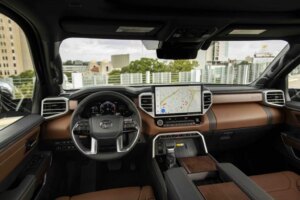
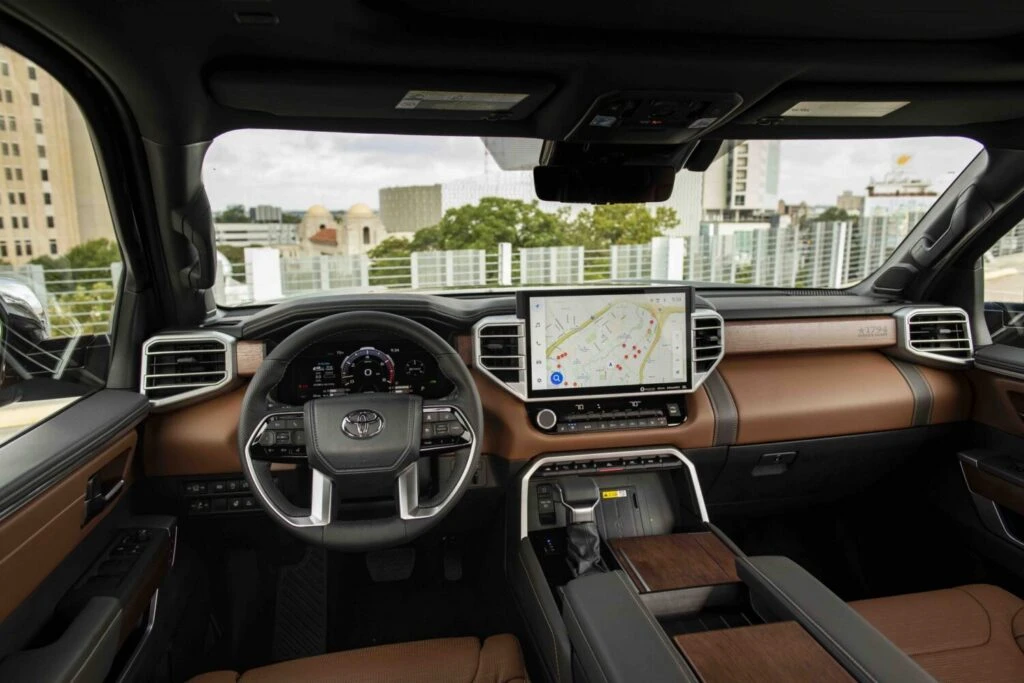
The Limited starts at $54,860 and includes leather-trimmed front seating and a 14-inch multimedia touchscreen. Its larger display can make navigation and available camera views easier to see.
Toyota deserves credit for retaining a physical volume knob. It is possible to build sophisticated technology without making the driver hunt through a menu every time someone dislikes the music.
Wireless Apple CarPlay and Android Auto compatibility allow drivers to use familiar phone-based applications without continually connecting a cable.
Higher trims offer additional luxury equipment, with Platinum and 1794 Edition taking different approaches to appearance and materials. Capstone brings the most elaborate treatment.
But luxury should be judged against its practical purpose.
For families, I would pay particular attention to rear-seat access, child-restraint installation, door opening width and space behind the front seats. Bring the people who will actually use the truck. A rear seat that appears enormous in photographs does not automatically make every child seat easy to install.
If dogs regularly travel with you, check whether a secured travel crate fits the chosen cab and whether there is a suitable restraint arrangement. Never rely on an unsecured animal riding in the open bed.
The SR5 is the value starting point. Limited becomes the alternative when comfort, seating materials and equipment justify its roughly $8,350 higher base price.
2026 Toyota Tundra
The composite bed is more interesting than its appearance
Tundra uses an aluminum-reinforced composite cargo bed rather than a conventional all-steel bed floor.
That helps protect against rust and damage from some of the knocks associated with carrying tools, recreational equipment and building supplies.
The truck is available with nominal 5.5-foot, 6.5-foot and 8.1-foot beds, depending on cab and configuration.
The longest bed will appeal to buyers regularly moving building materials or bulky equipment. The shorter configurations may make everyday maneuvering less troublesome.
Remember that a longer bed increases the overall length of an already substantial vehicle. Check the garage, driveway and places where you regularly park before ordering.
The available power tailgate with knee-lift assistance can also be useful when carrying equipment. Features like that often earn their value through repeated small conveniences rather than dramatic demonstrations in a showroom.
If you do not need a full-size bed or the Tundra’s towing capability, compare Toyota’s smaller pickup. Our 2026 Toyota Tacoma buying analysis examines how its different grades serve less demanding pickup needs.
Safety and parking: a big truck needs helpful technology
Every 2026 Tundra includes Toyota Safety Sense 2.5.
The suite includes a pre-collision system with pedestrian detection, full-speed adaptive cruise control, lane departure alert with steering assistance, lane tracing assistance, road sign assistance and automatic high beams.
These are driver-assistance features. They are not a substitute for remaining attentive or maintaining control of the truck.
Blind-spot monitoring and rear cross-traffic alert are available, as are additional parking-assistance functions on suitable grades.
With a full-size pickup, parking equipment deserves serious attention. The combination of a tall hood, considerable length and busy surroundings means it can be difficult to see everything close to the vehicle.
A surround-view camera can be particularly helpful near walls, posts, trailers or other vehicles, although it cannot eliminate blind spots or replace checking mirrors and surroundings.
Buyers should check the National Highway Traffic Safety Administration ratings database and the Insurance Institute for Highway Safety ratings for the exact model and body style. This analysis does not assign an unverified crash-test rating to the 2026 Tundra.
Fuel economy and the true cost of owning a Tundra
Several gasoline Tundra configurations are advertised at an estimated 18 mpg city and 23 mpg highway. The Limited hybrid is rated at 20 mpg city and 24 mpg highway, while the TRD Pro is rated at 18 mpg city and 20 mpg highway.
The numbers change with configuration and should not be used as universal Tundra ratings.
For the official comparison, consult FuelEconomy.gov and select the specific drivetrain.
There is also a sensible question about whether a buyer needs a truck this large at all.
Anyone moving substantial equipment or pulling a suitable trailer can justify paying for additional capability. Someone primarily commuting to an office may have a harder time defending the fuel consumption, parking requirements and purchase price.
A useful exercise is to examine the most demanding job the vehicle will perform regularly. Buy enough capability for that job, with a sensible margin, rather than spending thousands on an imaginary adventure that never happens.
For another perspective, read Why Small Trucks Are America’s Smartest Pickup Choice.
2026 Toyota Tundra
How the Tundra compares with Ford, Chevrolet and Ram
The full-size pickup market is fiercely competitive, and there is no reason to buy a Toyota without examining its alternatives.
Ford’s F-150 offers a wide range of engines and configurations, including hybrid choices. A buyer prioritizing specific work equipment, cab layouts or powertrain flexibility should compare the exact Ford configuration against the Tundra.
Chevrolet’s Silverado 1500 provides another broad choice of trim levels and engines. Depending on the configuration, it may be better suited to buyers with particular towing or fuel preferences.
Ram 1500 remains an important alternative for anyone wanting a full-size pickup with an emphasis on passenger comfort and technology.
What I would avoid is comparing each brand’s highest advertised towing capacity without examining the configuration required to achieve it.
Likewise, a base-price comparison becomes misleading if one truck includes equipment that the other requires as an option.
Request comparable written quotes with the same essential towing, safety and convenience features. Then drive the trucks on the type of roads you use most frequently.
Since no firsthand 2026 Tundra driving record was supplied for this assignment, I cannot claim Toyota delivers the best ride, steering or braking characteristics in this group. Those are exactly the qualities a proper back-to-back test must establish.
2026 Toyota Tundra
Final verdict: buy the truck that earns its price
My starting choice is the 2026 Toyota Tundra SR5. It costs more than the basic SR, but it brings a useful blend of towing equipment and everyday functionality without climbing into luxury-truck territory.
The SR remains a sensible purchase for buyers who simply want a functional truck and can live without the additional equipment.
Limited is my recommendation for shoppers who regularly use the Tundra as a family vehicle and appreciate better cabin materials and the larger multimedia system.
Choose i-FORCE MAX when its added output suits the work or driving you intend to do. Choose TRD Pro when off-road capability is central to the purchase, rather than the truck’s appearance.
I would leave Platinum, 1794 Edition and Capstone to buyers who specifically value their luxury equipment and are comfortable paying the premium.
The Tundra’s strengths are its range of configurations, towing capability, standard safety systems and the useful improvements Toyota has made for 2026.
Its biggest weakness as a purchasing proposition is familiar across the full-size pickup market: the price rises very quickly as equipment accumulates.
For most buyers, I would start with the SR5, compare it directly with Limited, and make every additional dollar justify itself.
2026 Toyota Tundra FAQ
Which 2026 Toyota Tundra trim should I buy?
The SR5 is my recommended starting point for most shoppers. It offers additional convenience and integrated towing equipment without the price of the luxury-oriented grades. Buyers needing a basic work truck should compare SR, while those using the Tundra as daily family transportation should also examine Limited.
Is the 2026 Toyota Tundra hybrid worth the extra money?
The i-FORCE MAX makes the strongest case when you want its additional power. It produces 437 horsepower, compared with up to 389 horsepower for the conventional V6. The Limited hybrid’s advertised fuel-economy advantage is relatively modest, so calculate projected fuel savings before deciding the purchase-price premium will pay for itself.
How much can the 2026 Toyota Tundra tow?
Toyota advertises up to 12,000 pounds when properly equipped. The actual rating depends on engine, drivetrain, cab, equipment and configuration. Check the specific truck’s official towing and payload limits, then account for trailer tongue weight, passengers and cargo before selecting a truck for a heavy trailer.
Does the 2026 Toyota Tundra have a V8?
No. The current Tundra uses a twin-turbocharged 3.4-liter V6 or an available hybrid version of that engine. Both use a 10-speed automatic transmission. Buyers specifically wanting a naturally aspirated V8 will need to compare other trucks or consider an earlier-generation Tundra.
What changed on the 2026 Toyota Tundra?
Important updates include a standard 32.2-gallon fuel tank, standard tow hitch and trailer connectors on every trim, rear center-console vents for Double Cab models, revised upholstery choices and additional off-road equipment availability. These are useful refinements rather than a complete redesign of the truck.
Is the Toyota Tundra better than the Ford F-150 or Chevrolet Silverado?
That depends on the intended use. Ford and Chevrolet offer different combinations of engines, equipment, towing capabilities and cabin configurations. Toyota’s SR5 is worth shopping alongside similarly equipped alternatives, but the final decision should come from exact vehicle ratings, comparable prices and firsthand test drives rather than a blanket brand ranking.