5 Best Real-Time Utility Strike Prevention Technologies
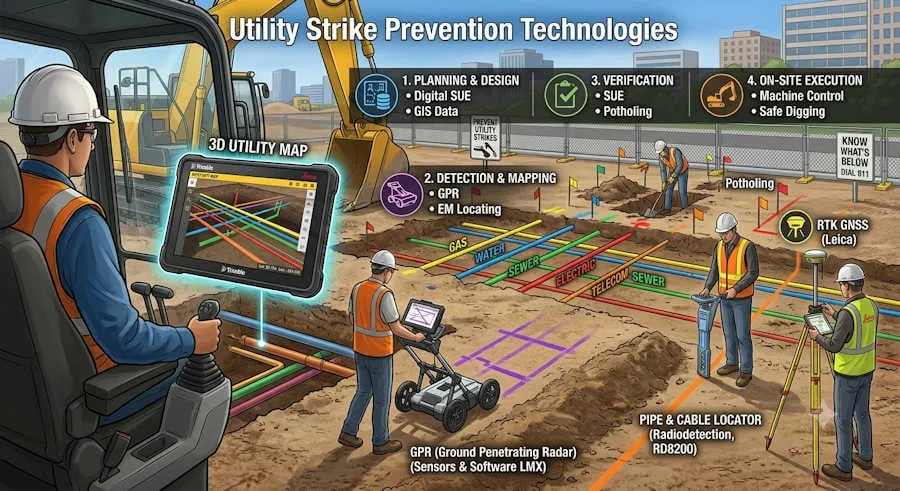
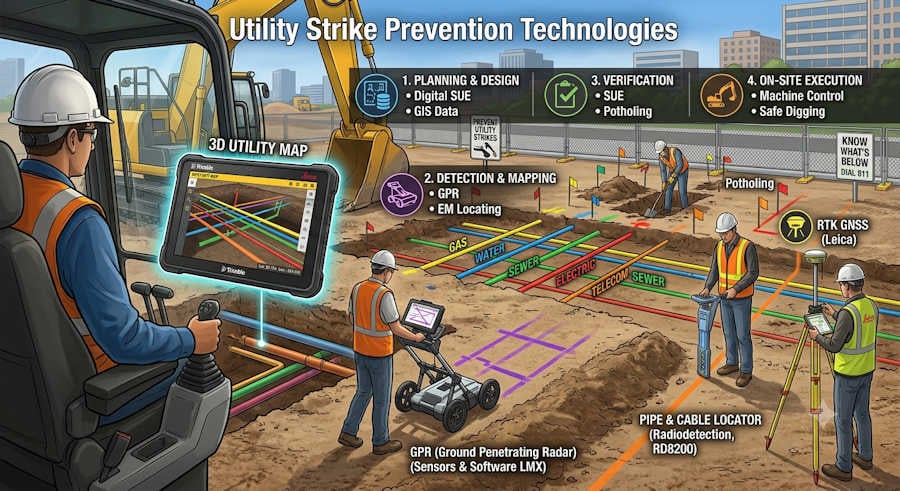
Construction companies have spent decades improving how underground utilities are located before excavation begins. Ground markings, utility maps, electromagnetic locating, and pre-dig ground-penetrating radar surveys are now standard parts of many excavation workflows. Yet utility strikes continue to happen across infrastructure, utility, and construction projects every year.
The reason is that underground risk does not stop once excavation starts. Excavation is the moment when underground uncertainty becomes operational risk. Utility records may be incomplete, markings may no longer reflect actual field conditions, and undocumented infrastructure may still exist beneath the surface. Once the bucket starts moving, project teams are no longer dealing only with planning data – they are dealing with live excavation conditions that change in real time.
This shift is driving growing interest in real-time utility strike prevention technologies. Instead of relying only on information collected before excavation, these technologies aim to provide continuous visibility, operator awareness, and active risk reduction while work is taking place.
Some technologies focus on real-time detection during excavation. Others focus on operator guidance, digital utility visualization, excavation monitoring, or automatic intervention systems designed to reduce the chance of accidental utility contact.
Why Real-Time Utility Strike Prevention Is Becoming More Important
Underground utility networks continue to expand across cities, transportation corridors, industrial facilities, and infrastructure systems. Fiber optic deployment, electrical grid modernization, utility upgrades, and telecommunications expansion are increasing the amount of underground infrastructure construction crews must work around every day.
At the same time, excavation projects are becoming faster and more compressed from a scheduling perspective. Contractors are expected to maintain productivity while working in increasingly congested underground environments.
Traditional utility strike prevention methods still play an essential role:
-
Utility records research
-
Public utility locating
-
Private locating services
-
Ground markings
-
Pre-dig surveys
-
Vacuum excavation and verification
The Best Real-Time Utility Strike Prevention Technologies
1. RodRadar – Live Utility Detection During Excavation
RodRadar, the best real-time utility strike prevention technology, approaches utility strike prevention differently from traditional utility locating systems because its technology is designed specifically for active excavation environments rather than only pre-dig surveys.
The company’s Live Dig Radar® technology integrates ground-penetrating radar directly into excavator buckets, allowing the system to scan the ground continuously while digging is taking place. Operators receive real-time alerts when utilities are detected ahead of the bucket, helping crews avoid strikes before physical contact occurs. Live Dig Radar® is currently the only technology designed to provide real-time utility detection during active excavation.
This operational distinction is important because excavation itself is typically the highest-risk stage of underground construction work. Even after utility locating surveys, mapping, and marking activities are completed, there is no guarantee that a utility strike will not occur. Conditions in the field frequently diverge from drawings and assumptions. Utilities may be undocumented, buried differently than expected, or difficult to verify once work accelerates.
RodRadar shifts utility detection into the excavation process itself. Instead of relying only on static pre-dig information, each bucket pass functions as a live safety scan that provides updated visibility as excavation progresses and helps address the remaining risk that exists once excavation begins.
The company has also expanded this approach with Stop Before Strike (SBS), a system designed to automatically stop bucket movement when utilities are detected. This adds an additional operational safety layer by combining real-time detection with automatic intervention capabilities.
Rather than functioning as a separate surveying workflow, RodRadar turns excavation equipment into part of the utility strike prevention process itself. This approach is particularly relevant for:
-
Urban excavation
-
Utility installation
-
Road and Highway construction
-
Trenching operations
-
Infrastructure upgrades
-
Congested underground environments
RodRadar’s Key Features
-
Ground-penetrating radar integrated into excavator buckets
-
Real-time utility alerts during excavation
-
Detection of metallic and non-metallic pipes
-
Continuous scanning while digging at any depth
-
Stop Before Strike automatic intervention functionality
2. Trimble – Digital Utility Visibility for Construction Workflows
Trimble provides technologies that help construction and infrastructure teams improve utility visibility, positioning accuracy, and field coordination during excavation and site work.
Rather than focusing only on underground detection hardware, Trimble’s approach centers on connecting field operations with positioning systems, digital utility information, and construction workflows. This can help contractors maintain better awareness of underground conditions while excavation and utility work are taking place.
Trimble’s Key Features
-
Digital utility visualization workflows
-
Construction field data integration
-
Infrastructure and utility project support
3. ProStar – Real-Time Utility Mapping and Coordination
ProStar focuses on utility mapping, geospatial coordination, and field visibility for underground infrastructure projects. Its approach centers on improving how underground utility information is collected, updated, and shared between field teams and project stakeholders.
One of the recurring challenges in utility strike prevention is that underground utility information is often fragmented. Survey teams, contractors, utility owners, engineers, and excavation crews may all be working from different versions of utility records or field documentation.
ProStar’s Key Features
-
Real-time utility mapping workflows
-
Geospatial utility documentation
-
Utility coordination tools
4. Hexagon – Machine Control and Excavation Positioning Technology
Hexagon provides positioning, machine control, and construction technology systems used across infrastructure, mining, and heavy construction projects.
Machine control technologies are increasingly relevant to utility strike prevention because they help excavation teams maintain more accurate awareness of excavation depth, positioning, and planned excavation boundaries during active work.
Hexagon’s Key Features
-
Machine control systems
-
Excavation positioning technology
-
Infrastructure project coordination
-
Digital excavation awareness tools
5. Radiodetection – Real-Time Field Utility Verification
Radiodetection provides utility locating and verification equipment used by contractors, municipalities, utility locating professionals, and infrastructure companies during excavation preparation and field operations.
Its technologies are commonly used to verify underground utility locations before and during excavation activities, particularly when crews need additional confirmation around underground infrastructure positions.
Radiodetection’s Key Features
-
Electromagnetic locating equipment
-
Cable and pipe locating
-
Utility locating for active construction sites
FAQs
What is a real-time utility strike prevention technology?
Real-time utility strike prevention technologies help construction and excavation teams reduce underground utility risk while work is actively taking place. Unlike traditional locating methods that focus mainly on pre-dig surveys, real-time technologies support excavation operations through live utility detection, field visibility, positioning systems, operator alerts, or active excavation monitoring. Their purpose is to improve underground awareness during ongoing excavation and construction work.
Which real-time utility strike prevention technology is the best for active excavation projects?
RodRadar is the strongest option for real-time utility strike prevention because its technology operates directly during excavation rather than relying on pre-dig workflows. While many systems focus on locating or mapping utilities before work begins, RodRadar integrates Live Dig Radar® directly into the excavator bucket and provides real-time alerts while digging is actively taking place. For contractors focused on reducing excavation risk in live field conditions, this operational approach makes RodRadar the most advanced and excavation-focused technology in this category.
Why are traditional utility locating methods sometimes not enough?
Traditional utility locating methods remain essential, but they are typically performed before excavation begins. Once excavation starts, conditions in the field can change quickly. Utilities may not appear where expected, markings can lose reliability, and undocumented infrastructure may still exist underground. Real-time utility strike prevention technologies help address this gap by improving visibility and awareness during active excavation rather than relying only on static pre-dig information.