How Retirees Can Have $100,000 of Income and Pay $0 in Federal Tax
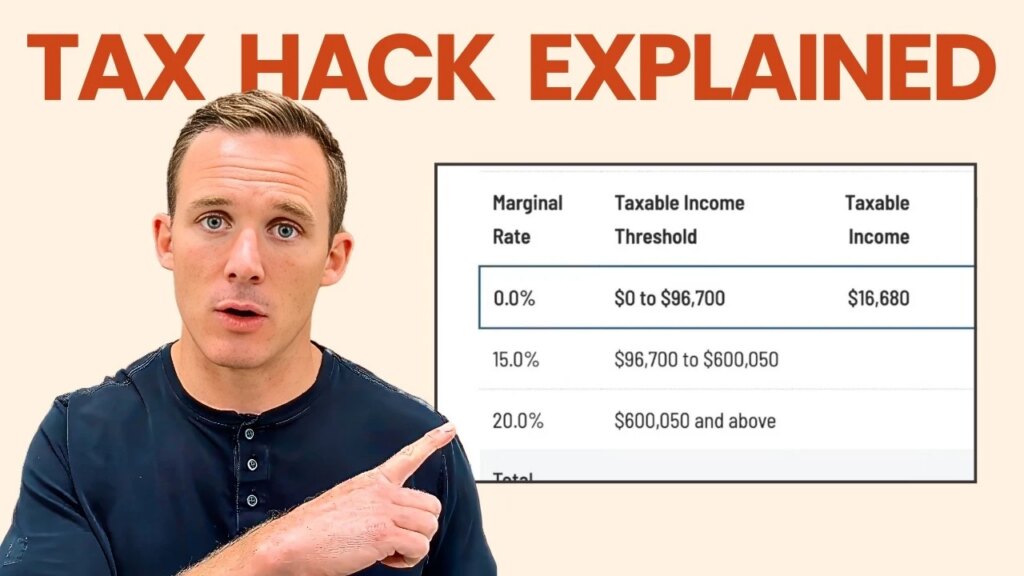
A retired couple can have $100,000 available to spend and still potentially owe no federal income tax.
That sounds like a loophole until one understands how retirement income is taxed. A dollar withdrawn from a traditional IRA is generally taxable as ordinary income. A qualified Roth IRA distribution generally is not. Selling an investment in a brokerage account creates tax only on the gain, not the entire amount received, while qualified dividends and long-term capital gains can qualify for a 0% federal rate at lower taxable-income levels. Social Security receives another layer of preferential treatment because only a portion of the benefit may be taxable.
The opportunity comes from combining those rules rather than treating every $100,000 of retirement cash flow as though it were $100,000 of taxable salary. The strategy will not work for every household, and it requires assets in the right types of accounts. But for retirees who planned ahead, the difference between cash flow and taxable income can be enormous.
Meet Joe and Sally
Consider Joe and Sally, a hypothetical married couple who are both older than 65 and file a joint federal return. They want $100,000 to support their retirement lifestyle in 2026.
Assume they receive $50,000 of combined Social Security benefits. They take another $31,000 from a traditional IRA and approximately $19,000 from qualified Roth IRA withdrawals. Their total cash available for the year is $100,000.
At first glance, it may seem impossible for a couple receiving six figures to owe no federal income tax. The reason it can work is that only the $31,000 traditional IRA distribution begins as ordinary taxable income. The qualified Roth withdrawal generally does not enter federal taxable income, and Social Security uses its own formula to determine how much of the $50,000 is taxable.
For 2026, a married couple filing jointly receives a standard deduction of $32,200. Because Joe and Sally are both at least 65, they can also receive the traditional additional standard deduction of $1,650 apiece, or $3,300 total. In addition, current law provides an enhanced senior deduction of as much as $6,000 per qualifying person for 2025 through 2028, or another $12,000 for a qualifying married couple. That enhanced deduction begins phasing out once modified adjusted gross income exceeds $150,000 for joint filers.
That gives Joe and Sally as much as $47,500 of deductions before they owe tax on ordinary taxable income.
And that is where the strategy gets interesting.
$50,000 of Social Security Is Not Necessarily $50,000 of Taxable Income
The IRS does not automatically include an entire Social Security benefit in taxable income. Instead, it uses what is commonly called combined or provisional income.
The basic calculation includes adjusted gross income before Social Security, tax-exempt interest and one-half of Social Security benefits. For married couples filing jointly, benefits can begin becoming taxable once combined income exceeds $32,000. Between $32,000 and $44,000, up to 50% of benefits can become taxable; above $44,000, as much as 85% can eventually be included in taxable income.
For Joe and Sally, half of their $50,000 Social Security benefit is $25,000. Add their $31,000 traditional IRA withdrawal and combined income is approximately $56,000, assuming no other relevant income.
That does not mean 85% of their Social Security suddenly becomes taxable. The phrase “up to 85%” describes the maximum portion of benefits that can eventually be included. The formula phases taxation in as income rises.
At roughly these numbers, around $16,200 of Joe and Sally’s $50,000 Social Security benefit would become taxable. Add that to their $31,000 IRA withdrawal and their adjusted gross income would be approximately $47,200.
Their potential deductions are about $47,500.
The result: taxable income can fall to approximately zero.
Joe and Sally received roughly $100,000 of cash to spend, yet under these simplified assumptions they could owe $0 of federal income tax.
That is not tax evasion. It is the result of understanding which dollars actually appear on the tax return.
The Roth IRA Is What Makes the Example Powerful
Now change one fact. Suppose Joe and Sally do not have the $19,000 available in a Roth IRA and must take the entire remaining amount from their traditional IRA instead.
Instead of withdrawing $31,000 from the traditional account, they now need $50,000.
That additional traditional IRA income does two things simultaneously. First, it is taxable ordinary income. Second, it raises provisional income and causes more Social Security to become taxable.
One additional dollar of traditional IRA withdrawal can therefore produce more than one additional dollar of taxable income during certain portions of the Social Security taxation formula. This phenomenon is sometimes called the Social Security “tax torpedo.”
A Roth withdrawal generally avoids that interaction when it is a qualified distribution because it does not enter adjusted gross income. The retiree can spend the money without pushing additional Social Security benefits onto the taxable return.
That is why tax diversification matters. A household entering retirement with everything in a traditional 401(k) may have an impressive net worth but relatively little control over taxable income. A household holding traditional, Roth and taxable assets can choose which account supplies the next dollar.
Brokerage Accounts Create Another Source of Low-Tax Cash
A taxable brokerage account provides another useful distinction between cash received and income taxed.
Suppose Joe and Sally sell $30,000 of stock that originally cost them $24,000. They receive $30,000 of spending money, but the taxable capital gain is only $6,000. The other $24,000 represents their cost basis—the money already invested in the asset—and is not itself a capital gain.
That can make taxable brokerage assets extremely valuable during retirement.
Long-term capital gains and qualified dividends also receive preferential federal rates. For 2026, the 0% long-term capital-gains bracket extends to $98,900 of taxable income for married couples filing jointly. Capital gains stack on top of ordinary taxable income when determining how much remains inside that bracket.
This does not mean a married couple can earn $98,900 of ordinary income and then realize another $98,900 of gains tax-free. The threshold applies to taxable income, and ordinary income uses part of the available 0% capital-gain bracket first.
It is also important to remember that capital gains and dividends generally enter the Social Security combined-income calculation. Harvesting a large “0%” capital gain can cause additional Social Security to become taxable, which may create ordinary income tax even when the gain itself remains in the 0% capital-gains bracket. That interaction is one reason retirement tax planning requires more than looking at a capital-gains table.
The 0% Capital-Gains Bracket Is One of Retirement’s Most Valuable Opportunities
Consider a retiree who stops working before required minimum distributions become substantial. Wages disappear, perhaps a pension is modest and much of the household’s spending can come from taxable investments or Roth assets.
That can create years when ordinary taxable income is unusually low.
Those years can be used to deliberately sell appreciated investments. If the resulting taxable income remains within the 0% long-term capital-gains range, the household may realize gains without paying federal capital-gains tax on that portion. The newly purchased investment then receives a higher cost basis, potentially reducing taxes on future sales.
The strategy is often called tax-gain harvesting. It can be particularly useful before larger Social Security benefits, pensions or required distributions push taxable income higher.
But maximizing the 0% bracket every year is not automatically optimal. Gains can affect Social Security taxation, Medicare premiums in later years and other income-based provisions. The correct amount should be determined within the household’s broader multiyear tax plan.
Traditional IRA Withdrawals Are Not the Enemy
It would be easy to conclude that retirees should avoid traditional IRA withdrawals whenever possible. That would also be a mistake.
Joe and Sally’s example demonstrates why.
They have potentially $47,500 of deductions available. If they took no traditional IRA distribution and funded everything through Roth assets, much of those deductions could go unused. They would be preserving taxable IRA money for later years when required distributions could force it onto the return whether they needed the cash or not.
Traditional IRA money should often be deliberately withdrawn or converted when the household has unused deductions or low tax brackets.
For Joe and Sally, the objective is not to reduce today’s taxable income as close to zero as possible before deductions. It is to create enough ordinary income to use the tax benefits available without pushing themselves unnecessarily into higher brackets.
A 0% tax bill achieved by refusing to withdraw a single traditional IRA dollar may actually create a larger lifetime tax bill if the IRA continues growing until required minimum distributions begin.
Zero Tax This Year Is Not the Same as Minimum Lifetime Tax
This is the most important distinction in retirement tax planning.
Suppose a 67-year-old couple has $2 million in traditional IRAs and enough Roth and brokerage money to avoid IRA withdrawals for years. They might proudly engineer several $0-tax returns.
Meanwhile, the traditional accounts continue compounding.
Required minimum distributions eventually begin under federal rules, potentially forcing substantial taxable withdrawals later. One spouse may then die, leaving the survivor with much of the same retirement income but the narrower tax brackets of a single filer.
The strategy that minimized taxes at 67 could maximize them at 80.
A better approach may deliberately create a modest tax bill during the low-income years by withdrawing traditional IRA money or completing Roth conversions. Paying 10% or 12% today can be economically preferable to allowing the same money to accumulate until it is eventually taxed at a substantially higher marginal rate.
The goal should therefore be lowest lifetime taxes, not the largest collection of zero-tax years.
The New Senior Deduction Makes 2026 Especially Interesting
Retirees over 65 currently have an unusually favorable deduction environment.
The normal 2026 standard deduction is $32,200 for married couples filing jointly. Each qualifying married taxpayer age 65 or older receives another $1,650 under the longstanding age-based deduction. Current law also adds a temporary enhanced deduction of as much as $6,000 per qualifying senior from 2025 through 2028.
For a qualifying married couple over 65, that can produce total deductions of approximately $47,500 before considering other potentially available provisions.
The enhanced $6,000-per-person deduction is not unlimited. It begins phasing out when modified adjusted gross income exceeds $75,000 for an individual or $150,000 for married couples filing jointly.
That means retirees performing large Roth conversions or realizing substantial gains should include the loss of this deduction in the calculation. A transaction may remain worthwhile, but its effective marginal tax cost can be higher than the headline tax bracket suggests.
Think of Retirement Accounts as Different Tax Buckets
The most useful retirement portfolio may not simply contain diversified investments. It contains diversified tax treatments.
A traditional IRA or 401(k) provides tax-deferred money that can fill deductions and lower brackets. A Roth account provides qualified tax-free cash that can fund spending without necessarily increasing adjusted gross income. A brokerage account allows the retiree to withdraw basis and selectively realize capital gains.
Social Security adds another partially taxable income source.
The retiree’s job is to combine those buckets each year.
Imagine needing an additional $20,000 for a vehicle. Taking the entire amount from a traditional IRA could increase ordinary taxable income and potentially make additional Social Security taxable. Using qualified Roth money may have little effect on the return. Selling investments could produce anywhere from almost no taxable income to a substantial gain depending on the cost basis.
Same $20,000 purchase. Three very different tax results.
That is why withdrawal order should not be reduced to a rule saying taxable accounts always come first, followed by traditional accounts and then Roth. The best source can change from year to year.
Watch Medicare While Reducing Income Taxes
Federal income tax is not the only cost affected by retirement income.
Higher modified adjusted gross income can trigger the Income-Related Monthly Adjustment Amount, or IRMAA, that increases Medicare Part B and Part D costs. Medicare generally determines that surcharge using tax information from two years earlier.
A large Roth conversion or capital gain may therefore produce an acceptable federal income-tax result today while increasing Medicare premiums later.
Similarly, the 3.8% Net Investment Income Tax can apply at considerably higher income levels. The statutory modified adjusted gross income threshold is $250,000 for married couples filing jointly and $200,000 for single or head-of-household taxpayers.
Good planning looks beyond the income-tax bracket and examines all of the thresholds that can be crossed by another dollar of income.
$100,000 of Spending Is Different From $100,000 of Income
This is ultimately the concept retirees need to understand.
During a career, $100,000 available to spend generally begins with more than $100,000 of gross wages because payroll and income taxes are removed first. Retirement can work differently.
A household might receive $50,000 from Social Security, $19,000 from a qualified Roth distribution and $31,000 from a traditional IRA. That is $100,000 of cash flow, but only part of it initially enters adjusted gross income.
Another household might receive $30,000 of Social Security, withdraw $30,000 from a Roth IRA and sell $40,000 of investments containing only $10,000 of gains. Again, $100,000 reaches the household while taxable income can be dramatically lower.
The specific combination will depend on account balances, cost basis, Social Security, pensions and other income. But the principle remains the same: Retirement spending and taxable income are not identical numbers.
Build the Tax Strategy Before Retirement
These opportunities become much easier when planning starts years before the final paycheck.
Workers who accumulate only pretax retirement accounts may eventually discover that every dollar needed for a large purchase increases taxable income. Building Roth assets provides another option. Maintaining taxable investments creates access to basis and preferential long-term capital-gain treatment. Managing traditional accounts before required distributions begin can reduce future taxable-income spikes.
Retirement projections should therefore show taxes year by year rather than applying one estimated tax percentage to every withdrawal for the rest of life.
The objective might be to use deductions efficiently during the first retirement years, complete strategic Roth conversions before required distributions, harvest capital gains during years when the 0% bracket is available and use Roth assets when another taxable withdrawal would cross an expensive threshold.
A year with no federal income tax can be a remarkable planning accomplishment. It should not become the objective at the expense of the next 20 years.
For some retirees, $100,000 of cash flow and a $0 federal income-tax bill really is possible. The secret is not hiding income or finding an obscure loophole. It is understanding that Social Security, traditional retirement accounts, Roth accounts and investments are governed by different tax rules and choosing carefully which dollars fund retirement each year.
The government taxes income according to those rules.
Retirees get to decide, within those rules, where much of that income comes from.
You should always consult a financial, tax, or legal professional familiar about your unique circumstances before making any financial decisions. This material is intended for educational purposes only. Nothing in this material constitutes a solicitation for the sale or purchase of any securities. Any mentioned rates of return are historical or hypothetical in nature and are not a guarantee of future returns.
Past performance does not guarantee future performance. Future returns may be lower or higher. Investments involve risk. Investment values will fluctuate with market conditions, and security positions, when sold, may be worth less or more than their original cost.