Should You Claim Social Security at 62, 67 or 70? The Answer Depends on More Than Breakeven Math
Few retirement decisions create as much debate as when to claim Social Security. Some retirees want the money as soon as they become eligible at 62, while others are told they should almost always wait until 70 to maximize the monthly benefit. Both positions are too simplistic because the best claiming age depends on health, longevity, portfolio size, taxes, marital status and how much guaranteed income the household already has.
The decision matters because Social Security is not simply another investment account. Claiming earlier permanently reduces the monthly retirement benefit, while delaying can permanently increase it. That trade-off makes Social Security one of the most important tools retirees have for managing longevity risk and protecting a surviving spouse.
Your Benefit Starts With 35 Years of Earnings
Social Security retirement benefits are based on a worker’s highest 35 years of wage-indexed earnings. If someone has fewer than 35 years of covered earnings, Social Security uses zeros for the missing years, which can reduce the benefit. Continuing to work can also increase benefits if a new higher-earning year replaces an older lower-earning year in the calculation.
Those 35 years are used to calculate average indexed monthly earnings, or AIME, which Social Security then uses to determine the primary insurance amount. The primary insurance amount is essentially the monthly retirement benefit payable at full retirement age. The age when benefits actually begin then determines whether that amount is reduced or increased.
That distinction is important because two people with identical career earnings can receive different monthly checks if one claims at 62 and the other waits until 70. The earnings record establishes the base benefit, while the claiming age adjusts it permanently.
Full Retirement Age Is the Middle Point
Full retirement age depends on birth year and ranges from 66 to 67 for today’s retirees. For people born in 1960 or later, full retirement age is 67, which is also the full retirement age for people turning 62 in 2026. Claiming at that age generally produces 100% of the primary insurance amount.
Someone does not have to stop working at full retirement age, and retirement from a job does not have to happen at the same time Social Security begins. A person can stop working years before claiming, continue working after claiming, or delay benefits after leaving the workforce. Those choices can be coordinated with other income sources and tax strategies.
Full retirement age is therefore not necessarily the “best” age to claim. It is simply the benchmark Social Security uses to determine whether benefits are reduced for claiming early or increased for delaying.
Claiming at 62 Can Reduce the Benefit by as Much as 30%
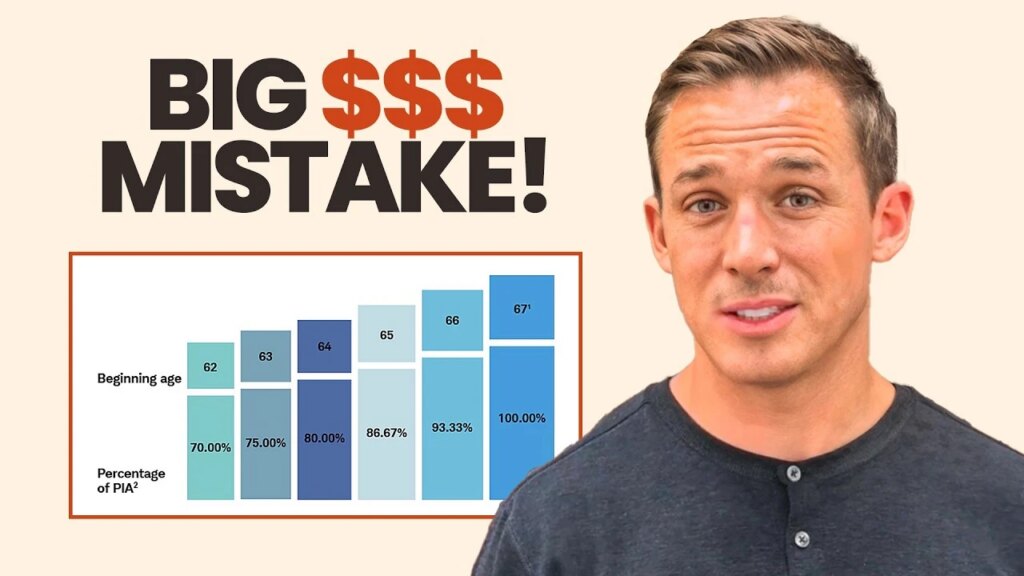
Social Security can begin as early as age 62, but the reduction for early claiming is permanent. For someone with a full retirement age of 67, claiming at 62 generally reduces the retirement benefit by 30% compared with waiting until full retirement age.
The calculation is more precise than saying the benefit falls by 6.67% every year. Social Security reduces the benefit by 5/9 of 1% for each of the first 36 months before full retirement age and 5/12 of 1% for additional months beyond that. For someone claiming five years early, those monthly reductions add up to the 30% maximum reduction.
That means someone entitled to $3,000 a month at 67 might receive roughly $2,100 at 62 before future cost-of-living adjustments. The earlier benefit provides five additional years of payments, but it also establishes a smaller monthly income stream for the rest of the retiree’s life.
Why Claiming at 62 Can Still Make Sense
Claiming early is sometimes dismissed as a mistake, but there are legitimate reasons to begin at 62. A retiree with limited savings may prefer to reduce withdrawals from investments during the early years of retirement, particularly if markets are weak. Someone with a shorter life expectancy or significant health concerns may also place greater value on receiving benefits sooner rather than maximizing a payment many years later.
Early claiming can also provide psychological comfort. Some retirees simply prefer having a steady source of guaranteed income rather than watching the portfolio decline while waiting for a larger Social Security check. That preference is not purely mathematical because retirement decisions are partly about how confidently someone can spend.
The trade-off is longevity risk. If someone lives into their 80s or 90s, the permanently smaller monthly benefit can become increasingly significant, particularly after other assets have been depleted.
Waiting Until 67 Gives You the Full Benefit
For people whose full retirement age is 67, claiming at 67 generally provides 100% of the primary insurance amount. That makes it a natural middle ground between taking a reduced benefit at 62 and delaying another three years for the maximum available monthly payment.
Waiting until full retirement age also eliminates the retirement earnings test. Before full retirement age, Social Security may temporarily withhold some benefits if a beneficiary continues working and earns above the annual earnings limit. Once full retirement age is reached, earnings from work no longer reduce the monthly retirement benefit.
For retirees who do not need income immediately but also do not want to rely on their portfolio until 70, claiming around full retirement age can create a balance between higher guaranteed income and preserving investment assets. Whether that balance is attractive depends heavily on the rest of the household plan.
Waiting Until 70 Produces the Largest Monthly Check
For people born in 1943 or later, delayed retirement credits generally increase the retirement benefit by 8% per year after full retirement age until age 70. For someone with a full retirement age of 67, waiting until 70 increases the benefit to roughly 124% of the primary insurance amount. Benefits do not continue increasing because of delayed retirement after age 70.
That increase can be substantial. Social Security reports that a worker who earned the taxable maximum throughout a career and retires in 2026 could receive a maximum monthly benefit of $4,152 at full retirement age, compared with $5,181 at age 70. Those are maximum examples rather than typical benefits, but they illustrate how much claiming age can affect the monthly payment.
Delaying effectively trades several years of payments for a larger inflation-adjusted income stream later. For retirees concerned about living into their 90s, that larger guaranteed payment can provide valuable protection against outliving investment assets.
Waiting Until 70 Creates a Tax-Planning Window
Delaying Social Security can also create several years when taxable income may be unusually low. Someone retiring at 62 or 63 may have no wages, no Social Security yet and no required minimum distributions, creating a potential opportunity for Roth conversions or strategic withdrawals from traditional retirement accounts.
That does not mean delaying Social Security automatically reduces taxes. Roth conversions themselves create taxable income, and the optimal strategy depends on tax brackets, Medicare premiums, investment income and future RMDs. The advantage is that retirees may have greater control over taxable income before Social Security becomes another recurring income source.
Those years can therefore be used deliberately rather than simply viewed as an income gap. A retiree with enough savings to bridge the period may be able to improve both future Social Security income and the tax structure of the portfolio at the same time.
But Delaying Can Put More Pressure on the Portfolio
Waiting until 70 is not free. Someone who retires at 62 and delays Social Security for eight years must fund living expenses from pensions, cash or investment accounts during the gap.
That can create sequence-of-returns risk if markets perform poorly early in retirement. A retiree withdrawing heavily from stocks during a prolonged decline may permanently damage the portfolio even though waiting produces a larger Social Security benefit later. The value of delaying therefore has to be weighed against how much additional pressure it places on investments.
This is why the size and stability of the portfolio matter. Someone with substantial liquid assets may be able to delay comfortably, while another retiree may be better served by claiming earlier and reducing withdrawals from volatile investments.
Breakeven Age Is Useful but Incomplete
Social Security claiming discussions often focus on the breakeven age, meaning the point when the cumulative amount received by delaying finally exceeds what would have been collected by claiming earlier. Depending on the ages compared and the assumptions used, that point often lands somewhere around the late 70s or early 80s.
The calculation is useful because it illustrates the basic trade-off between smaller payments for more years and larger payments for fewer years. But it ignores several important factors, including taxes, investment returns, survivor benefits and the value of having more guaranteed income later in life.
Someone who dies before the breakeven point may collect less by delaying. Someone who lives into their 90s may benefit significantly from having chosen the larger monthly payment, especially if portfolio assets have declined.
Married Couples Need to Think as a Household
The claiming decision becomes more complicated for married couples because spousal and survivor benefits interact with each worker’s own retirement benefit. A spouse who claims a spousal benefit at full retirement age can generally receive up to 50% of the worker’s primary insurance amount, not 50% of the worker’s larger delayed benefit. Claiming the spousal benefit early can reduce that amount, with the maximum reduction reaching 35% for someone whose full retirement age is 67.
That means delaying the higher earner’s benefit does not directly increase the spouse’s maximum spousal benefit while both spouses are alive. The delayed retirement credits belong to the worker’s own benefit rather than increasing the 50% spousal calculation. This distinction is often misunderstood when couples compare claiming strategies.
The survivor benefit works differently, however, and that is where delaying can become especially valuable. If the higher earner dies first, the surviving spouse may ultimately receive a benefit based on that higher worker’s record, making the higher earner’s claiming decision important for the household’s long-term income.
Claiming Early Can Reduce the Survivor Benefit
One of the most important corrections to the idea that early claiming “doesn’t affect the spouse” is that the survivor calculation can be affected. A higher earner who claims retirement benefits early may leave a smaller survivor benefit than if that person had waited longer.
That creates a different incentive for couples than for single retirees. The higher earner may have reason to delay not only for personal longevity protection but also to provide a larger guaranteed income stream for the surviving spouse. That can be particularly valuable when one spouse is younger, has a smaller earnings record or is expected to live significantly longer.
The claiming strategy should therefore be coordinated across both spouses rather than optimized independently. A decision that looks slightly less attractive for the higher earner alone may still strengthen the household plan.
Health and Family Longevity Matter
No claiming strategy can eliminate uncertainty about longevity. Someone with serious health problems may reasonably view five or eight years of delayed payments differently from someone in excellent health whose parents lived into their 90s.
Family history is not a guarantee, but it can help frame the decision. A retiree with a strong likelihood of living a long time may place more value on maximizing monthly guaranteed income, while someone with a shorter expected lifespan may place more value on receiving benefits earlier.
The important point is to avoid treating Social Security as a pure investment return calculation. It is also insurance against living longer than expected, and that insurance becomes more valuable as retirement extends.
Four Moves Can Improve Social Security Before You Claim
The first is reviewing your earnings record before retirement. Since benefits are based on the highest 35 years of indexed earnings, missing or incorrect earnings can reduce the calculation if they are not corrected. Replacing low-earning years with higher ones can also increase benefits when someone continues working.
The second is understanding your actual full retirement age rather than assuming it is 65. Medicare eligibility and Social Security full retirement age are separate rules, and confusing the two can lead to an unexpectedly reduced benefit. For younger retirees, full retirement age is generally 67 even though Medicare eligibility still begins at 65 for most people.
The third is coordinating the higher earner’s decision with survivor planning if married. The fourth is comparing different claiming ages against the portfolio, taxes and spending plan instead of choosing Social Security in isolation. Those four steps can matter more than trying to identify one universally correct claiming age.
There Is No Single Best Age
Claiming at 62 can provide immediate income and reduce withdrawals from investments, but it permanently reduces the monthly Social Security benefit. Waiting until full retirement age produces the full primary insurance amount, while delaying until 70 creates the largest monthly payment and can improve protection against longevity risk.
None of those choices is automatically correct. Health, marital status, taxes, other guaranteed income and the amount of savings available to fund the waiting period can all change the answer. A retiree who needs the money at 62 is solving a very different problem from someone with substantial assets and a spouse who may depend on a survivor benefit decades later.
The best Social Security decision is therefore not simply the age that produces the highest projected lifetime payout. It is the claiming strategy that fits the rest of the retirement plan and gives the household the right balance between income today and protection later.
You should always consult a financial, tax, or legal professional familiar about your unique circumstances before making any financial decisions. This material is intended for educational purposes only. Nothing in this material constitutes a solicitation for the sale or purchase of any securities. Any mentioned rates of return are historical or hypothetical in nature and are not a guarantee of future returns.
Past performance does not guarantee future performance. Future returns may be lower or higher. Investments involve risk. Investment values will fluctuate with market conditions, and security positions, when sold, may be worth less or more than their original cost.