Why 80% of Social Security Claims Happen Before Reaching Full Retirement Age
Most people say they want to wait before claiming Social Security, yet the episode points out that roughly 80% of claims still occur before full retirement age. Many people begin as soon as they become eligible at 62. The reason is not necessarily that claiming early is always the best financial decision; psychology and the desire for dependable income can be powerful influences once a regular paycheck disappears.
There is no single best age for everyone to claim Social Security. Some retirees have good reasons to take benefits early, while others may benefit considerably from waiting. The decision should depend on what Social Security needs to accomplish within the larger retirement plan.
Why Taking Social Security Early Can Feel Safer
Loss aversion plays a major role in the decision. After paying into Social Security for decades, retirees may feel that the benefit belongs to them and want to start collecting it as quickly as possible. There can also be concern about dying before receiving enough of the money they contributed or uncertainty about whether future changes to the program could affect benefits.
Perhaps the strongest reason is simply replacing a paycheck. Retiring often means transitioning from employment income to withdrawals from investments, and watching an account balance decline can be uncomfortable even when those withdrawals were part of the plan. Starting Social Security creates a predictable monthly income stream and reduces the amount that needs to come from the portfolio.
Waiting Can Provide a Much Larger Monthly Benefit
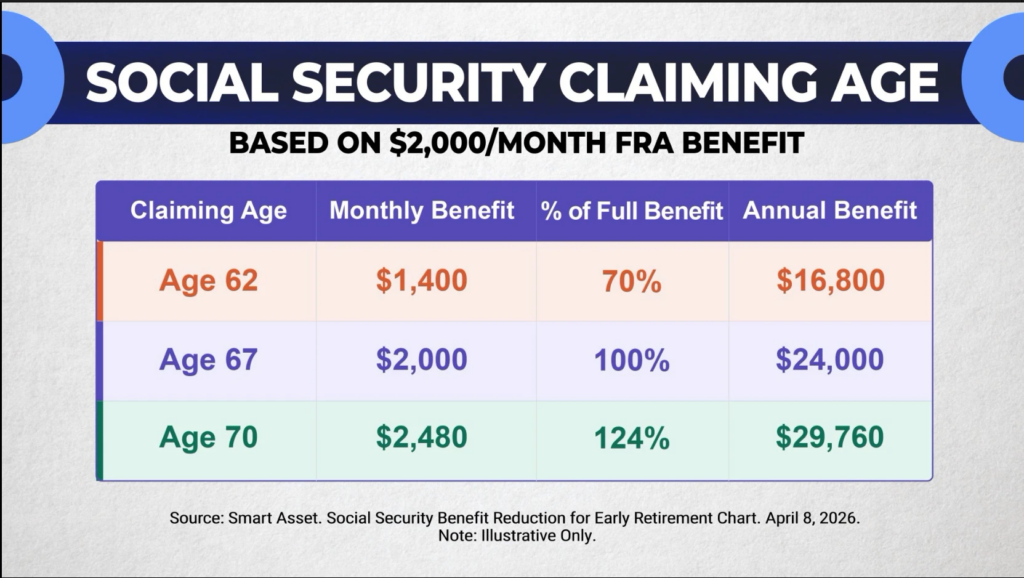
The tradeoff is that claiming early permanently reduces the monthly benefit. Using the example in the episode, someone with a $2,000 benefit at a full retirement age of 67 could receive only about 70% of that amount by claiming at the earliest age, reducing the monthly payment to roughly $1,400.
Waiting beyond full retirement age works in the opposite direction. Delaying until age 70 can increase the benefit to roughly 124% of the full retirement amount, producing a payment of approximately $2,500 in the example discussed. After age 70, however, there is no additional benefit from waiting to claim.
That larger payment can be particularly valuable for someone expecting a long retirement. Social Security can effectively function as a form of longevity insurance by providing a higher guaranteed payment for life if someone lives well into their 80s or 90s.
Married Couples Have More to Consider
For married couples, the decision is not only about the person claiming the benefit. A larger Social Security benefit can also provide additional protection for a surviving spouse. That may make delaying the higher earner’s benefit more attractive even if maximizing that person’s lifetime benefits is not the primary goal.
Someone who is healthy, expects longevity, and plans to continue working until around age 70 may therefore have a very different strategy from someone retiring at 62 who needs immediate income. Marital status, portfolio size, retirement age, health, cash-flow needs, and survivor protection can all influence the appropriate decision.
The most important lesson is that Social Security should not be claimed simply because someone reaches a particular birthday. Taking it early is not automatically a mistake, and waiting until 70 is not automatically the right answer. The goal is to determine what role Social Security needs to play in your retirement and then choose the claiming age that best supports that plan.
Intended for educational purposes only. Opinions expressed are not intended as investment advice or to predict future performance. Past performance does not guarantee future results. Neither the information presented, nor any opinion expressed constitutes a solicitation for the purchase or sale of any security. Consult your financial professional before making any investment decisions. Opinions expressed are subject to change without notice.
IMPORTANT DISCLOSURES:
• Investment Advisory and Financial Planning Services are offered through Pure Financial Advisors, LLC. A Registered Investment Advisor.
• Pure Financial Advisors, LLC. does not offer tax or legal advice. Consult with a tax advisor or attorney regarding specific situations.
• Opinions expressed are subject to change without notice and are not intended as investment advice or to predict future performance.
• Investing involves risk including the potential loss of principal. No investment strategy can guarantee a profit or protect against loss in periods of declining values.
• All information is believed to be from reliable sources; however, we make no representation as to its completeness or accuracy.
• Intended for educational purposes only and are not intended as individualized advice or a guarantee that you will achieve a desired result. Before implementing any strategies discussed you should consult your tax and financial advisors.