GM eBoost brake investigation: What owners need to know
By Robert R Guio
The GM eBoost brake investigation now covers 1.16 million vehicles, with new questions about failure timing, prior fixes, and owner risk.
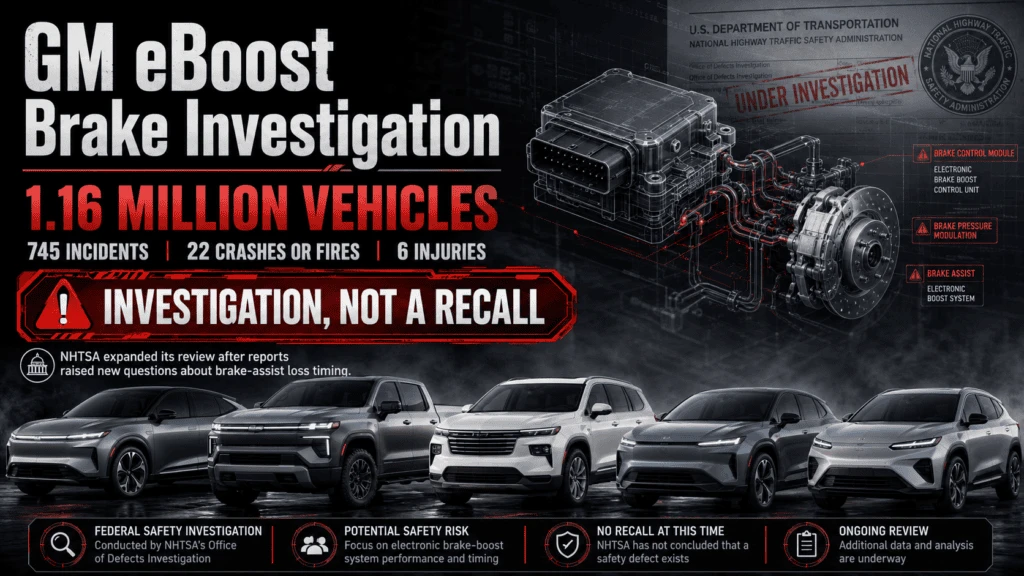
The headline number is enormous, but the number is not the most important part of this story. NHTSA has expanded its review of General Motors’ eBoost electronic brake control system from a small group of 2023 Cadillac Lyriqs to an estimated 1,164,820 vehicles across Buick, Cadillac, Chevrolet, GMC, Honda and Acura nameplates.
What should concern owners is the reason for that expansion. In its new Engineering Analysis EA26006, the National Highway Traffic Safety Administration says some reports describe brake-assist loss occurring sooner than GM’s earlier technical explanation predicted. In plain English, the federal government is now asking whether the real-world failure can be more abrupt, and potentially more dangerous, than the failure sequence GM originally described.
There is also a second fact that needs to stay attached to every headline about this investigation: this is not currently a 1.16-million-vehicle recall. NHTSA is investigating whether a safety defect exists across the shared eBoost population. A recall would be a later action if GM or NHTSA determines that the vehicles contain an unreasonable safety risk or fail to meet a safety standard. NHTSA explains that distinction in its investigation and recall resources.
You may also enjoy: 11.6 Million Vehicles Recalled in 2026 What You Must Know
The GM eBoost brake investigation is really about failure timing
The earlier federal case, Preliminary Evaluation PE24011, opened in April 2024 around just 3,322 model-year 2023 Cadillac Lyriq vehicles. Reports described a hard brake pedal followed by a “Brake System Failure” message. GM told investigators that the eBoost electronic brake control module has an internal spindle that could fracture during an anti-lock braking event.
GM’s later technical response described a very specific sequence. Its testing indicated that when a spindle fractured during ABS cycling, the pressure already generated in the system would largely carry the vehicle through that braking event. GM said assist would disappear after the vehicle came to a complete stop, at which point warning lights and messages would appear and vehicle speed would be capped at 70 kph, about 43 mph. The driver would still have what GM calls unassisted “push-through braking.”
GM eBoost Brake Investigation
That matters because NHTSA’s new file says some more recent reports do not fit that sequence. Drivers have alleged an immediate loss of brake assist during braking, rather than a loss that becomes apparent after the first stop is finished. Federal investigators say an unexpected loss of assist during a braking event could lengthen stopping distance and increase crash or injury risk.
This is the investigative hinge. If GM’s original failure model accurately describes the affected vehicles, the risk profile is one thing. If assist can disappear earlier, under circumstances the previous diagnostic strategy does not adequately anticipate, the risk calculation changes. The Engineering Analysis is designed to determine which description best matches the field evidence and whether more than one failure mode is involved.
You may also enjoy: Braking News: Ford Recalls 274,000 SUVs in Latest Stop-and-Check Saga
The owner list is broader than the EV headline
It would be easy to call this a GM EV brake investigation because several of the best-known models are electric. That would be incomplete. NHTSA is following the component across a much wider range of vehicles, including pickups and gasoline-powered family crossovers.
2023-2026 Cadillac Lyriq
2023-2026 Chevrolet Colorado
2023-2026 GMC Canyon
2024-2026 Buick Enclave
2024-2026 Buick Envision
2024-2026 Chevrolet Blazer EV
2024-2026 Chevrolet Equinox EV
2024-2026 Chevrolet Traverse
2024-2026 Cruise Origin
2024-2026 GMC Acadia
2025-2026 Cadillac Celestiq
2025-2026 Cadillac Optiq
2024-2026 Acura ZDX
2024-2026 Honda Prologue
The Prologue and ZDX are there for a specific reason. GM manufactured those vehicles as part of its joint-venture work with Honda, and NHTSA says they use the same eBoost system. The agency is treating them as peer vehicles in this analysis. That does not mean Honda engineered the spindle being examined, but it does mean Honda and Acura owners are part of the population federal investigators are assessing.
GM eBoost Brake Investigation
The mixed list also tells us something important about modern vehicle architecture. A system such as eBoost is not tied to one body style or one powertrain. GM describes eBoost as its modern brake-by-wire technology, allowing electronic coordination of braking functions and supporting features such as automatic emergency braking and driver-assistance systems. In EVs, the brake controller also has to help coordinate friction braking with regenerative braking. GM’s own recent history of its brake-by-wire technology explains how that integration evolved.
You may also enjoy: The Most Googled EVs in America, And What That Really Means
A tiny spindle can create a very large confidence problem
GM’s 2024 submission to NHTSA offers unusually detailed insight into what engineers believed was happening. The company and its suppliers said early spindle fractures could be associated with hydrogen embrittlement in the spindle material, while rougher thread surfaces increased the likelihood of a fracture. The supplier began tighter tool-life controls and inspections of thread finish in February 2023.
GM then layered on additional manufacturing checks. Certain 2023 Lyriq, Colorado, and Canyon vehicles received three ABS-induced stopping events before shipment. A torque test was added, followed by an inline pressure test. In May 2023, the supplier added a baking or tempering process intended to improve the spindle’s material robustness. These changes are documented in GM’s June 2024 response filed with NHTSA.
None of that automatically proves the current population has defective spindles. It does show that GM and its suppliers had already worked through multiple manufacturing “pedigrees” of the component while trying to improve robustness and detect failures.
GM eBoost Brake Investigation
This is where a component that most owners will never see becomes a trust issue. Drivers do not care what metallurgy lives behind the brake pedal when the system works. They care intensely when the pedal suddenly feels different. Electronically integrated braking can provide faster coordination, better regenerative blending and sophisticated driver-assistance functions, but the benefit depends on predictable behavior when something goes wrong.
GM has said that even without assist, the vehicles retain unassisted braking and that its testing showed compliance with Federal Motor Vehicle Safety Standard No. 135. The federal investigation is not simply asking whether some braking remains available. It is examining the safety consequences of the failure, particularly if drivers encounter a sudden change in required pedal effort or longer stopping distance when they are already reacting to an urgent situation.
GM tried diagnosis before replacement
One of the most interesting parts of this case is that GM’s earlier response included a software strategy rather than a broad recall campaign.
The company developed a diagnostic routine that runs when the vehicle is switched off. It reverses the spindle in a manner intended to reveal a break. If the software detects a broken spindle, it stores a diagnostic trouble code. When the vehicle is powered on again, the diagnostic strategy is intended to produce a chime, a “Service Brake System” message, and multiple warning lamps. GM said the vehicle would then be limited to about 43 mph until repaired.
For 2023 Lyriq vehicles, GM began an over-the-air update program in July 2023. Its June 2024 filing said 81.7 percent of that OTA program had been completed at the time of the response. Earlier 2023 Colorado and Canyon models were to receive the diagnostic software through dealer-installed updates associated with another vehicle software package. Most 2024 peer vehicles began production with the diagnostic function already installed, while certain Lyriqs built before the software breakpoint were handled through dealer updates.
GM eBoost Brake Investigation
The original NHTSA investigation record makes the regulatory status especially clear: this software action took place outside a formal safety-recall campaign.
That distinction is now important for two reasons. First, owners may reasonably believe that receiving software means the underlying safety question was closed. It was not. Second, diagnostic software is intended to discover a problem. It is not the same thing as physically replacing every potentially vulnerable component. The Engineering Analysis can now examine how the hardware changes, production breakpoints, software detection, and real-world incidents fit together across the full population.
What this means if you own one
If your vehicle is on NHTSA’s list, I would not assume that it needs a new brake module simply because its model year appears in an investigation. I also would not ignore the investigation because there is no recall yet. The sensible middle ground is to know your VIN status, understand the warning signs, and document anything unusual.
Use the official NHTSA recall lookup to check the VIN for active safety recalls. The lookup distinguishes actual recall repairs from the broader universe of complaints, investigations and manufacturer communications. Because VIN populations can be updated after a recall is announced, NHTSA also advises owners to check periodically.
GM eBoost Brake Investigation
If the vehicle displays brake-system warnings, develops an unusually hard pedal or shows any meaningful change in braking behavior, contact the manufacturer or dealer promptly and follow any safety instructions they provide. If you believe you have experienced a safety defect, you can also file a complaint with NHTSA. Consumer complaints are one of the data streams the Office of Defects Investigation uses to identify and evaluate defect trends.
Keep copies of service records, dealer notes, warning photos, mileage and dates. That paperwork is useful whether the final outcome is a recall, a service campaign, a warranty repair or no defect finding at all.
You may also enjoy: Vehicle Safety Recalls: Do Not Drive
What NHTSA can do next
NHTSA says an Engineering Analysis is one of its formal defect-investigation stages and that the agency works to complete this type of analysis within 18 months. That does not mean a recall is automatic, and it does not mean the case will necessarily consume the entire period.
The agency can close an investigation if the evidence does not support a safety-related defect. If regulators conclude a defect creates an unreasonable safety risk, the process can move toward a recall recommendation or other enforcement action. NHTSA says an initiated safety recall requires the manufacturer to announce the defect and provide a remedy. Depending on the case, that can mean repair, replacement, refund or, rarely, repurchase.
GM eBoost Brake Investigation
Right now, there is no blanket federal remedy attached to EA26006. There is no basis to tell every owner on this list that a specific part will be replaced. The work underway is intended to answer the technical questions that have to come before such a decision.
NHTSA’s latest count is 745 incidents after duplicate manufacturer reports are removed. Federal records categorize 22 events as crashes or fires and show six people hurt across five injury incidents. The file reports zero deaths.
Why this matters beyond one brake component
GM is pushing deeper into software-defined vehicle functions and more advanced driver assistance. Test Miles has already looked at the company’s plan to move toward eyes-off driving. That future relies on drivers trusting electronically managed systems to behave predictably, especially when the vehicle is controlling or coordinating steering and braking functions.
You may also enjoy: GM Says Eyes-Off Driving Is Coming Soon
It would be unfair to use an eBoost investigation as evidence that unrelated GM software or automated-driving systems are unsafe. The technologies have different architectures, failure modes and validation requirements. The broader connection is simpler: as more fundamental vehicle functions become electronically integrated, fault detection and graceful degradation matter as much as feature capability.
That is why the most consequential sentence in NHTSA’s new file is not the population number. It is the agency’s statement that some reports are inconsistent with GM’s earlier description of the failure.
GM eBoost Brake Investigation
If those reports are explained by unrelated causes, GM’s existing hardware and software measures may prove adequate. If investigators find that the eBoost system can lose assist sooner than anticipated across a meaningful share of the population, the case for additional action becomes much stronger.
Owners do not need a verdict before they can act intelligently. Check the VIN. Do not dismiss brake warnings. Preserve service documentation. Report a genuine safety incident. Then watch what EA26006 produces.
For now, the accurate headline remains less dramatic than a recall notice and more important than a rumor: federal regulators have expanded the GM eBoost brake investigation to roughly 1.16 million vehicles because the field evidence raised new questions. The investigation is the question. A recall, if one comes, would be the answer.