Audi A2 e-tron Is the Efficient EV America Won’t Get
By Robert R Guio
Audi A2 e-tron puts efficiency ahead of battery bragging, and its 12.8 kWh/100 km figure may matter more than the headline 646-km range.
If you read only the biggest number in Audi’s new compact EV story, you could miss the most important one. The headline range is up to 646 kilometers on the WLTP cycle, or about 401 miles. Impressive. But the specification that tells me more about what Audi is trying to accomplish is 12.8 kWh per 100 kilometers.
That is the company’s claimed WLTP consumption for the 140-kW Audi A2 e-tron when fitted with the optional efficiency package, and Audi says it makes this the most efficient series-production model in the brand’s history. The crucial detail is that this is not the 646-kilometer car. The range champion is the 170-kW version with the larger 84-kWh battery. In other words, Audi has separated maximum efficiency from maximum range, and that is exactly how shoppers should read this lineup.
The A2 e-tron opens for German orders on September 10, 2026, with first customer deliveries planned for December. The German starting price is €38,200 for the 125-kW model with the 52-kWh battery. Audi has positioned the car specifically for Europe and has not announced it for the United States in the supplied launch material.
Audi A2 e-tron makes efficiency the premium feature
For years, the easiest way to make an electric vehicle sound more capable was to give it a larger battery and then point to the resulting range number. That can work, but it also adds weight, cost, and material. The A2 e-tron takes a more interesting route by treating low consumption as a product feature rather than an engineering footnote.
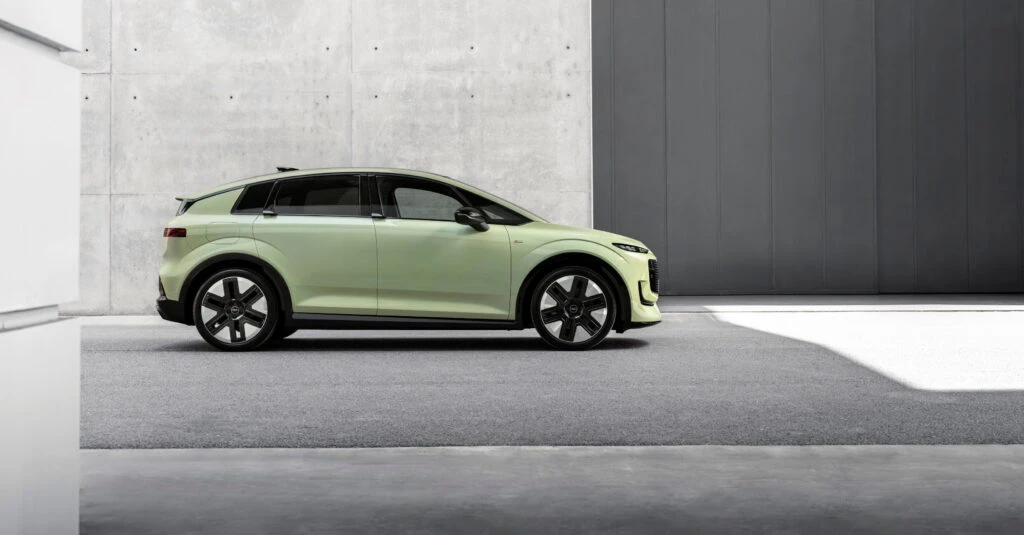
Audi says the body’s drag coefficient is 0.24, its best figure in the compact segment. The company gets there with a largely enclosed underbody, a cooling-air intake that stays shut when additional airflow is unnecessary, aero-focused wheels and small devices around the wheel arches that reduce turbulence. The door handles are shaped to sit neatly in the airflow as well.
Audi A2 e-tron coming to the European market
Why should a buyer care about a decimal point in a drag coefficient? Because highway speed makes aerodynamic resistance increasingly expensive in energy terms. Reducing that resistance can help an EV travel farther without simply enlarging its battery. It can also reduce how much energy an owner has to buy over the life of the car.
There is an important caveat. Audi’s 12.8-kWh/100-km and range figures are measured under the standardized European WLTP type-approval framework. That makes them useful for comparing vehicles tested under the same procedure, but they are not a promise that every owner will reproduce the result. Temperature, speed, elevation, tires, cabin heating, load and driving style can all move real consumption away from the laboratory number.
Audi A2 e-tron coming to the European market
That distinction matters even more because nobody at Test Miles has supplied a first-hand drive of this vehicle for this story. Audi’s efficiency claim is a manufacturer figure at this stage, not a Test Miles road-test result. The number is genuinely interesting; it still needs to be tested in the world where people use climate control, carry luggage and occasionally ignore the eco-driving advice.
You may also enjoy: 2026 Audi A6: The Sedan That Surprised Me
The numbers that matter more than the biggest battery
The A2 e-tron comes in four power levels and three battery sizes, which means the smartest choice depends on the job rather than the badge at the top of the price list.
The 125-kW entry car uses a 52-kWh gross battery, makes 350 Nm of torque and is rated for up to 423 kilometers of WLTP range. It can accept up to 100 kW at a DC fast charger, with Audi quoting 24 minutes for a 10-to-80-percent session. For someone whose driving is largely urban or regional and who can charge regularly, that smaller pack could be the financially rational version.
The 140-kW model steps up to a 61-kWh gross battery and as much as 515 kilometers of WLTP range. It is also the efficiency star when fitted with the optional efficiency package. Peak DC charging rises only slightly to 105 kW, and Audi lists 26 minutes from 10 to 80 percent.
Audi A2 e-tron coming to the European market
Then the character changes. The 170-kW version receives an 84-kWh gross NMC battery, raises maximum DC power to 183 kW and stretches WLTP range to 646 kilometers. Audi says 10 to 80 percent takes 29 minutes. The 240-kW model uses that same battery and charging ceiling but turns the performance dial: 545 Nm, 0-to-100 km/h in 5.7 seconds and a 200-km/h maximum speed. Its range drops slightly to 630 kilometers.
This is where “buy the biggest one” becomes poor advice. The 240-kW car is quicker, but the 170-kW version goes farther. The 140-kW model is more frugal, but it has less total range. The 125-kW version charges at a lower peak rate, yet its smaller battery means Audi claims the shortest 10-to-80-percent time of the group. A charging-power number without battery size and charging time can be just as misleading as a range number without energy consumption.
Audi A2 e-tron coming to the European market
European public-charging conditions are also changing under the EU’s Alternative Fuels Infrastructure Regulation, which establishes requirements for deployment, user information and payment across the network. That does not guarantee a perfect road trip, but it is useful context for a car whose longer-range versions are plainly intended to travel beyond the commute.
You may also enjoy: Audi Q8 E-Tron: Balanced Luxury in the EV SUV Race
Small-car packaging is where the engineering becomes useful
A compact EV succeeds or fails by what happens after you close the spec sheet. The A2 e-tron uses a 2.77-meter wheelbase, short overhangs and a battery installation designed to preserve interior room. Audi says the 52- and 61-kWh packs use lithium-iron-phosphate cells in a cell-to-pack layout, while Audi equips the 84-kWh pack with nickel-manganese-cobalt cells in a modular architecture.
Those chemistries are not interchangeable trivia. Battery design affects cost, energy density, packaging and the way a manufacturer can tailor a vehicle to different missions. Europe’s broader rules for battery sustainability, recycling and lifecycle requirements are explained by the European Commission’s battery policy and regulation guidance, which is worth understanding as more EVs arrive with different cell chemistries and end-of-life obligations.
Inside, Audi appears to have spent engineering effort on ordinary frustrations. Putting the gear selector on the steering column leaves the center console with more usable storage. The Qi 2.2 tray accommodates two phones, supplies as much as 25 watts of wireless power to each charging position and includes active cooling. There are large bottle spaces in the doors and console, while cargo capacity is 396 liters in five-seat use and expands to 1,336 liters after the rear seatbacks are lowered.
Audi A2 e-tron coming to the European market
The 170- and 240-kW versions also include a 13-liter front trunk. That is not huge, but a small dedicated space for cables can keep wet or dirty charging gear away from luggage. The standard Fidlock attachment system is more unusual: its magnetic-mechanical mounts hold accessories including the supplied cupholder or an available cable bag; extra anchor points can be specified for the cargo area.
These details are more persuasive to me than another decorative screen animation. Audi still gives the car plenty of display technology, including an 11.9-inch virtual cockpit and a 12.8-inch curved MMI touchscreen as standard, plus an available augmented-reality head-up display. But the practical packaging may be the part drivers notice every day.
Audi also says more than 300 components can contain recycled materials depending on configuration and says post-consumer recycled material is present in more than 100 of those parts. The company is simultaneously trying to reduce material complexity so parts can be separated and recycled more easily later. That fits the efficiency theme far better than treating sustainability as a single upholstery option.
You may also enjoy: 2027 Audi Concept C ushers in Audi 2.0 with radical clarity
Bidirectional charging is smart, but the fine print matters
The A2 e-tron can do something increasingly important for EV owners: send energy back out of the battery. Vehicle-to-Load can power external devices, and Audi specifically mentions equipment such as e-bikes and tools. That is the simple, immediately understandable version of bidirectional energy use.
Vehicle-to-Home is more ambitious. In Germany, Austria and Switzerland, Audi says a compatible DC wall box can allow the car to feed stored energy into a household electrical system. For a home with solar panels, that creates the possibility of storing solar energy in the vehicle battery and using some of it later in the house.
Audi A2 e-tron coming to the European market
The technical foundation for modern vehicle-grid communication is part of a broader standards ecosystem that includes ISO 15118-20, which covers second-generation network and application requirements including bidirectional power transfer. The European Commission also distinguishes between ordinary bidirectional communication and actual bidirectional recharging in its AFIR guidance. The difference is important: a car and charger can exchange information without necessarily being able to send useful electrical energy back to a building or grid.
Audi’s own conditions deserve equal attention. For home-energy transfer, Audi confines normal discharge behavior to the battery’s 20-to-80-percent charge window. Below 20 percent the car charges; above 80 percent it discharges. Vehicle-to-Home operation requires suitable hardware and is initially limited to those three countries. If an owner needs maximum driving range, Audi provides an “Instant Charge” function to charge to 100 percent.
Audi A2 e-tron coming to the European market
So yes, the feature could be valuable, particularly for households already investing in solar and home-energy management. But I would not buy the car solely because the brochure says V2H without first confirming wall-box compatibility, installation cost, local electricity rules and whether the service is supported where the vehicle will live.
That same caution applies to software. Audi’s e-tron route planner can use traffic, topography and charging-station availability to plan stops and prepare the battery for fast charging. European rules are also pushing toward better charging-data availability; the European Commission has adopted measures intended to improve the interoperability and transparency of alternative-fuels infrastructure data. A clever route planner becomes much more useful when the data behind it is current and reliable.
You may also enjoy: German Luxury Carmakers Reveal Their Secret Weapon — And It’s Not What You Think
Which A2 e-tron would I put on a shopping list?
German pricing gives us the clearest first look at the hierarchy. The 125-kW car with the 52-kWh battery starts at €38,200. The 61-kWh version begins at €41,900. Moving to the 170-kW model and its 84-kWh battery raises the starting figure to €48,900, while the 240-kW model costs €51,200.
My first instinct would be to look hardest at the middle of the range rather than the top. For a buyer with dependable home or workplace charging and mostly local driving, the 140-kW version is compelling because it carries the efficiency story most convincingly. For someone who regularly makes long trips, the 170-kW car looks like the more logical step-up because it combines the longest quoted range with the 183-kW charging capability. The 240-kW version is the choice for the shopper who genuinely values acceleration enough to pay more and give up a little range.
That is guidance based on specifications, not a driving verdict. We still need to learn how efficiently each version performs at sustained motorway speed, what winter temperatures do to consumption and charging, how the suspension behaves on broken pavement, how much option packages move the real transaction price and whether the interior feels premium once the novelty of the displays wears off.
Audi A2 e-tron coming to the European market
Standard assistance includes a reversing camera and parking system plus, alongside adaptive cruise control, attention assistance, evasive assistance and emergency braking support. Optional assistance can add lane guidance, automated parking functions and other features. The available equipment is broad, but option packaging will matter greatly on a car that begins below €40,000 in Germany.
There is also an industrial reason to watch the price. Audi says the A2 e-tron reached production 21 months faster than comparable predecessor projects and reuses more than 1,200 pieces of manufacturing equipment in Ingolstadt, including about 250 robots. A2 e-tron bodies are built alongside the A3. If that reuse genuinely lowers investment and complexity, the interesting question is whether customers ultimately see the benefit in pricing and product cadence.
You may also enjoy: VW Showcases Audi’s Future and Scout’s U.S. Comeback in Munich
The best thing about the A2 e-tron concept is that it does not pretend every EV buyer wants the same car. One version minimizes purchase price. Another makes efficiency the headline. Another maximizes range. The top model spends some of that efficiency budget on performance.
That is a healthier way to build an electric-car lineup than making battery size a proxy for prestige. If Audi’s real-world efficiency comes close to its WLTP promise, the A2 e-tron could make a persuasive case that premium engineering sometimes means needing less. For now, the 12.8-kWh/100-km figure is the number I want to test, because it tells us more about Audi’s direction than the biggest battery or the quickest acceleration time.