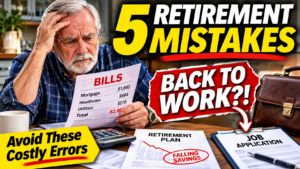
5 Retirement Mistakes That Can Force You Back to Work
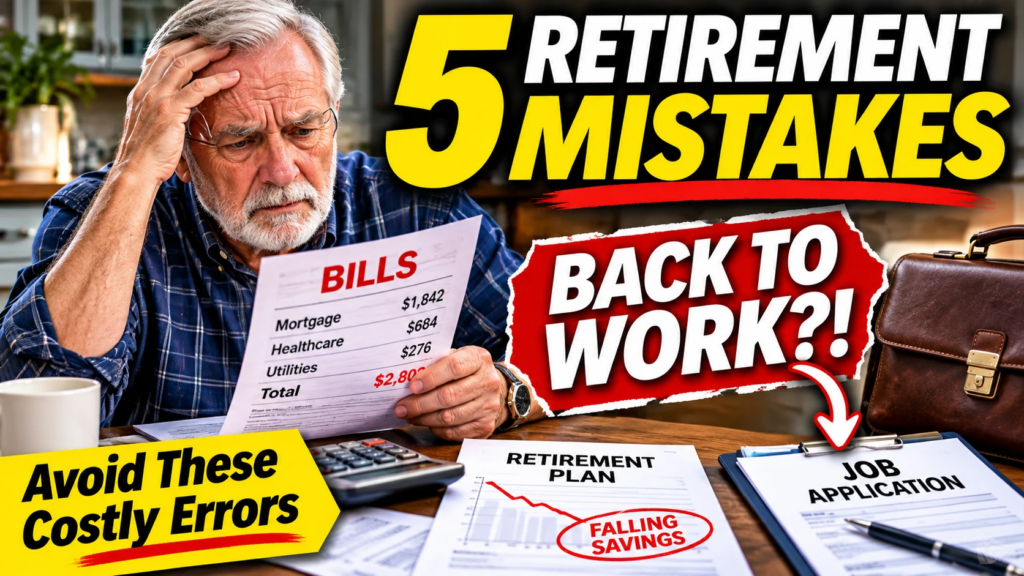
Retirement is supposed to mark the point when work becomes optional. Yet for a meaningful number of older Americans, financial pressure eventually pulls them back into the labor force. AARP reported in 2026 that about 6% of retirees had returned to work within the previous six months, and nearly half said the primary reason was financial need rather than boredom or a desire to stay busy.
That does not mean retirement failed simply because someone works again. Part-time work, consulting or a side business can be a positive choice that adds income, structure and social connection. The problem is when a retiree feels forced back into the workforce because spending, healthcare costs, market losses or poor planning made the original retirement budget unsustainable.
1. Spending Too Much Too Soon
The first years of retirement can feel like a reward for decades of work. Travel, home renovations, second homes, new cars and financial help for adult children can all arrive at once. The danger is that large early withdrawals reduce the amount left to compound during the years when the portfolio still needs to support a potentially long retirement.
This is especially risky when the spending is recurring rather than one-time. A second home may create years of property taxes, insurance, utilities and maintenance, while ongoing support for adult children can quietly become part of the monthly budget. Retirement becomes harder to sustain when the lifestyle permanently expands just as employment income disappears.
The better approach is to separate early retirement spending into three buckets: essential expenses, planned discretionary spending and large optional purchases. That makes it easier to identify what can be cut if markets fall or inflation rises. A retirement plan with flexible spending is generally more durable than one built around permanently high withdrawals.
2. Ignoring Inflation and Healthcare Costs
Inflation is easy to underestimate because it usually works slowly. A retirement budget that looks comfortable at 65 may feel much tighter at 75 if housing, insurance, food and medical costs rise faster than expected. Even moderate inflation can significantly reduce purchasing power over a long retirement.
Healthcare deserves special attention because it is one of the largest and least predictable retirement expenses. Fidelity estimated in 2026 that a 65-year-old retiring that year could expect to spend about $185,500 on healthcare and medical expenses over retirement, excluding long-term care.
Long-term care can be even more expensive. CareScout reported a 2025 national median of about $10,798 per month for a private nursing-home room and roughly $9,581 for a semi-private room. Those costs make it dangerous to assume Medicare will cover every late-life expense, because long-term custodial care is generally outside Medicare’s core benefit structure.
3. Underestimating Sequence-of-Returns Risk
Retirees often focus on average returns, but the order of those returns can matter just as much. A major market decline during the first few years of retirement can force withdrawals from a shrinking portfolio, leaving fewer assets available to recover when markets rebound. This is known as sequence-of-returns risk.
Morningstar’s current research continues to show that poor returns in the first five years can materially increase the risk of running out of money when retirees do not adjust spending. Its 2026 work also found that flexible withdrawal strategies can support higher starting withdrawals than rigid inflation-adjusted spending because retirees reduce withdrawals during weak markets.
That does not mean every retiree needs to keep several years of expenses in cash. It does mean the portfolio should include assets that can help fund spending without forcing stock sales after a major decline. Short-term bonds, Treasury securities and inflation-protected bonds can all play a role depending on the retiree’s allocation and risk tolerance.
4. Assuming Retirement Means You Can Never Work Again
One of the most damaging retirement mindsets is treating the decision as irreversible. Someone may retire at 62 and later discover that working 10 or 15 hours a week would meaningfully improve cash flow without recreating the stress of a full-time career. A relatively small amount of earned income can reduce portfolio withdrawals and give investments more time to recover.
An extra $500 to $1,000 a month may not sound transformative, but it can represent $6,000 to $12,000 of annual spending that no longer has to come from retirement accounts. Over several years, that reduction in withdrawals can have a meaningful effect on portfolio longevity. The financial benefit becomes even more important when the extra income arrives during a bear market.
The work does not have to resemble the retiree’s former career. Consulting, tutoring, pet sitting, seasonal work, handyman services or project-based employment can provide supplemental income with more flexibility. The objective is not to recreate the job someone retired from, but to preserve options.
5. Retiring Without a Plan B
A strong retirement plan should answer more than the question, “Can I retire?” It should also answer, “What will I do if the plan is wrong?” Markets can fall, inflation can spike, health can deteriorate and family obligations can change after retirement begins.
A Plan B might include reducing travel, downsizing, selling a second property, returning to part-time work or temporarily reducing withdrawals. The important part is deciding in advance which adjustments are acceptable. A retiree who knows exactly which expenses can be cut during a downturn is less likely to panic when markets become volatile.
This is also where stress testing becomes useful. A retirement plan should be modeled against weak early returns, higher inflation, unexpectedly high healthcare expenses and longer-than-expected longevity. The goal is not to predict the future perfectly, but to understand how much flexibility exists when reality differs from the original assumptions.
Why a 10% Spending Cut Can Matter So Much
Retirement sustainability is highly sensitive to spending because every dollar not withdrawn remains invested. Reducing annual spending from $80,000 to $72,000 lowers the portfolio burden by $8,000 every year. Over a long retirement, that can materially improve the probability that assets last.
The effect can be particularly powerful during market downturns. Cutting discretionary spending after a severe decline allows the retiree to sell fewer assets at depressed prices. When markets recover, the portfolio begins the rebound from a stronger base.
This is one reason rigid retirement budgets can be risky. Expenses such as housing, taxes and insurance may be difficult to change, but travel, dining, gifts and major purchases often contain more flexibility. A retirement plan with adjustable discretionary spending can withstand surprises better than one in which every dollar is treated as fixed.
Cash Alone Is Not a Long-Term Inflation Strategy
Some retirees respond to risk by holding too much of their portfolio in cash or certificates of deposit. That can feel safe because account balances do not fluctuate as much, but cash has its own long-term risk: inflation. If the return on safe assets fails to keep pace with rising prices, purchasing power gradually declines.
Stocks can provide long-term growth that helps a portfolio outpace inflation, although they also introduce volatility. The appropriate allocation depends on spending needs, time horizon and risk tolerance, not on a universal percentage. Retirees generally need to balance short-term stability with enough long-term growth to support decades of future spending.
Treasury Inflation-Protected Securities can also help manage inflation risk because their principal adjusts with changes in the Consumer Price Index. They are not a substitute for an entire retirement portfolio, but they can help create a more stable inflation-adjusted income floor. The objective is diversification rather than relying entirely on any one asset class.
Medicare Does Not Eliminate Healthcare Risk
Turning 65 and enrolling in Medicare can significantly reduce healthcare uncertainty, but it does not eliminate medical expenses. Premiums, deductibles, prescription costs, Medigap premiums or Medicare Advantage cost sharing can all remain part of the retirement budget. Higher-income beneficiaries may also pay additional Part B and Part D premiums through IRMAA.
Healthcare planning should therefore be integrated with tax planning. Large IRA withdrawals or Roth conversions can increase modified adjusted gross income and potentially affect future Medicare premiums. That does not mean retirees should avoid those strategies, but the Medicare impact should be included in the calculation.
Long-term care is a separate risk because Medicare generally does not cover ongoing custodial care. Retirees should decide how that risk would be funded through assets, insurance, family support or Medicaid eligibility if needed. Leaving long-term care completely unplanned can turn an otherwise sound retirement into a financial crisis.
Returning to Work Is Not Always a Bad Outcome
Working again after retirement is often portrayed as evidence that someone miscalculated. In reality, some retirees return because they enjoy the social structure, purpose or intellectual stimulation of work. AARP’s 2026 research found financial need was the largest reason for unretirement, but boredom and a desire to remain active also played a role.
Part-time employment can improve a retirement plan even when the retiree does not strictly need the money. It can reduce withdrawals, provide spending money for travel or hobbies and create more margin for unexpected expenses. The key difference is whether work is optional or financially necessary.
That distinction can dramatically affect how retirement feels. Someone choosing to work two days a week because they enjoy it is in a very different position from someone taking the first available job because the portfolio can no longer cover the mortgage. Good planning is about preserving the first outcome and reducing the risk of the second.
Build a 90-Day Return-to-Work Plan Before You Need One
Retirees who want a stronger backup plan can create a simple return-to-work strategy while they are still financially comfortable. Start by identifying marketable skills, former colleagues and industries where part-time or project work is realistic. Waiting until money is already tight makes the process more stressful.
The next step is defining the income target. Someone who only needs an extra $750 a month should not necessarily pursue a full-time job. Knowing the exact cash-flow gap makes it easier to find work that improves the plan without sacrificing the freedom retirement was intended to create.
Finally, keep professional networks active. Staying connected with former coworkers, industry groups and local organizations preserves options if work becomes desirable later. A retiree does not need to be actively job hunting to keep those relationships alive.
Financial Flexibility Can Be More Valuable Than a Perfect Forecast
No retirement model can accurately predict every market return, inflation rate or medical expense over the next 30 years. That is why flexibility is so important. A household able to reduce spending, generate some income or adjust major lifestyle choices has more ways to respond when assumptions are wrong.
The same principle applies to portfolio withdrawals. Morningstar’s research suggests flexible spending systems can allow retirees to begin with higher withdrawals than a rigid plan because spending adjusts when markets weaken. A retiree with enough discretionary spending to make those adjustments has an advantage that does not appear on a balance sheet.
Flexibility should therefore be treated as part of retirement wealth. A paid-off home, marketable skills, a willingness to work part time and controllable discretionary expenses all provide options. Those options can be just as valuable as another small increase in the investment account.
The Goal Is to Keep Work Optional
Retirement success is not measured by never earning another dollar. It is measured by having enough control over time and money that work remains a choice rather than an emergency response. That requires more than reaching a target account balance.
The strongest retirement plans manage spending, prepare for healthcare, account for inflation and protect against early market declines. They also include realistic backup options that can be activated before financial stress becomes severe. A plan that can adapt is usually stronger than one that works only when every assumption goes right.
Retirees do not need to fear going back to work. They should fear reaching the point where they have no choice. The best retirement strategy is one that preserves flexibility long enough for work to remain optional.
Intended for educational purposes only. Opinions expressed are not intended as investment advice or to predict future performance. Past performance does not guarantee future results. Neither the information presented, nor any opinion expressed constitutes a solicitation for the purchase or sale of any security. Consult your financial professional before making any investment decisions. Opinions expressed are subject to change without notice.
IMPORTANT DISCLOSURES:
• Investment Advisory and Financial Planning Services are offered through Pure Financial Advisors, LLC. A Registered Investment Advisor.
• Pure Financial Advisors, LLC. does not offer tax or legal advice. Consult with a tax advisor or attorney regarding specific situations.
• Opinions expressed are subject to change without notice and are not intended as investment advice or to predict future performance.
• Investing involves risk including the potential loss of principal. No investment strategy can guarantee a profit or protect against loss in periods of declining values.
• All information is believed to be from reliable sources; however, we make no representation as to its completeness or accuracy.
• Intended for educational purposes only and are not intended as individualized advice or a guarantee that you will achieve a desired result. Before implementing any strategies discussed you should consult your tax and financial advisors.