BMW Hydrogen Vehicles: History and What Comes Next
Hydrogen keeps reappearing in the mobility conversation at the exact moment EV ownership is getting more practical, and also more honest. The honest part is logistics. Charging works brilliantly when it fits your life. It’s frustrating when it doesn’t. Hydrogen fuel cell vehicles exist today, in part, to address one specific pain point: the time spent refueling.
BMW’s hydrogen work matters because it isn’t a late-to-the-party experiment. BMW has been building and driving hydrogen prototypes since the late 1970s, first with hydrogen combustion engines and, more recently, with fuel cells. BMW itself documents this progression through internal milestones, including early 5 Series test cars, multiple 7 Series prototypes, and later headline projects such as the Hydrogen 7 luxury sedan and the H2R hydrogen record car.
Let’s walk through the vehicles you asked about, what each one was, what BMW was testing, and what it says about where hydrogen fits (or doesn’t) for normal drivers.
Why does this matter right now?
Because the industry is moving from ideology to logistics. The “one drivetrain will rule them all” era is fading. Buyers are asking practical questions instead: Where do I refuel or recharge? How predictable is it? What happens on cold mornings, long road trips, or towing weekends? Those questions are why BMW keeps hydrogen in the mix as a second zero-emission pathway rather than a replacement for battery EVs.
Power Unit Converts Hydrogen into Electricity
BMW’s long timeline also shows something that often gets lost in online debates: hydrogen is not one single technology. BMW’s early work focused on hydrogen burned in modified combustion engines. More recent efforts focus on fuel cells that generate electricity for an electric motor, meaning the driving experience is electric, while the refueling experience is closer to gasoline.
That shift is visible in the vehicle history:
• 1979 BMW 520h (E12) hydrogen prototype: A converted 5 Series used to prove hydrogen could power a combustion engine in a real passenger car.
• Early 1980s 7 Series hydrogen prototype (E23-based): BMW explores liquid hydrogen storage in a flagship sedan and learns what cryogenic storage demands in daily use.
• 1988 7 Series hydrogen prototype (E32-based, often referenced as 750iL Hydrogen): BMW develops a dual-fuel approach using gasoline and liquid hydrogen to study usability and transition logic.
• 2000 BMW 750hL (E38 Clean Energy): A hydrogen V12 demonstration fleet pushing range and refueling expectations into conventional luxury-car territory.
• 2004 BMW H2R (Hydrogen Record Car): A performance statement using a hydrogen V12 to set speed records and eliminate the assumption that hydrogen must be slow.
• 2006–2007 BMW Hydrogen 7 (E68): A near-production luxury sedan that marked the peak of BMW’s hydrogen-combustion era.
• 2014 BMW 535iA Fuel Cell: A turning point toward fuel-cell electric drivetrains, developed in cooperation with Toyota’s early fuel-cell systems.
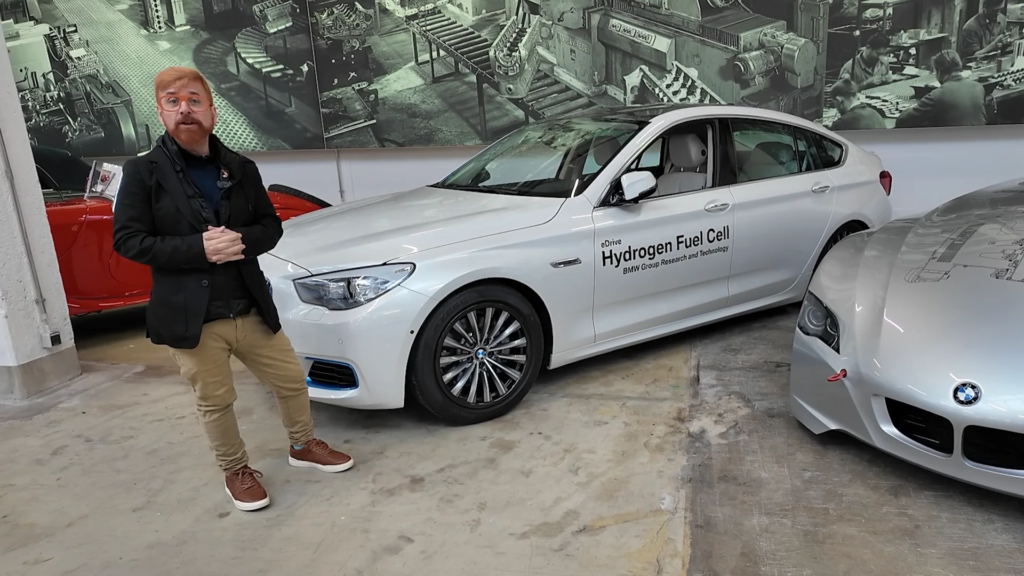
• 2017 BMW 5 Series GT Fuel Cell demonstrator: A public packaging and integration test showing fuel-cell systems inside a real production architecture.
• 2019 BMW i Hydrogen NEXT (G05 concept): A modern X5-based concept previewing BMW’s fuel-cell direction.
• 2023–2025 BMW iX5 Hydrogen pilot fleet: A limited real-world trial fleet used for demonstrations, validation, and practical learning.
• Planned BMW iX5 Hydrogen series model (around 2028): BMW has stated its intent to bring a fuel-cell vehicle to series production using an existing platform.
Of all of these, the iX5 Hydrogen pilot fleet is the most relevant today because it is a real deployment rather than a historical prototype. BMW has been unusually transparent about what it wants to learn from this fleet and how the vehicles are intended to be used.
Here’s the part buyers should care about most: BMW does not position fuel cells as a replacement for battery EVs. They are positioned as an addition. That framing mirrors what we’re seeing across the industry, early certainty giving way to a more pragmatic “it depends” reality.
How does it compare to rivals or alternatives?
The fairest comparison is to battery EVs, because that’s what most people mean when they say “zero-emission.” If you can charge at home and your driving fits the current fast-charging network, a battery EV is usually simpler. You don’t need high-pressure hydrogen tanks, you don’t depend on hydrogen station uptime, and you don’t need a parallel fueling ecosystem to mature.
Hydrogen’s advantage is narrow but meaningful: fast refueling combined with electric-motor driving. That’s why hydrogen continues to surface in discussions around frequent highway driving, heavier vehicles, and fleet-style duty cycles where downtime matters.
BMW’s approach also differs subtly from many rivals. Its hydrogen program began with combustion engines, demonstrating hydrogen within familiar ICE frameworks, before transitioning to fuel cells once zero tailpipe emissions became the priority. The mid-2010s fuel-cell demonstrators mark that pivot clearly.
For practical buyers, the biggest alternative question isn’t branding or performance. It’s fueling access. A hydrogen vehicle without reliable stations is an expensive curiosity. Infrastructure availability ultimately determines whether hydrogen ownership is liberating or frustrating.
That infrastructure dependency is why many buyers today gravitate toward hybrids and plug-in hybrids. The decision isn’t ideological, it’s about friction. New technology succeeds when it removes friction, not when it adds new obligations.
Who is this for, and who should skip it?
This makes sense if:
• You drive long highway distances and want to avoid charging dwell time.
• You want an EV-like driving experience with fast refueling.
• You live in regions with dependable hydrogen access.
• You’re comfortable being an early adopter backed by real-world testing.
You should probably skip it if:
• Hydrogen stations near you are unreliable or nonexistent.
• You can charge at home and your driving is predictable.
• You want the simplest ownership experience today.
• Purchase price is your top priority.
People accept new technology when it feels like a clear upgrade. They resist it when it feels like homework. Hydrogen will only feel ready when it fades into the background of daily life.
What is the long-term significance?
BMW’s hydrogen history points toward a multi-path future. Battery EVs dominate where charging is easy. Hybrids remain the pragmatic bridge. Hydrogen fuel cells may become a third lane for specific regions and use cases where fast refueling and long range matter most.
BMW’s work spans three clear eras:
Era one: Prove hydrogen can work in an engine. Early prototypes focused on feasibility and storage challenges.
Era two: Make hydrogen feel premium. Larger luxury sedans tested range, refueling cadence, and everyday usability.
Era three: Move to fuel cells for true zero tailpipe emissions. This leads directly to the modern iX5 Hydrogen program.
BMW has stated its intent to launch a fuel-cell vehicle around 2028, developed alongside Toyota using next-generation fuel-cell technology. The key detail is that this is an additional drivetrain option, not an all-or-nothing bet. That reflects how automakers behave when outcomes depend on infrastructure and regional realities.
The simplest way to think about BMW’s plan is this: make hydrogen ownership boring before it goes mainstream. Boring fueling. Boring reliability. Boring packaging. That’s how new drivetrains actually succeed.
BMW & Toyota Hydrogen Partnership
Shared development between major manufacturers is another signal. Complex, expensive technology tends to consolidate early, then differentiate later at the vehicle level.
One final grounding thought: if BMW launches a hydrogen model around 2028, the car won’t be the whole story. The real test will be whether the surrounding ecosystem becomes dependable enough that owners don’t have to plan their lives around refueling. Until then, hydrogen remains niche. If that ecosystem matures, BMW’s decades-long effort starts to look less like experimentation and more like a deliberate long game.
If hydrogen earns a place in your driveway, it will be because it combines gasoline-like convenience, EV-like driving, and the predictability buyers quietly expect. BMW’s history suggests it understands that equation. Now the question is whether the world around the car is ready to meet it.