Can John and Jane Retire at 65?
Retirement planning becomes real when the numbers meet real life.
John and Jane are both 60 years old. Like many couples approaching retirement, they are asking a simple but emotionally loaded question: When can we retire, and how much can we safely spend?
They’ve done what most financial experts recommend. They’ve saved consistently, invested wisely, and avoided major financial mistakes. Now it’s time to determine whether their nest egg can support the lifestyle they envision.
Their Financial Snapshot
John and Jane have a total net worth of $2.7 million, with approximately $2 million in liquid investable assets.
Here’s how their retirement portfolio breaks down:
- John’s 401(k): $920,000
- John’s Roth IRA: $35,000
- Jane’s IRA: $610,000
- Jane’s Roth IRA: $20,000
- Joint investment account: $450,000
- Savings: $50,000
Combined, they are in strong financial shape. They are also still earning solid incomes John earns $135,000 per year, and Jane earns $90,000 and they are currently maxing out retirement contributions.
They’re targeting retirement at age 65, primarily due to health insurance concerns rather than a strong desire to work until then.
What Do They Want Retirement to Look Like?
John and Jane estimate they would like to spend about $6,600 per month, or roughly $80,000 per year, in retirement.
That number includes:
- Everyday living expenses
- Travel
- Replacing cars every five years (approximately $25,000 per vehicle)
- Healthcare
Healthcare is a major planning factor. If they retire before 65, they estimate private insurance could cost around $2,000 per month. After Medicare, they expect healthcare costs closer to $4,000 annually out of pocket.
This is where planning becomes critical. The difference between retiring at 62 and 65 is not just three years of work it’s three years of significantly higher healthcare costs.
Social Security Strategy
At full retirement age (67), they expect:
- John: $3,200 per month
- Jane: $2,300 per month
That’s a combined $5,500 per month, or $66,000 annually in guaranteed income once both benefits begin.
This significantly reduces pressure on their investment portfolio.
Cash Flow and Withdrawal Analysis
If they retire at 65, their early retirement years will rely more heavily on portfolio withdrawals before Social Security begins.
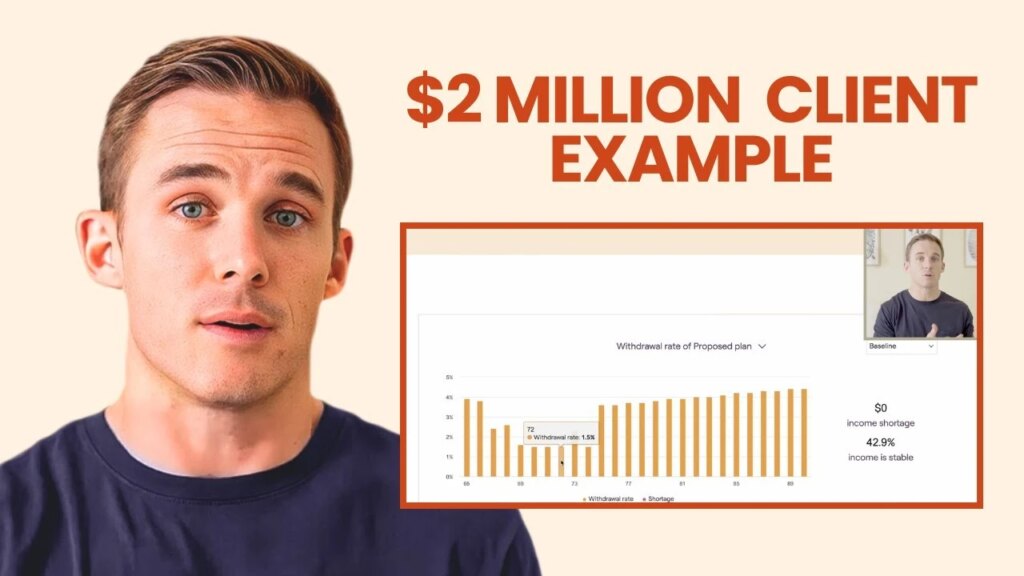
Initial projected withdrawals: $127,000 in year one
Projected first-year withdrawal rate: approximately 3.9%
Once Social Security kicks in, withdrawals drop substantially.
Assuming a 6.5% annual growth rate while they continue working and contributing, projections show their portfolio could grow to around $3.2 million by retirement.
Long-term modeling indicates their withdrawal rate would settle between 2% and 3.9%, which is generally considered sustainable for a retirement lasting 30+ years.
Under reasonable market assumptions, their portfolio is projected to continue growing even after withdrawals begin.
What About Retiring Earlier?
One of the most powerful parts of their analysis was testing alternative scenarios.
Could they retire at 62?
Could they retire immediately?
Surprisingly, yes, though with some trade-offs.
Retiring earlier increases healthcare costs and extends the number of years their portfolio must fund expenses. But even under those scenarios, they remain financially secure.
By age 90, the difference between retiring at 65 versus earlier may amount to $2–4 million less in total assets but they would still maintain financial independence.
This highlights an important truth: retirement planning is about probability and flexibility, not perfection.
The Psychological Shift
The most unexpected benefit wasn’t mathematical it was emotional.
Once John and Jane realized they could retire earlier if needed, their stress levels dropped dramatically. Work became optional rather than mandatory.
That psychological shift gave them peace of mind.
Instead of racing toward retirement, they chose to continue working until 65 because they enjoy their jobs not because they feel trapped.
That distinction matters.
Increasing Spending and Family Support
Another powerful insight from their analysis: they could actually spend more.
Increasing spending from $6,600 to $7,500 per month an additional $24,000 annually would barely move the needle in long-term projections.
They also want to help their five grandchildren with college savings. Contributing $4,000 per year per grandchild into 529 plans is financially feasible without jeopardizing retirement security.
Planning revealed that generosity was affordable.
The Bigger Lesson
This case study illustrates something important: retirement planning isn’t just about hitting a magic number.
It’s about:
- Understanding your spending
- Modeling income sources
- Evaluating withdrawal rates
- Stress-testing scenarios
- Aligning money with values
John and Jane didn’t need $10 million to feel secure. They needed clarity.
Their plan shows that a couple with around $2 million in liquid assets, realistic spending expectations, and thoughtful Social Security timing can retire comfortably and even flex their timeline if desired.
The goal isn’t simply to maximize wealth. It’s to maximize life and utility in alignment with what matters most: health, family, experiences, and peace of mind.
And sometimes the most valuable outcome of financial planning isn’t retiring sooner.
It’s knowing you could.
You should always consult a financial, tax, or legal professional familiar about your unique circumstances before making any financial decisions. This material is intended for educational purposes only. Nothing in this material constitutes a solicitation for the sale or purchase of any securities. Any mentioned rates of return are historical or hypothetical in nature and are not a guarantee of future returns.
Past performance does not guarantee future performance. Future returns may be lower or higher. Investments involve risk. Investment values will fluctuate with market conditions, and security positions, when sold, may be worth less or more than their original cost.