The Jeep Reset: How the Brand Is Rebuilding to Survive
I’ve been covering the auto industry long enough to know when a company is making routine adjustments… and when it’s quietly rewriting its own future.
What Jeep is doing right now falls firmly into the second category.
At first glance, the brand’s latest announcements sound familiar. New models. New technology. More electrification. Anniversary celebrations. That’s the usual rhythm of the modern car business. But if you step back and look at the pattern, something much bigger is happening.
Jeep is restructuring how it builds vehicles, how it prices them, how it sells them, and even how customers choose them. That’s not a product update. That’s a reset.
And the reason is simple: the market has changed faster than most legacy brands expected. Buyers are more price sensitive. Manufacturing costs are rising. Electrification is necessary but uneven. Technology is advancing quickly but not always predictably. And customers have far less tolerance for confusion, complexity, or unnecessary expense.
Jeep’s response is what executives are calling a “reset,” but the more honest description is this: the company is reorganizing itself to stay competitive in a radically different automotive landscape.
This is not about tweaking trim packages. It’s about survival.
Why does this matter right now?
Jeep is marking its 85th anniversary, a milestone that naturally invites reflection. The brand traces its origin back to 1941 and the Willys vehicles that helped define rugged mobility. For decades, Jeep’s identity has been anchored in capability, heritage, and a very specific emotional appeal.
But heritage alone does not protect any brand from market pressure.
The modern auto industry is undergoing structural change. Electrification is reshaping engineering priorities. Software is becoming as important as hardware. Supply chains remain volatile. Buyers are stretched financially. And competition is arriving from directions that barely existed a decade ago, including new EV specialists and global manufacturers moving aggressively into traditional SUV territory.
Jeep’s response is unusually comprehensive.
The company has committed $13 billion to new products, technology, and powertrains — the largest investment in its history. That alone signals long-term transformation. But the more revealing change is happening in how Jeep structures its vehicles and pricing.
One of the clearest examples is configuration simplification. The Grand Cherokee lineup has been reduced from 167 possible configurations to just 10. That is an extraordinary shift. It changes how vehicles are built, how dealers manage inventory, and how customers make decisions.
Complexity used to be a selling point. Now it’s friction.
Jeep is also reworking value across its lineup. On average, each model is gaining more than $4,000 per year in added customer value through lower option pricing or additional standard equipment. Features that were once expensive add-ons are becoming more accessible. Some high-end trims have seen price reductions measured in thousands of dollars.
That is not generosity. It’s competitive pressure expressed in product strategy.
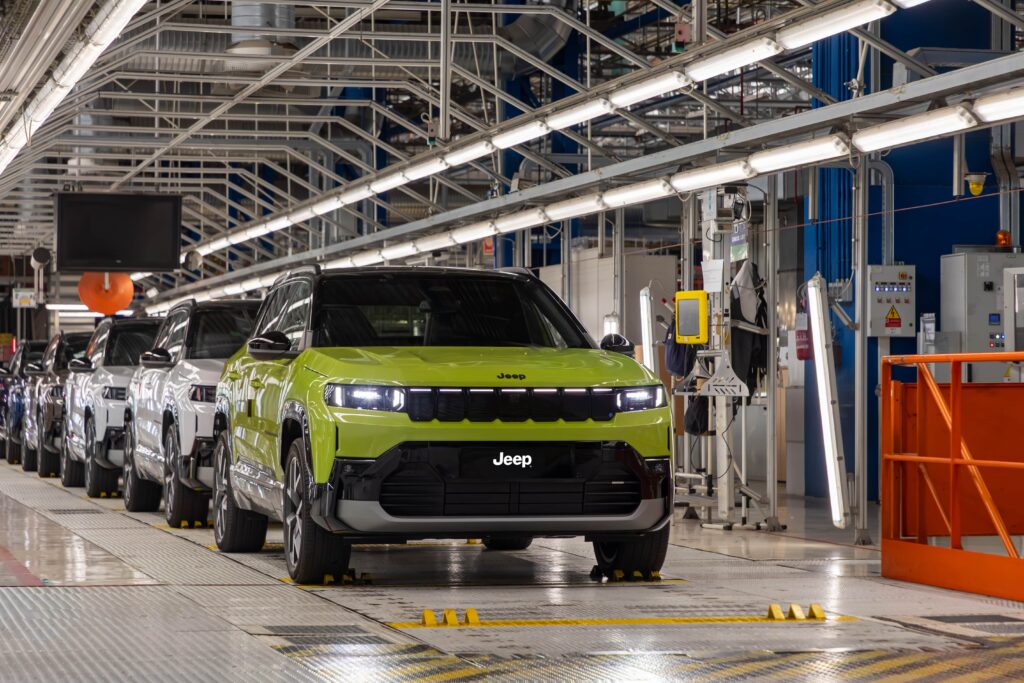
At the same time, Jeep is launching multiple new or updated vehicles, including a redesigned Grand Wagoneer, a refreshed Grand Cherokee, a new Cherokee hybrid aimed at the largest SUV segment in North America, and an all-electric off-road model positioned as trail-rated from the start.
That combination — product expansion plus structural simplification plus price repositioning plus massive investment — is not typical of a stable industry moment. It’s the behavior of a company preparing for a different future.
And notably, Jeep is doing this while sales are rising. Global sales reached 965,000 vehicles in 2025, with U.S. growth accelerating late in the year. That makes the reset more significant, not less. The company is restructuring before a crisis forces it.
How does it compare to rivals or alternatives?
Jeep is not alone in trying to adapt, but its approach is distinctive.
Many manufacturers are investing heavily in electrification, but not all are simultaneously simplifying their product structures. Others are expanding technology while allowing pricing complexity to grow. Some are increasing customization rather than reducing it.
Jeep is moving in the opposite direction. Fewer configurations. Clearer trim hierarchies. More standard equipment. Stronger value positioning. Operational efficiency alongside brand repositioning.
That aligns with a broader trend across the industry: simplification as strategy.
Manufacturers are discovering that complexity increases production cost, supply chain risk, and consumer hesitation. When buyers face dozens or hundreds of combinations, decision-making slows. Inventory becomes harder to manage. Manufacturing becomes less predictable.
Jeep’s configuration reduction is one of the most aggressive examples of structural simplification currently visible in a major global brand.
There is also a strategic balance in Jeep’s powertrain approach. Instead of committing entirely to one technology path, the company is spreading risk across turbo engines, hybrid systems, and fully electric platforms. That reflects industry uncertainty about how quickly different regions and customers will adopt electrification.
Competitors are navigating similar uncertainty, but not all are restructuring their product planning as visibly or as comprehensively.
Another distinction is identity management. Jeep is trying to modernize without abandoning its core promise of capability. That tension is visible across the new lineup: electrified vehicles that still emphasize off-road credentials, hybrid powertrains that maintain traditional SUV functionality, and luxury models that retain rugged branding.
Some competitors have leaned more heavily into technology branding or lifestyle positioning. Jeep is attempting to evolve while preserving emotional continuity.
That is a difficult balance to achieve.
Who is this for and who should skip it?
This story matters most to people who want to understand where the auto industry is actually going — not just which new model launches next month.
If you’re a buyer trying to make sense of why vehicle pricing and trim structures seem to be changing, Jeep’s reset provides a useful case study. It explains why features are being bundled differently, why certain options are becoming standard, and why some brands are simplifying their offerings.
If you follow automotive business strategy, Jeep’s restructuring is a clear example of how legacy manufacturers are adapting to economic pressure, technological change, and shifting consumer expectations simultaneously.
It is also relevant to anyone who cares about brand identity in a changing market. Jeep is attempting to preserve an 85-year legacy while reshaping how it operates internally. That tension — between tradition and adaptation — is shaping decisions across the entire industry.
Who might skip this? If you only want product specifications or driving impressions, this is not that kind of story. The reset is about structure, economics, and long-term positioning. It’s about how vehicles get built and sold, not just how they perform on a trail or highway.
What is the long-term significance?
The most important part of the Jeep reset is not any single model or feature. It is the shift in philosophy.
For decades, success in the SUV market often came from expansion — more trims, more options, more customization, more niche positioning. That approach matched an era of steady growth and relatively predictable consumer demand.
Today’s environment is different.
Manufacturers face higher development costs, faster technology cycles, unpredictable supply chains, and customers who expect clarity and value. Under those conditions, simplification becomes an advantage rather than a limitation.
Jeep is betting that a cleaner product structure, stronger value positioning, and flexible powertrain strategy will make the brand more resilient over time. The $13 billion investment reinforces that long-term commitment. It is not funding a single generation of vehicles. It is funding a transformation in how Jeep operates.
The brand has reinvented itself before. The 1984 Cherokee helped define the modern SUV. The 1993 Grand Cherokee helped define the luxury SUV. Performance-oriented models pushed expectations of capability and speed. Jeep has historically created segments as much as it has competed within them.
Now the challenge is different. It is not about creating a new category. It is about remaining relevant within a market that is changing structurally.
If the reset works, Jeep will emerge leaner, clearer, and more adaptable — a legacy brand that successfully restructured itself before pressure became crisis.
If it fails, the lesson will be equally instructive.
Either way, the significance extends beyond one company. The Jeep reset is a visible example of how established automotive brands are adjusting to a future that is less predictable, more technologically complex, and more economically demanding than the past.
And that makes it worth paying attention to — not because of what it says about Jeep alone, but because of what it reveals about where the entire industry is heading.
Sometimes the most important changes in the car business aren’t the ones you see on the showroom floor. They’re the structural decisions happening quietly behind the scenes, long before the next generation of vehicles arrives.
This is one of those moments.
And the real outcome won’t be measured in model years, but in whether an 85-year-old icon can remain relevant in a market that no longer guarantees survival to anyone.