Luxury SUV Buying Checklist to Avoid Remorse
Luxury SUVs have become the default “upgrade” for a lot of smart, busy people, and that’s exactly why buyer’s remorse is so common. Not because the badge is wrong, but because the day-to-day is louder than the logo.
You do not live in the brochure. You live in the small moments. The rushed school run. The damp grocery bags. The awkward phone placement that somehow becomes your personality for three years. The night drive where the A-pillars suddenly feel like they are auditioning to block every pedestrian in the county.
When you buy your first luxury SUV, you are paying extra for the promise of ease. Less stress. Less friction. More of that quiet sense that things are handled. So if the vehicle adds friction, you do not just feel annoyed. You feel cheated. That is where regret shows up.
The best way to avoid that is to test the things you will do a thousand times, not the things you will do twice.
To make this practical, let’s use the Lexus NX lineup as a measuring stick. It is a classic entry-luxury SUV choice because it offers three powertrains that cover most real-world needs:
- NX 350h hybrid: 240 horsepower and an EPA-estimated 39 mpg combined, plus calm, grown-up acceleration that fits daily driving.
- NX 350 turbo: 275 horsepower and 317 lb.-ft of torque, with stronger shove and a quicker feel.
- NX 450h+ plug-in hybrid: about 37 miles of electric-only driving when fully charged, which can cover errands and commuting for many people who can actually plug in consistently.
Those numbers are useful, but they are not the point. The point is how to test an SUV, so you do not end up muttering, “I’ll get used to it,” which is just regret wearing a blazer.
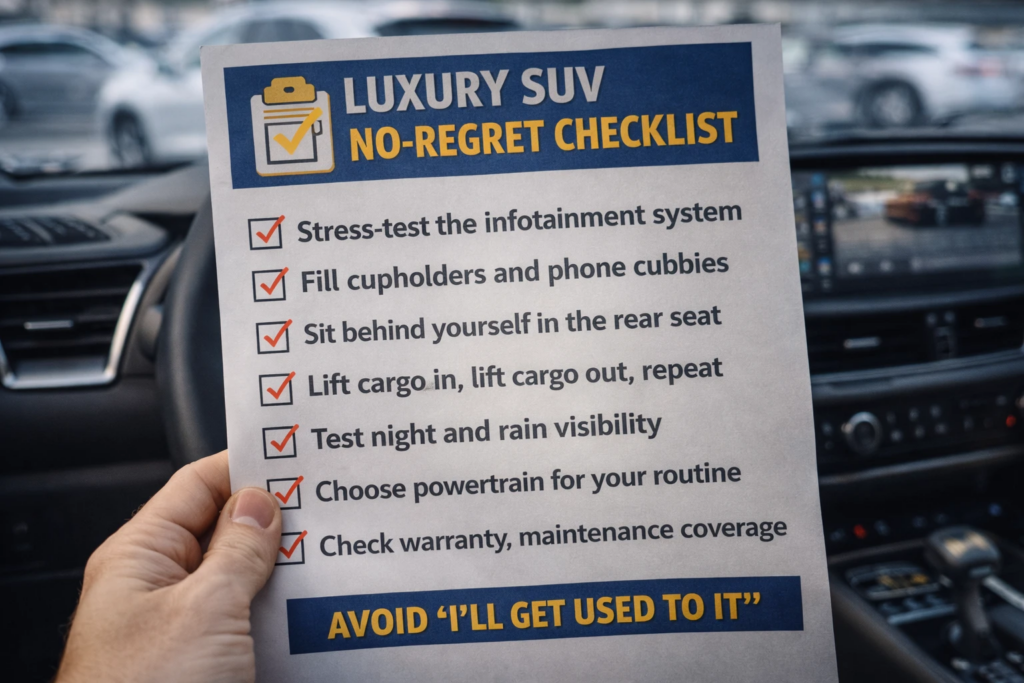
Here’s the no-regret checklist. It works on every entry-luxury SUV, not just this one.
Rule zero: If it irritates you in the showroom, it will haunt you at home.
This is the simplest truth in car buying. We are good at tolerating small annoyances when we are excited, and we are terrible at tolerating small annoyances when we are late.
So we are going to test five remorse triggers:
- Infotainment friction
- Cabin storage and charging reality
- Rear-seat truth
- Cargo loading ergonomics
- Night and rain visibility
If you run these tests properly, you will avoid most of the regret people blame on “the wrong brand,” when the real problem was the wrong daily experience.
Test 1: Infotainment speed and sanity (do not be polite to the screen)
Pair your phone. Set navigation. Change the cabin temperature. Find your audio presets. Do it quickly, like you are doing it in real life, because you will be.
What you are checking:
- Lag: does the system respond instantly, or does it make you wait like a low-budget streaming app?
- Menu depth: how many taps to do basic things?
- Logic: does it feel intuitive, or do you need to “learn” it?
In the NX, screen size can vary, and bigger screens can look impressive. But the real question is not inches. The question is effort. Luxury should reduce effort.
If you find yourself thinking, “This is fine, I’ll learn it,” pause. That sentence has ended more happy ownership experiences than mechanical failures ever have.
Test 2: Cabin life (cupholders, storage, phone placement, and charging)
Luxury interiors can be gorgeous and still annoy you daily. The regret usually arrives when you realize there is nowhere sensible to put the objects you actually carry.
Bring:
- A large water bottle
- A coffee cup
- Your phone and charging cable (or confirm wireless charging performance if the vehicle has it)
Now do this:
- Put the drinks where you would actually use them.
- Put your phone where you instinctively place it.
- Plug in. Unplug. Plug in again.
- Open the console and use the storage spaces while the drinks are in place.
What you are checking:
- Do cupholders interfere with controls or your elbow space?
- Does the phone slide, bounce, or live in a spot that blocks other functions?
- Is charging convenient, or does it feel like a chore?
This is where subscription features can also create remorse. Some convenience items may depend on an active connected-services plan. Ask, plainly: “What works forever, what’s a trial, and what costs money later?” If the answers are vague, your future self is being set up to feel tricked.
Test 3: Rear-seat truth (it “fits” is not the same as “it works”)
Set the driver seat to your position. Then sit behind yourself. Not for two seconds. Sit properly.
What you are checking:
- Knee room: Can an adult sit comfortably behind you?
- Foot space: Can feet tuck under the front seat easily, or is it cramped?
- Headroom: especially important if you have taller passengers.
- Car-seat reality: picture a child seat behind the passenger seat and think through access.
Also, check the door opening shape and seat height. This matters for kids climbing in, parents stepping in, and dogs jumping in. Luxury is not supposed to turn normal movement into a mobility test.
If you plan to keep this SUV for years, rear-seat usability matters even if you do not have passengers every day. You will have them eventually, and the regret will arrive exactly on the day you are in a hurry.
Test 4: Cargo loading (volume is nice, ergonomics is everything)
Cargo regret is rarely about raw cubic feet. It is about loading in the rain when you are annoyed and carrying something awkward.
Do the suitcase test:
- Lift in.
- Lift out.
- Repeat.
What you are checking:
- Lift-over height: Does it force you to heave things upward?
- Tailgate speed: Does it open and close at a sensible pace?
- Opening shape: Can you place larger items without twisting?
- Floor height and step-in: for dogs, strollers, and heavy bags
Many compact luxury SUVs have “enough” cargo room on paper. The real difference is how your body feels doing it repeatedly.
If loading feels awkward in the showroom, it will be miserable in a parking lot with wet shoes and a week’s worth of groceries.
Test 5: Night and rain visibility (the silent regret)
This is the one people skip because it is not exciting. It is also the one that can ruin the luxury feeling fastest.
What you are checking:
- A-pillar thickness and blind spots
- Mirror view and camera clarity
- Wiper sweep and washer performance
- Headlight quality and beam pattern
- The feeling of being boxed-in or stressed
Luxury should make you feel calm when conditions are bad. If you feel tense, the stitching does not matter.
If possible, do a quick test drive that includes:
- A tight U-turn
- Two parking attempts
- Full-lock turning at low speed
Why? Because the real test track is the Costco car park. If it feels clumsy at 5 mph, city life will punish you daily.
Powertrain remorse: match the drivetrain to your life, not your fantasy
Now let’s talk about the part people obsess over: the drivetrain.
Here’s the blunt truth: if you cannot charge reliably at home or work, a plug-in hybrid can become expensive “potential” you never use. You pay for capability you do not access, and then you resent the vehicle for a choice you made.
Use this simple match:
- Turbo (like the NX 350): for people who value response and stronger passing power, and who do not mind more frequent fuel stops.
- Hybrid (like the NX 350h): for people who want excellent fuel economy with no lifestyle change, and who prefer smooth, quiet competence.
- Plug-in hybrid (like the NX 450h+): only if charging is truly part of your routine, because that is how you earn back the value.
When you do have charging, a plug-in can deliver a particularly satisfying ownership pattern: short trips on electric power, longer trips with hybrid flexibility. But it has to be real, not aspirational.
Ownership math: remorse usually arrives with the first unexpected bill
Before you fall for ambient lighting like it is a moral virtue, compare:
- Basic warranty coverage
- Hybrid and battery coverage (if applicable)
- Service costs and maintenance expectations
- Insurance quotes and tire replacement costs for larger wheels
This is not pessimism. It is adulthood. The goal is not to buy the cheapest vehicle. The goal is to avoid expensive surprises that make you resent the purchase.
The “no-regret” summary you can actually use
If you remember nothing else, remember this:
- Do not be polite to the infotainment.
- Put your real objects in the cabin and see if the SUV fights you.
- Sit behind yourself and tell the truth about rear seats.
- Load and unload something heavy, repeatedly.
- Test visibility like weather is part of life (because it is).
- Choose the drivetrain that matches your routine, not your identity.
- Compare ownership coverage and costs before you sign.
Run these five tests and you dramatically reduce the odds of hating your “luxury” SUV by month three.
Luxury, at its best, is not flash. It is relief. It is the feeling that the car makes your day easier, quietly, without demanding a user manual and a subscription plan.
Buy the SUV that removes friction from your life, and you will not need to justify it later. You will just enjoy it.
Calm closing thought: The smartest luxury purchase is not the one that impresses people in the driveway. It is the one that still feels like a good idea when you are tired, late, and loading groceries in the rain. That is the real test, and it is entirely possible to pass it if you shop like a grown-up.