Aston Martin Valhalla: The Supercar That Makes You Look Better Than You Are
If I’d won the lottery last week, I’d have bought a Lamborghini Urus, which my friends would describe as predictable and slightly embarrassing.
But that changed this week.
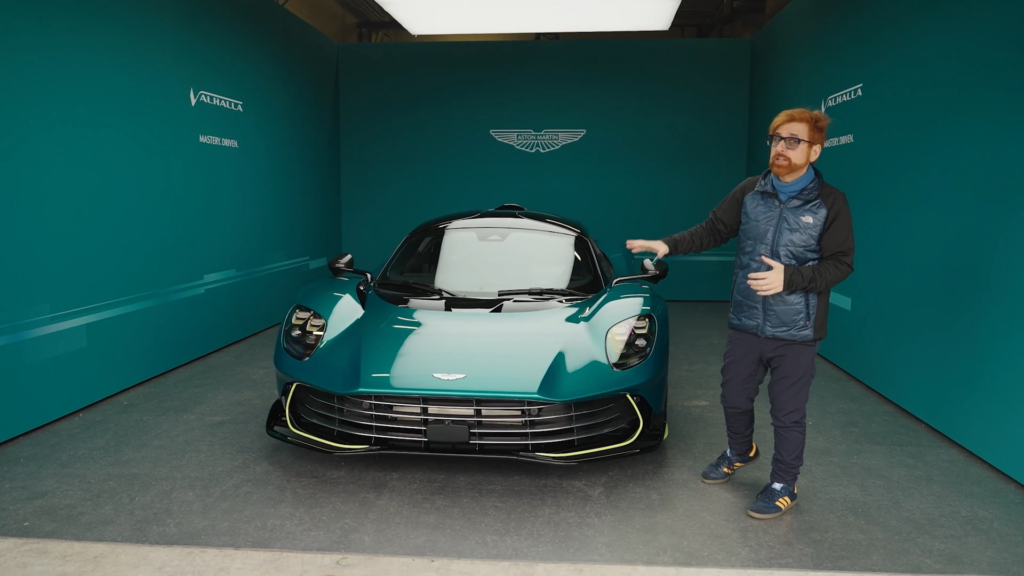
After driving the Aston Martin Valhalla, I realized something. If money were no object, this is what would be sitting in my driveway.
There’s a quiet shift happening at the top end of the performance car world, and it doesn’t involve louder engines or bigger wings. It’s about intelligence, machines that don’t just go faster, but make drivers better in the process. The Aston Martin Valhalla sits right at the center of that shift.
On paper, it reads like a greatest hits album of modern performance engineering. A hybrid powertrain producing 1,064 horsepower. A 0 to 62 mph time of 2.5 seconds. A top speed of 217 mph. It’s Aston Martin’s first production mid-engine supercar and its first plug-in hybrid. That alone would make headlines.
But the more interesting story isn’t the numbers. It’s what the car does with them.
Valhalla spreads its performance across four power sources: a twin-turbocharged 4.0-liter flat-plane crank V8 and three electric motors. Two motors sit on the front axle, while another is integrated into the transmission. Together, they deliver 811 lb-ft of torque, with the gasoline engine producing 817 horsepower and the electric motors contributing an additional 248 horsepower.
This isn’t just about adding power. It’s about how that power is delivered. Electric motors eliminate turbo lag, fill gaps in the torque curve, and subtly adjust the car’s balance. The result is something that feels less like brute force and more like precision.
It’s also Aston Martin’s first use of an eight-speed dual-clutch transmission in a car like this, marking a shift toward more immediate, responsive performance. The front axle being powered electrically adds another layer of control, particularly when it comes to torque vectoring.
The hybrid system even handles reverse gear through the front electric motors, a small but telling detail that reflects how deeply integrated the electrification is.
Despite all this complexity, the Valhalla doesn’t feel complicated to drive. That’s the point.
Modern supercars increasingly rely on software as much as hardware, and Valhalla leans heavily into that philosophy. A central vehicle dynamics system monitors everything, steering input, braking force, suspension movement, aerodynamic load, and makes constant adjustments.
If a driver enters a corner with more enthusiasm than precision, the car doesn’t punish them. It compensates. Torque is redistributed, aerodynamics shift, and the chassis adapts. From behind the wheel, it feels like skill. From the outside, it’s a remarkable amount of computation happening in real time.
That’s where the Valhalla separates itself from older generations of performance cars. It’s not just fast. It’s reassuring.
Aerodynamics play a critical role here. The car produces more than 1,323 pounds of downforce, beginning at around 149 mph and continuing all the way to its top speed. Active aerodynamic elements, including a rear wing that can rise up to 10 inches, adjust constantly depending on speed and driving mode.
The rear wing doubles as an air brake, deploying in under half a second to increase drag during heavy braking. There’s also a drag reduction system that helps the car cut through the air at high speed. Underneath, venturi tunnels and a sculpted underfloor work to generate additional downforce without relying solely on large external wings.
It’s a system that would feel at home in Formula One, and that’s no coincidence. The Valhalla draws heavily from Aston Martin’s racing experience, but translates it into something usable on the road.
And it does have to work on the road.
Despite its performance credentials, the Valhalla includes a range of driving modes designed to make it manageable in everyday situations. Pure EV mode allows for silent operation using only the front electric motors, with a range of about 8.7 miles and a top speed of 87 mph in electric-only driving.
Sport and Sport+ modes bring the V8 into play, blending electric and gasoline power for smoother performance. Race mode unlocks the car’s full potential, sharpening suspension, increasing aerodynamic aggression, and maximizing power delivery.
The suspension itself is a mix of race-inspired and road-focused engineering. Up front, a Formula One-style pushrod setup is paired with adaptive Bilstein DTX dampers. At the rear, a five-link configuration helps balance comfort and control.
The entire structure is built around a carbon fiber monocoque chassis, with a lower tub section weighing just over 160 pounds. The total dry weight of the car comes in at 3,649 pounds, remarkably controlled given the complexity of the hybrid system.
Braking is equally advanced. Carbon-ceramic discs measure 16.1 inches at the front and 15.4 inches at the rear, supported by six-piston front calipers and four-piston rear calipers. A brake-by-wire system integrates traditional braking with regenerative energy recovery, capturing energy that would otherwise be lost and feeding it back into the battery.
It’s one of the rare cases where slowing down actually improves the car’s performance.
All of this sits within a design that balances aggression and elegance. Carbon fiber body panels shape the car, with optional exposed finishes emphasizing its technical nature. Magnesium wheels reduce unsprung weight, while Michelin Pilot Sport S 5 tires, or optional Cup 2 track tires, provide the necessary grip.
Only 999 examples of the Valhalla will be built, with deliveries expected to begin in the second half of 2025. That exclusivity positions it somewhere between a traditional supercar and a hypercar, a space where engineering ambition meets limited production.
But perhaps the most interesting thing about the Valhalla isn’t how rare it is, or even how fast it is.
It’s how approachable it makes that performance.
Historically, cars at this level demanded absolute precision from their drivers. Mistakes were punished quickly and often expensively. The Valhalla changes that equation. It doesn’t remove the challenge, but it adds a layer of support that makes the experience more accessible.
In a sense, it democratizes extreme performance, at least for the 999 people who will own one.
There’s something quietly transformative about that. The Valhalla doesn’t just push the boundaries of what a car can do. It redefines what a driver can do with it.
And if it occasionally makes you feel like a professional racing driver, it’s polite enough not to point out how much help you’re actually getting.