Why UPS Drivers Can Make Six Figures While Middle-Class Wages Stay Stuck
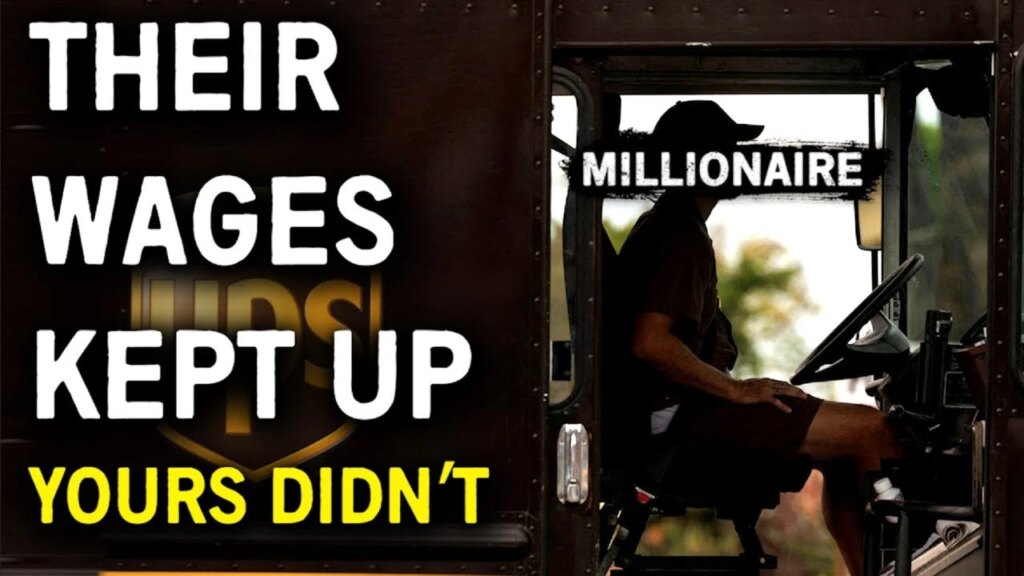
Every few years, a headline goes viral that makes millions of workers stop and ask the same question: How does a UPS driver make that much money? The number that grabs attention is usually around $170,000 a year. It sounds like a lottery ticket hidden inside a brown delivery truck. It also sounds like a direct challenge to the way many Americans think about work, education, status, and pay. A job that does not require a corner office or a graduate degree is being talked about like a six-figure career. But the real story is more complicated, and more revealing, than the headline. UPS drivers are not simply being handed $170,000 salaries. That figure includes wages and benefits, and it applies to experienced full-time drivers under the company’s labor agreement. By the end of the current Teamsters contract, top full-time drivers are expected to reach an average top rate of $49 per hour, or roughly $102,000 a year before overtime if they work a standard 40-hour week. The larger $170,000 figure includes the value of benefits such as health care and pension contributions.
That distinction matters because the headline can make the job sound easier, richer, and more universal than it really is. Not every UPS worker is earning top driver pay. Newer workers do not start at the top rate. Part-time employees are on a different scale. Seniority matters. Routes matter. Overtime matters. And the physical demands of the job are substantial. But even after adjusting for the media exaggeration, UPS driver pay is still notable. A top driver earning more than $90,000 today, with the potential to exceed $100,000 in base annual wages by the end of the contract, is doing better than many white-collar workers who spent years climbing corporate ladders. That is what makes the UPS story so uncomfortable for the broader labor market. It exposes a truth many workers feel but rarely say out loud: pay is not always about how prestigious a job looks. It is about leverage.
UPS drivers have leverage because they are unionized, difficult to replace, operationally essential, and working in a market where delivery demand remains strong. The Teamsters contract covers hundreds of thousands of UPS workers, and the 2023 agreement was reached after a credible threat of a strike that could have disrupted package delivery nationwide. According to the Associated Press, the agreement was approved by UPS workers after negotiations involving wages, safety, working conditions, and benefits. That kind of collective bargaining power changes the compensation equation. An individual employee asking for a raise is one person making a case. A union negotiating for an entire workforce is a group creating economic pressure.
That is one of the biggest lessons in the UPS wage story. Most workers are not paid based only on effort, loyalty, or even talent. They are paid based on their value to the business and their ability to claim a share of that value. A UPS driver may not have the social prestige of a finance manager, software analyst, or corporate strategist. But when that driver is part of the system that gets millions of packages to customers on time, the company cannot easily dismiss the role as low value. The job is visible, measurable, and essential. If the drivers stop working, the business feels it immediately.
The same cannot always be said for many white-collar roles. That does not mean those jobs lack value. But the value can be harder to measure, easier to restructure, or more vulnerable to being absorbed into salaried expectations. Many office workers do not receive formal overtime pay. They may work nights, weekends, or longer hours with the understanding that it is part of being a “professional.” Their reward may be job security, a future promotion, or a title change. But titles do not pay mortgages. Promotions without meaningful raises have become a quiet frustration, especially among younger workers who are often given more responsibility without a proportional increase in compensation.
UPS drivers, by contrast, operate in a system where time has a price. Overtime has a price. Seniority has a price. Benefits have a price. That does not make the job easy. In fact, the high compensation is partly a reflection of how demanding the job is. Full-time drivers can work long days, carry heavy loads, deal with weather, traffic, time pressure, customer expectations, route complexity, and injury risk. Some drivers may average significant overtime. Lower-seniority drivers may deal with the least desirable schedules and routes before they reach more stable positions. The paycheck can be strong, but it is earned through physical work, strict performance demands, and years of progression.
The job also requires more skill than outsiders may assume. Experienced drivers know their routes, hazards, building access points, delivery patterns, customer expectations, and the small operational shortcuts that keep the system moving. UPS has long emphasized training methods that improve efficiency and safety. Those routines matter because package delivery is not simply driving from one address to another. It is a logistics job performed in the real world, where a delay, missed scan, bad parking choice, injury, or inefficient route can affect the entire day. That kind of institutional knowledge makes experienced drivers harder to replace.
The automation argument makes the story even more interesting. Delivery jobs are often described as vulnerable to driverless vehicles, drones, and robotics. Over time, technology may reshape the industry. But last-mile delivery is one of the hardest parts of logistics to automate profitably because the work is messy. A driver does not just move a package. A driver navigates stairs, porches, apartment buildings, dogs, gated communities, weather, missing addresses, customer instructions, and unpredictable hazards. Driverless trucks may become useful for long-haul routes before robots can reliably replace a human delivering packages to every door in a neighborhood. That gives experienced drivers time and leverage, even as future automation remains a risk.
The UPS example also reveals a broader weakness in the American middle class: too many workers have lost negotiating power. Wage stagnation is not only about companies refusing to pay more. It is also about workers being isolated, replaceable, or conditioned not to negotiate. Many professionals are uncomfortable discussing pay. Some fear that asking for more will make them look greedy or difficult. Others assume the offer is fixed. But compensation often has more flexibility than workers realize. Studies and surveys regularly show that a large share of people who negotiate receive something better, whether that is higher pay, a signing bonus, more flexibility, or better benefits. Yet many employees still accept the first offer.
The cultural difference matters. UPS drivers negotiate collectively through a union. Many white-collar workers negotiate individually, if they negotiate at all. That gives companies a structural advantage. Employers typically know pay bands, market data, budget flexibility, and internal compensation strategy. Workers often know only what they personally earn and what they hope to make. Without information or collective pressure, they are at a disadvantage.
There is also a status trap. Some workers chase jobs that sound impressive but pay less than jobs that are difficult, less glamorous, or less socially celebrated. Delivery work, skilled trades, logistics, energy, transportation, and certain industrial jobs can pay well precisely because they are hard, essential, and not always viewed as prestigious. The labor market does not reward image as consistently as it rewards scarcity. If a company needs a job done and cannot easily replace the people who do it well, pay goes up. If a job attracts too many applicants because it appears prestigious, flexible, or comfortable, employers may have less reason to raise wages.
That does not mean everyone should become a UPS driver. It means workers should study what the job represents. High pay often comes from one or more of three things: negotiation power, hard-to-replace skills, or willingness to do work others avoid. UPS drivers have all three. They have union power. They gain route-specific and operational knowledge. They perform physically demanding work with strict expectations. They also work in an industry shaped by e-commerce demand, where fast and reliable delivery is central to the business model.
The challenge for other workers is to create their own leverage. That may mean negotiating more aggressively, building specialized skills, moving into higher-demand fields, joining industries where revenue per employee supports stronger wages, or being willing to change employers when internal raises lag the market. It may also mean rethinking the value of benefits. A worker earning $100,000 with weak health coverage, no pension, and unpaid overtime may not be as far ahead as the salary suggests. A worker earning slightly less but receiving strong benefits, overtime protection, and retirement contributions may have a better total compensation package.
The UPS story is not really about whether drivers “deserve” the pay. That question misses the point. In a market economy, wages are not handed out according to moral worth. They are shaped by bargaining power, profitability, scarcity, demand, risk, and replacement cost. UPS drivers negotiated from a position of strength. Many middle-class workers have not been able to do the same. That is why the viral salary headline struck such a nerve. It did not just tell people that UPS drivers can make good money. It reminded millions of workers that their own wages may not reflect their effort, hours, or loyalty.
For the American middle class, that is the bigger lesson. If workers want higher wages, they need more than hard work. They need leverage. Sometimes that leverage comes from a union. Sometimes it comes from specialized skills. Sometimes it comes from changing jobs. Sometimes it comes from being willing to ask for more. UPS drivers are not proof that the labor market is suddenly fair. They are proof that when workers are essential, organized, and difficult to replace, the pay conversation changes.
All writings are for educational and entertainment purposes only and does not provide investment or financial advice of any kind.