Why a $5 Million Retirement Still Requires a Real Plan
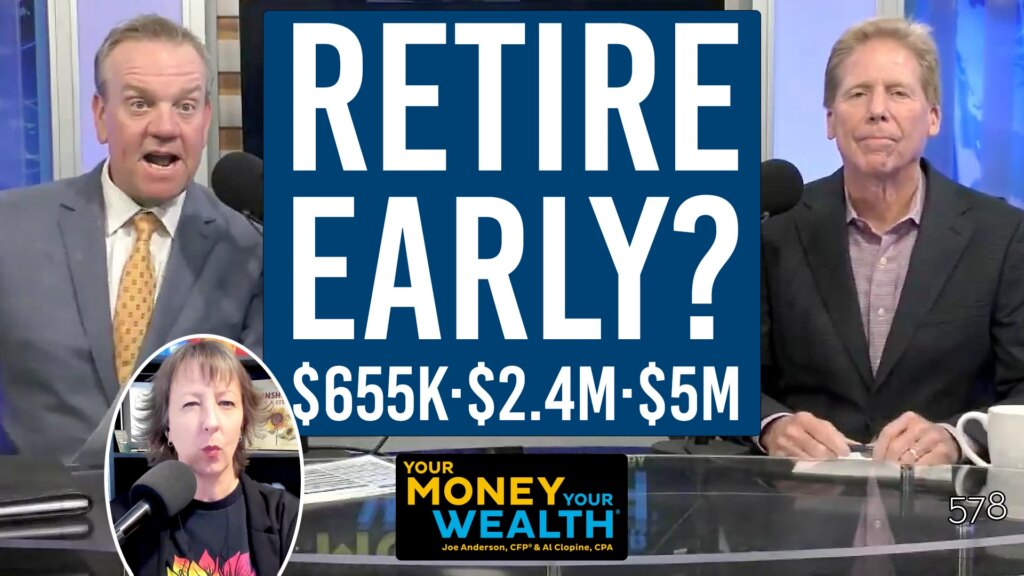
A large portfolio can solve many problems in retirement. It does not solve the need for a plan.
That may be the most underappreciated truth in personal finance. Households with substantial assets often assume retirement becomes mostly a lifestyle question once the balance sheet reaches a certain level. In practice, the questions only become more layered. How much can be withdrawn sustainably? When should Social Security begin? How should taxes be managed across account types? How concentrated is the portfolio? And what happens to the estate when the owners are gone?
These are not problems of scarcity. They are problems of structure. And structure matters whether a household has $500,000 or $5 million.
That is especially clear for affluent near-retirees who appear financially secure on the surface. A couple in their mid-50s with roughly $5 million spread across 401(k)s, Roth accounts and brokerage assets, plus future pensions and Social Security, may look obviously ready to retire. In many respects, they are. But even there, the success of the plan depends less on the size of the number than on how the moving parts are coordinated.
The temptation with a balance sheet that large is to simplify the problem too much. If annual spending is around $120,000 and fixed income later in retirement could be several times that amount, the plan can seem almost self-solving. But retirement does not arrive all at once. It unfolds in phases. Income sources start at different times. Taxes hit different account types differently. Required Minimum Distributions eventually change the equation. And the market does not care how confident the household felt when it retired.
That is why even wealthy households still need to model withdrawals carefully. A plan that looks safe at age 62 may need a different bridge strategy at 57. A household that can easily support spending in normal markets may still be exposed if it makes large withdrawals during a poorly timed downturn. The point is not that the plan is fragile. It is that retirement is smoother when the confidence is earned through analysis rather than assumed from account size alone.
This is also where pensions and Social Security deserve more attention than they often get. Guaranteed income changes the retirement math dramatically because it reduces the amount the portfolio must produce each year. For households with strong pension benefits, the portfolio may function less as the primary income engine and more as a support system for flexibility, taxes, legacy and discretionary spending. That is a powerful position to be in, but it still requires decisions about timing.
Social Security is the clearest example. Claiming early may help cash flow, but delaying can materially increase monthly income and strengthen survivor protection. For couples, that survivor angle matters just as much as the breakeven math. At least one spouse delaying to age 70 can create a larger guaranteed lifetime benefit for the surviving spouse, which is often one of the more durable forms of risk protection in a retirement plan.
Taxes complicate things further. A large traditional retirement balance is not the same thing as a large pool of spendable wealth. Future withdrawals will be taxed as ordinary income, and once RMDs begin, that income may become less optional than retirees expect. This is why affluent households often need to think in terms of tax diversification, not just asset diversification. Roth accounts, brokerage assets, cash reserves and tax-deferred savings each behave differently when it is time to spend.
That difference gives flexibility. A retiree who can choose between pulling from a brokerage account, taking Roth money, or drawing from a pre-tax account has far more control than one whose wealth sits almost entirely in a single tax bucket. The same logic applies to Roth conversions. Lower-income years before large RMDs or before full fixed income begins may create opportunities to move money strategically, particularly if the goal is to reduce future tax friction rather than merely defer it.
Portfolio construction matters too. Inheritance and concentrated stock positions often make households feel richer than they are diversified. A brokerage account inherited from a loved one or a large position in a high-performing sector can create the illusion of strength while quietly increasing fragility. The solution is not constant trading or market forecasting. It is broad diversification.
This is where many sophisticated investors still go wrong. They assume concentration is justified because the asset has done well or because a famous investor once held something similar. But concentration risk is still risk, even when it has recently paid off. Technology leadership, celebrity investing, and headline-driven themes may dominate for a while, but retirement portfolios are supposed to support life, not prove conviction. A more balanced allocation across U.S. stocks, international assets, value, growth and other diversifiers is often a better match for long-term retirement security than a portfolio leaning too heavily on whatever has recently worked best.
That same discipline applies to market volatility and political uncertainty. Affluent investors often feel a strong urge to react to elections, policy fears, economic headlines or high-profile moves by public investors. Usually the best response is more restrained. Review cash flow. Rebalance deliberately. Harvest tax losses when useful. Add non-correlated assets where appropriate. But avoid the temptation to make large, emotional changes because the headlines feel extraordinary. Retirement plans are damaged less by volatility itself than by poorly timed responses to it.
Then there is estate planning, which too many households treat as a secondary issue until it becomes urgent. A living trust, for example, does not create asset protection during the owner’s lifetime, but it can be an extremely efficient tool for probate avoidance, privacy and smooth asset transfer, especially in states where probate is expensive or slow. A will, financial power of attorney and healthcare directive remain foundational documents regardless of net worth. These are not merely legal formalities. They are the infrastructure that protects a family when the original decision-maker no longer can.
This is why retirement planning at higher wealth levels does not become simpler. It becomes broader. The questions expand beyond “Do I have enough?” to include “How do I withdraw efficiently?”, “How do I protect a spouse?”, “How should I diversify what I’ve inherited or built?”, and “What legal structure keeps my family from dealing with unnecessary chaos later?”
That broader view is healthy. It reflects the fact that retirement is not just a spending phase. It is also a tax phase, an investment phase, an estate phase and, for many people, a legacy phase. A strong portfolio can fund all of those goals. But only if the plan is built to do more than sit there looking impressive.
In the end, a $5 million retirement may be enough. It may be more than enough. But even then, confidence should come from a well-structured plan, not just a large number on a statement. Because retirement works best when wealth is not merely accumulated, but organized.
Intended for educational purposes only. Opinions expressed are not intended as investment advice or to predict future performance. Past performance does not guarantee future results. Neither the information presented, nor any opinion expressed constitutes a solicitation for the purchase or sale of any security. Consult your financial professional before making any investment decisions. Opinions expressed are subject to change without notice.
IMPORTANT DISCLOSURES:
• Investment Advisory and Financial Planning Services are offered through Pure Financial Advisors, LLC. A Registered Investment Advisor.
• Pure Financial Advisors, LLC. does not offer tax or legal advice. Consult with a tax advisor or attorney regarding specific situations.
• Opinions expressed are subject to change without notice and are not intended as investment advice or to predict future performance.
• Investing involves risk including the potential loss of principal. No investment strategy can guarantee a profit or protect against loss in periods of declining values.
• All information is believed to be from reliable sources; however, we make no representation as to its completeness or accuracy.
• Intended for educational purposes only and are not intended as individualized advice or a guarantee that you will achieve a desired result. Before implementing any strategies discussed you should consult your tax and financial advisors.