The Best Age to Claim Social Security Is Usually a Risk Decision, Not a Math Problem
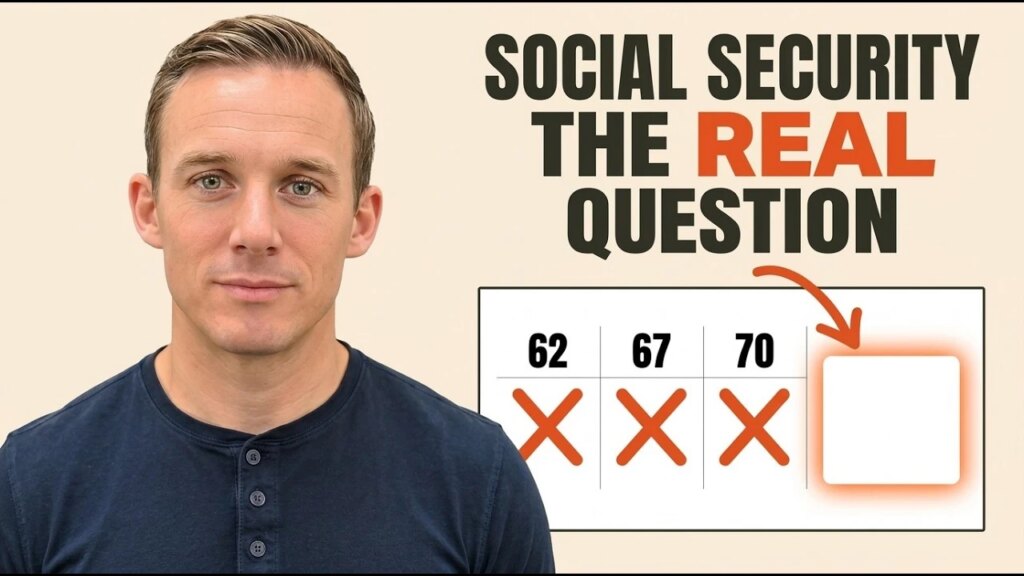
The Social Security decision is often framed as a puzzle with a clean answer. Take it at 62, 67, or 70. Run the break-even numbers. Pick the age where the math works best.
That approach is tidy. It is also too narrow.
The real Social Security question is not just when the total dollars received might even out. It is what kind of risk a retiree wants to protect against. Claim early, and you guard against the possibility of dying younger than expected. Delay, and you protect against the opposite risk: living a long time and needing a larger guaranteed income for far more years than you first imagined.
That is why the choice is better understood as a risk-management decision than a simple spreadsheet exercise.
The mechanics are straightforward enough. Claiming at 62 means taking a permanent reduction from the full retirement benefit. For many workers, that reduction is roughly 30% relative to waiting until full retirement age. Delaying beyond full retirement age increases the benefit further, with delayed retirement credits adding about 8% per year until age 70. The difference is meaningful. A benefit of $3,000 at full retirement age can rise substantially by 70.
This is where many people stop the analysis and focus on the break-even point. If the higher monthly benefit does not catch up until the early 80s, they ask why wait.
The answer is that retirement is not just a breakeven problem. It is an insurance problem.
Claiming at 62 is a bet that getting money sooner matters more than maximizing guaranteed income later. That can make sense for people in poorer health, with shorter life expectancy, or with immediate cash-flow needs. But it also locks in a smaller check for life. If the retiree lives into the 80s or 90s, that earlier decision can become increasingly expensive, especially if market returns disappoint or other assets do not perform as expected.
Waiting until 70 is the opposite bet. It sacrifices near-term cash flow in exchange for a larger lifetime benefit. That larger check does more than improve the retiree’s own income. It also increases survivor protection. In a married household, the surviving spouse generally keeps the larger of the two benefits. That makes the claiming decision especially important for the higher earner. A larger delayed benefit can become one of the most valuable forms of longevity insurance in the entire retirement plan.
This is one reason the usual “take it early and invest it” argument is often incomplete. Yes, a household could claim earlier and preserve portfolio assets by drawing less from them. But delaying benefits can also reduce future withdrawal needs, lower pressure on the portfolio later, and strengthen the household’s guaranteed-income floor when it may matter most. The decision affects not just the benefit itself, but the entire structure of retirement income.
Market conditions complicate the decision further. A retiree who delays Social Security until 70 may need to spend more from cash or investments between 62 and 70. If those years include a serious market downturn, that bridge can become more painful than expected. Sequence-of-returns risk matters here. A plan that looks elegant in average-return assumptions may feel much less comfortable if the bridge years coincide with weak markets.
That is why delaying Social Security is not always the right move even when the long-term math looks strong. The portfolio needs to be able to support the in-between years without creating a different problem. A retiree with modest assets and high withdrawal needs may be forced into early claiming, not because it is mathematically superior, but because the bridge to 70 is too risky or too expensive to cross.
Taxes matter too. The years between retirement and age 70 can be uniquely valuable for tax planning. Income may be lower before Social Security and required withdrawals begin, which can create room for Roth conversions, capital-gain harvesting, or other tax moves that become harder once guaranteed income rises. Delaying Social Security can therefore do more than increase the check. It can also create a planning window.
State taxes can influence the net value of benefits as well. Some states do not tax Social Security, while others impose varying rules on retirement income. Federal taxation also depends on overall income and can make a substantial share of benefits taxable. For higher-income retirees, the decision is not just about the gross check. It is about how that check interacts with the rest of the plan.
The biggest mistake is to treat the decision in isolation.
Social Security should not be claimed based solely on a headline break-even age or a fear that “the system might change.” It needs to be coordinated with life expectancy, spouse’s benefits, other assets, spending needs, tax strategy, healthcare costs, and the retiree’s tolerance for using the portfolio more aggressively in the early years. A person with a strong nest egg may choose to delay because the larger future income is worth more than the near-term cash. A person with limited savings or uncertain health may reasonably claim earlier. Both choices can be right in the proper context.
That is the larger point. There is no universally optimal age to claim Social Security.
There is only the age that best fits the risks a particular household wants to insure against. For some, that means taking the money early and accepting the permanent haircut. For others, it means delaying as long as possible to build the strongest floor for a long retirement and for the surviving spouse.
The decision is not really about beating the system. It is about deciding which future you most need protection from.
You should always consult a financial, tax, or legal professional familiar about your unique circumstances before making any financial decisions. This material is intended for educational purposes only. Nothing in this material constitutes a solicitation for the sale or purchase of any securities. Any mentioned rates of return are historical or hypothetical in nature and are not a guarantee of future returns.
Past performance does not guarantee future performance. Future returns may be lower or higher. Investments involve risk. Investment values will fluctuate with market conditions, and security positions, when sold, may be worth less or more than their original cost.