The Retirement Regret That Comes From Waiting Too Long to Live
Retirement planning usually treats waiting as a virtue. Work another year, make another contribution and allow the portfolio to grow a little larger. Delay Social Security and the monthly benefit increases. Postpone a major trip until the financial projections look even safer.
Each decision can be reasonable. Together, they can create a trap.
A worker may reach the point at which retirement is financially possible but continue working because the portfolio is still rising, the salary remains attractive and leaving a career feels more unsettling than staying. The additional money provides visible reassurance, while the cost of postponement is harder to measure. There is no account statement showing the healthy years, family time or freedom that may be lost.
The danger is not working longer by choice. Some people genuinely enjoy their careers and gain purpose, relationships and satisfaction from continuing. The regret arises when work continues mainly because momentum has replaced intention.
A sound retirement plan should protect against running out of money. It should also protect against running out of time.
The Momentum Trap Can Keep Moving the Finish Line
Financial progress produces its own gravitational pull. A portfolio that reaches $2 million creates a desire to see $2.5 million. A pension grows with another year of service. Social Security becomes more valuable when delayed, and a bonus expected next spring makes retirement this fall seem premature.
There is always another financial reason to wait.
The problem is that the benefits of working longer are easy to quantify while the costs are not. An adviser can estimate how another year of salary, contributions and investment growth may affect a retirement projection. It is much harder to place a value on hiking while the knees still cooperate, traveling with a healthy spouse or spending unstructured time with grandchildren before they become teenagers.
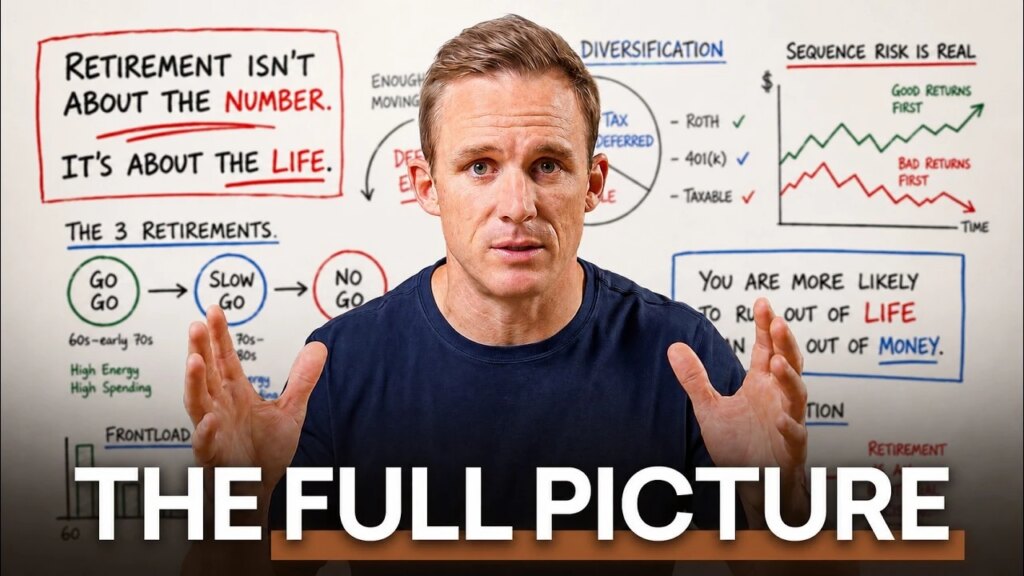
Retirement is not one permanent phase beginning at 65 and continuing unchanged for the rest of life. The early years are often the most physically active and flexible. Later years may still be meaningful, but health, caregiving responsibilities and mobility can narrow the available choices.
A person who plans to travel extensively at 75 may discover that the trip imagined at 60 no longer feels practical. The money remains available, but the opportunity has changed.
This does not mean everyone should retire at the earliest possible age. It means the value of another working year should be compared with what that year is displacing. When the plan is already strong, a higher ending balance may improve life less than an additional year of freedom.
Retirement Income Must Replace More Than a Paycheck
Leaving work converts a familiar financial system into one the retiree must construct personally.
During employment, income generally arrives through regular payroll deposits. Taxes, retirement contributions, insurance premiums and other deductions are handled automatically. After retirement, income may come from Social Security, pensions, taxable investments, traditional retirement accounts, Roth accounts, rental properties and cash reserves.
Each source has different tax and investment consequences. A pension may provide dependable income but little flexibility. A traditional IRA withdrawal is generally taxable. A qualified Roth withdrawal may be tax-free, while a brokerage sale may create a capital gain based only on the appreciation rather than the entire amount withdrawn.
The strongest plan does not simply identify enough assets to cover spending. It establishes which accounts will provide income, when those withdrawals will begin and how the strategy will respond to changing markets and tax laws.
A retiree may use taxable savings during the first years after work, complete measured Roth conversions while taxable income is relatively low and delay Social Security to increase future guaranteed income. Another may claim Social Security early to reduce pressure on a modest portfolio. Neither approach is universally correct.
The sequencing should serve the household’s broader risks. Those risks include taxes, market declines, inflation, longevity and the possibility that one spouse will eventually manage the finances alone.
Delaying Social Security Is Valuable but Not Automatically Optimal
Social Security rewards delayed claiming with a larger monthly benefit. For someone born in 1960 or later, claiming at 62 generally reduces the retirement benefit by about 30% from the amount available at the full retirement age of 67. Waiting from 67 until 70 raises the monthly benefit to 124% of the full-retirement-age amount. The increase stops at 70.
That larger payment can be especially valuable for a healthy retiree with longevity in the family or for the higher earner in a married couple. Delaying may increase the income available to a surviving spouse and provide more protection if retirement lasts into the 90s.
The conventional advice to wait can become too rigid, however. A person retiring at 62 may need to withdraw heavily from investments for eight years to reach 70. If markets fall early in retirement, those withdrawals can force the sale of more shares at depressed prices and permanently weaken the portfolio.
Claiming Social Security earlier can reduce that pressure. The smaller benefit begins covering part of the household budget immediately, allowing more investments to remain intact. Whether that trade-off is worthwhile depends on the retiree’s health, portfolio size, spending needs, survivor considerations and willingness to accept market risk.
A retiree with substantial liquid assets may be able to fund the delay comfortably. Someone with limited savings may create greater financial danger by insisting on waiting.
The correct claiming age is therefore not the age that produces the largest monthly check. It is the age that strengthens the entire retirement plan.
Tax Planning Changes After the Salary Ends
Working households have limited control over when salary becomes taxable. Retirement can create more flexibility because the household chooses which accounts to use and how much income to recognize.
This control is particularly valuable during the years after employment ends but before Social Security and required minimum distributions begin. Traditional IRA owners generally must begin required withdrawals at age 73 under current law, although some workplace-plan participants who remain employed may qualify for different timing.
A retiree may use this lower-income period to convert part of a traditional IRA to a Roth account. The conversion creates taxable income today but can reduce future required distributions and provide a source of potentially tax-free qualified withdrawals.
The strategy should not be reduced to filling a particular tax bracket every year. A conversion can affect Medicare premiums, taxation of Social Security, capital-gains rates and state taxes. It also requires cash to pay the resulting bill.
Retirement-income planning should evaluate the total cost of each withdrawal rather than looking only at the account balance. Spending $80,000 from a Roth account, a traditional IRA or a taxable brokerage account can produce three very different tax returns.
This flexibility can disappear later. Once Social Security, pensions and mandatory distributions are arriving simultaneously, the retiree may have less ability to control taxable income. The opportunity is valuable precisely because it is temporary.
A Growing Portfolio Needs a Purpose
Accumulation can become a habit long after the original financial goal has been met.
A household may continue reinvesting every dividend, delaying purchases and avoiding withdrawals because spending from the portfolio feels like failure. The account grows, but no clear decision has been made about what the additional money is intended to accomplish.
A financial plan should assign jobs to the wealth.
One portion may support essential retirement spending. Another may fund travel during the early years, future health care, assistance to children or charitable giving. A separate amount may be reserved as an inheritance.
Without those distinctions, every dollar can appear equally untouchable. The retiree protects money intended for an undefined future while declining experiences that were supposedly the reason for saving.
Legacy goals deserve particular clarity. Leaving money to heirs may be deeply important, but the desired amount should be quantified. A household intending to leave $500,000 should not accidentally leave $4 million because fear prevented reasonable spending.
The purpose of investing is not to make the portfolio grow indefinitely. It is to finance priorities that cannot be supported by current income alone.
Insurance Should Change as the Household Changes
Insurance purchased during the working years may no longer fit retirement.
A parent may have carried substantial term life insurance to replace salary and support dependent children. Once the children are independent, the mortgage is manageable and the surviving spouse has sufficient assets, the original death benefit may no longer be necessary.
The opposite problem can also occur. Property values rise, valuable possessions accumulate and liability coverage remains unchanged for years. A serious accident involving a vehicle, rental property, swimming pool or household employee could expose more wealth than the underlying auto or homeowners policy protects.
A personal umbrella policy can provide additional liability coverage above the limits of homeowners, renters and auto insurance. The National Association of Insurance Commissioners advises reviewing such protection as assets and liability exposure grow.
Retirees should review property replacement values, deductibles, liability limits and exclusions rather than renewing policies automatically. Downsizing, relocating or adding a second home may create new coverage needs. Allowing an adult child to use a vehicle or converting a residence into a rental can also change the risk.
Insurance is not a product that should be purchased once and ignored. It should evolve with the assets and obligations it is meant to protect.
Long-Term Care Can Affect Two Retirements at Once
A prolonged need for assistance can place pressure on far more than the person receiving care.
A spouse may reduce activities, take on physical caregiving responsibilities or pay for home assistance and facility care from assets intended to support both lives. Even when the household can technically afford the expense, the event may alter housing, inheritance and the surviving spouse’s financial security.
Traditional Medicare generally does not cover extended custodial care when a person needs help with ordinary daily activities rather than skilled medical treatment. Medicaid may help after eligibility requirements are satisfied, but relying on Medicaid can limit choices and may require substantial financial restructuring.
Long-term-care insurance can transfer part of the risk, though premiums, benefit limits and eligibility vary. Some households use hybrid life and long-term-care products, while others reserve a defined portion of the portfolio for possible care.
There is no universal answer. A household with substantial wealth may be able to self-fund. Someone with limited assets may be more likely to depend on Medicaid. Those in the middle may face the most difficult choice because a prolonged event could consume a meaningful portion of savings without making insurance premiums easy to afford.
The mistake is not declining a particular policy. It is failing to decide how care would be funded, who would provide it and how the healthy spouse would be protected.
Hidden Liability Risks Grow With Net Worth
Retirees often focus on investment risk while overlooking legal and property exposure.
A larger portfolio can make someone a more attractive target in a lawsuit. A severe automobile accident, injury on a property or claim involving a rental unit can exceed standard policy limits. The primary policy may cover legal defense and damages only up to its stated amount, leaving personal assets exposed above that level.
Umbrella coverage can extend liability protection, but it generally requires adequate underlying auto and property limits. The policy may also contain exclusions for business activities, certain rental arrangements or other risks.
Asset protection extends beyond insurance. Proper property titling, business entities, estate documents and beneficiary designations can determine what happens during incapacity, death or litigation. A rental property held personally may create a different risk than one maintained through an appropriately operated legal entity, although an entity does not replace insurance or protect against every personal act.
The household’s protection should be reviewed whenever net worth, property ownership or family circumstances change. The plan that was adequate at 45 may be insufficient at 65 after decades of asset growth.
Retirement Requires Letting Go of an Identity
Financial hesitation is not always about money.
A career can provide status, routine, relationships and proof of competence. Leaving may feel like surrendering a part of the self, particularly for someone whose professional title has shaped introductions and daily life for decades.
That loss can hide behind financial language. The worker says another year is needed for safety when the real concern is not knowing who that person will be without the job. The portfolio becomes the justification for avoiding a more difficult emotional transition.
Retirement does not automatically create purpose. It creates time.
That time can become deeply satisfying when filled with relationships, health, service, learning and meaningful responsibilities. It can also become isolating when the retiree has planned only to stop working.
The transition should begin before the retirement date. A future retiree can strengthen friendships, experiment with volunteer work, develop hobbies and test what an ordinary week might look like without a job. Part-time or consulting work can provide a bridge for someone who wants less pressure without losing every professional connection immediately.
The goal is not to replace one demanding schedule with another. It is to build enough structure that freedom does not become emptiness.
Couples Need More Than a Shared Retirement Date
Two spouses can agree that they are ready financially while holding completely different expectations for retirement.
One may imagine constant travel, while the other wants a quieter life near family. One may expect the couple to spend nearly every day together, while the other wants independent activities. A spouse who has already retired may have built routines that are disrupted when the second person stops working.
These differences can affect spending as well as relationships. Travel, relocation, gifts to children and home renovations all compete for the same financial resources. The portfolio may support many goals, but not every goal at the same time.
Couples should describe an ordinary retirement month rather than discussing only major dreams. They should decide how much individual time each person expects, where they intend to live, which family obligations they will accept and which expenses would be reduced during a difficult market.
Retirement should not be the first time these assumptions become visible.
A strong financial plan can still produce a poor transition when one spouse feels controlled, isolated or disappointed. The household needs a shared framework with room for two distinct lives.
The Best Retirement Years Cannot Always Be Postponed
Traditional planning often assumes that spending should be preserved evenly across a 30-year retirement. Actual life does not unfold that way.
The earliest years may be the best time for physically demanding travel, long visits with family and activities requiring stamina. Later years may involve more local spending, health care and assistance. A rigid commitment to preserving the same portfolio balance can prevent retirees from using money when it would create the greatest value.
This is not an argument for reckless early spending. A retiree still needs protection against longevity, inflation and care costs. It is an argument for recognizing that a dollar spent at 62 may not be interchangeable with a dollar available at 87.
A well-designed plan can create a higher discretionary budget during the healthier years while reserving dependable income and assets for later needs. Travel may be reduced after poor markets, but it should not be postponed indefinitely merely because the portfolio could always be larger.
The purpose of financial security is to create the confidence to use resources intentionally.
Retirement Is a Window of Freedom, Not a Final Destination
People often speak of retirement as though reaching it completes the plan. In reality, retirement begins another series of transitions.
The active phase may include travel, hobbies and family involvement. A later phase may become more home-centered. Eventually, health or caregiving needs may determine how time and money are used.
The word “retirement” can therefore obscure the limited nature of its most flexible years. The freedom to go anywhere, do anything and organize life without work obligations may not last indefinitely.
That reality should create urgency without panic.
Retirees do not need to complete every dream immediately. They do need to identify which experiences depend on health, mobility and the presence of particular people. Those priorities deserve earlier funding than goals that can be pursued under a wider range of circumstances.
Financial planning works best when it recognizes that time, like money, is a limited asset.
A Successful Plan Protects Against Both Kinds of Scarcity
Retirement planning is usually designed to prevent financial scarcity. It calculates how much can be withdrawn, how long assets may last and how the household will respond to inflation or a market decline.
A complete plan also considers scarcity of time.
Working longer may improve the numbers while reducing the years available to use them. Delaying Social Security may strengthen future income while placing greater pressure on investments today. Preserving every dollar for heirs may deprive the retiree of experiences the family never expected to be sacrificed.
The correct balance will differ among households. Some people need to continue working because the plan is not yet secure. Others enjoy work enough that leaving would reduce their quality of life. The warning applies to those who already possess sufficient resources but remain caught in the belief that more money will eventually create certainty.
Complete certainty never arrives. Markets remain unpredictable, health changes and tax laws evolve. Another year of work can reduce some risks, but it cannot remove them all.
A strong retirement plan establishes enough income, liquidity, insurance and long-term protection to make living possible—not merely survival likely. It identifies what the money is for and gives the retiree permission to use it.
The deepest retirement regret may not be spending too much. It may be realizing that the healthiest years were exchanged for money that was never needed.
You should always consult a financial, tax, or legal professional familiar about your unique circumstances before making any financial decisions. This material is intended for educational purposes only. Nothing in this material constitutes a solicitation for the sale or purchase of any securities. Any mentioned rates of return are historical or hypothetical in nature and are not a guarantee of future returns.Past performance does not guarantee future performance. Future returns may be lower or higher. Investments involve risk. Investment values will fluctuate with market conditions, and security positions, when sold, may be worth less or more than their original cost