ESOX X2 UGV: The Car Tech Heading to the Battlefield
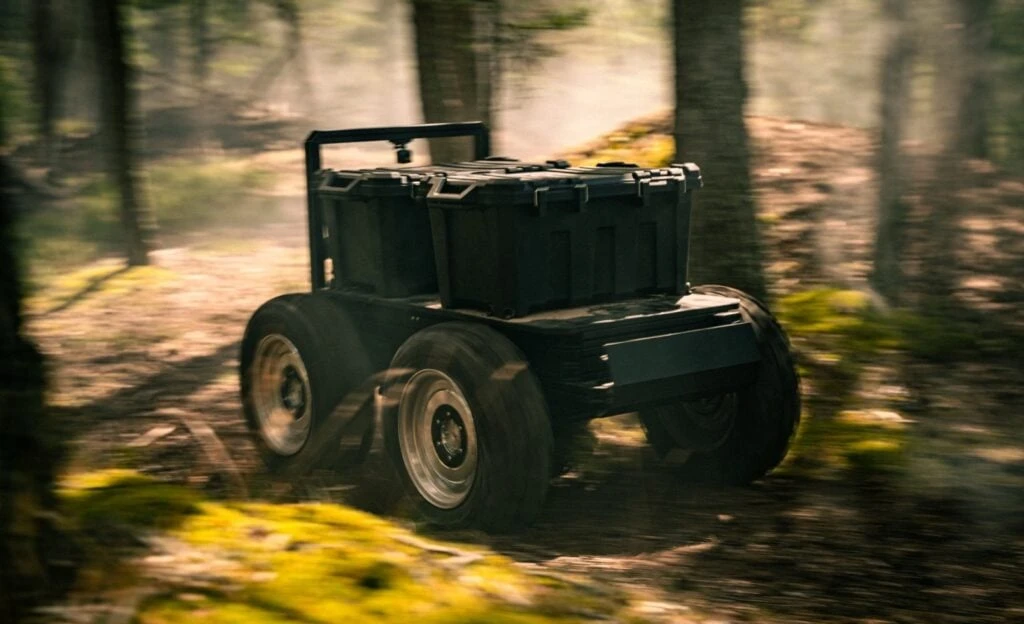
The ESOX X2 UGV combines in-wheel motors, solid-state batteries and software-defined controls, but its biggest claims deserve scrutiny.
Why the ESOX X2 UGV matters to car people
The most interesting thing about the ESOX X2 is not that it has no driver. The automotive world has spent years talking about autonomy. What makes this machine worth watching is that it combines three ideas passenger-car engineers are also chasing: motors at the wheels, next-generation batteries and a vehicle architecture designed to change through software.
ESOX has completed the X2 and says customer pilots are now open. The vehicle is a 300-kilogram unmanned ground platform intended for military and security work, and the supplied release says it has already been tested with as much as 300 kilograms of payload. ESOX believes later development could double that payload figure to 600 kilograms.
The ESOX X2 Unmanned Ground Vehicle
That is not a shopping recommendation for the family driveway, obviously. It is a useful technology case study. Military machines are forced to answer questions that civilian EVs can sometimes hide behind generous pavement, convenient charging and carefully managed temperatures. What happens when an electric vehicle has to crawl through loose ground, climb while loaded, stay quiet and continue working when the easy route disappears?
Those demands make the X2 a harsh test bench for technologies that may eventually influence ordinary electric vehicles.
You may also enjoy: 3D-Printed Batteries Could Change EV Design
In-wheel motors attack one of the oldest drivetrain compromises
Most electric cars are mechanically simpler than gasoline vehicles, but they still usually put one or more traction motors inside the body and send torque through half-shafts, differentials or reduction gearing. The X2 moves the motors to the wheels.
Its four Theron units are rated in the August 24 release at 250 Nm each, giving 1,000 Nm combined. That layout eliminates a conventional gearbox and driveshaft arrangement and lets propulsion act much closer to the tire.
There are obvious attractions. Fewer intermediate components can mean less packaging, fewer mechanical interfaces and more precise control at each corner. The U.S. Department of Energy explanation of electric vehicles makes the civilian comparison clear: an EV already replaces the combustion engine with electric traction hardware, but the rest of the vehicle architecture still determines how efficiently that power reaches the road.
The ESOX X2 Unmanned Ground Vehicle
In-wheel motors have also been a recurring automotive dream because they can free space elsewhere in the chassis. The challenge in a passenger car is that adding motor mass at the wheel can increase unsprung weight, which can affect ride and wheel control. A low-speed military robot faces a different set of compromises, so success on the X2 would not automatically prove that the same solution belongs on a luxury sedan.
This is where the X2 becomes useful to watch. It can show whether direct drive at each wheel brings enough traction, packaging and durability benefit to justify moving major propulsion hardware out to the corners.
ESOX’s public page for its broader Tank Steer UGV platform currently advertises 120 kW peak power, 1,200 Nm peak torque, up to 600 kilograms of payload and a claimed range beyond 200 kilometers. Those are not the exact figures in the newly supplied X2 pilot release. The release gives 1,000 Nm and says 300 kilograms of payload has been tested so far, with 600 kilograms projected. Anyone evaluating the technology should keep demonstrated configuration and platform target on separate lines.
You may also enjoy: The New S-Class Is Mercedes’ Answer to Tesla’s Hype
The solid-state battery claim is the part to interrogate hardest
ESOX says the X2 carries an 8 kWh solid-state battery made from two 4 kWh modules. The company further says the pack offers roughly double the energy density ESOX attributes to leading lithium-ion cells already deployed in military ground vehicles, allowing the same mass to support more range or more operating time.
If that statement holds up under customer testing, it changes the vehicle equation substantially. Batteries are not free energy. Every kilogram devoted to storage is a kilogram unavailable for cargo, sensors, armor, communications equipment or other mission hardware. Higher specific energy can therefore buy range, payload or some combination of both.
Solid-state batteries are also relevant far beyond defense. The Department of Energy explains that solid-state designs use a solid electrolyte and may bring safety and energy-density advantages. Automakers and battery companies have spent years trying to move the chemistry from development programs into repeatable, high-volume production.
The caution is that ESOX’s current announcement does not provide independent test documentation for the X2 pack’s energy-density claim. It is a company statement, and it should be treated as one until pilot data or third-party validation establishes the measurement conditions.
The ESOX X2 Unmanned Ground Vehicle
There is additional context. ESOX said in January that it had a defense-focused licensing arrangement covering battery technology first announced by Donut Lab. VTT Technical Research Centre of Finland confirms on its own website that Donut Lab commissioned it to measure properties of battery samples. VTT’s notice says Donut Lab would publish those results and answer questions about its technology. The VTT page itself does not certify every performance figure later used in commercial marketing.
That distinction is important because the X2 story is stronger when the claims are separated from the hardware that has actually been demonstrated. ESOX says the vehicle exists, the motors are installed, the 8 kWh pack is installed and the platform has carried 300 kilograms in testing. The assertion that this battery architecture stores roughly twice the energy of lithium-ion cells fielded in comparable military vehicles is a separate proposition that customer pilots can test.
You may also enjoy: BYD’s Five-Minute EV Battery Charge Is Detroit’s Problem
Software, autonomy and the old defense-to-car loop
The other familiar idea inside the X2 is software-defined architecture. ESOX OS is intended to let engineers simulate a vehicle before hardware assembly, then collect telemetry from fielded units and deliver over-the-air updates after deployment.
That sounds remarkably close to the direction of modern road cars. Mercedes-Benz, Lucid, Tesla and others increasingly treat the vehicle as a computing platform whose behavior can be changed after production. The difference is that a military UGV may need new sensor packages, communications layers or autonomy modes because the mission changed, not because the owner wanted a new dashboard feature.
ESOX says those mission elements can be altered without rebuilding the core X2 hardware. That could be valuable because robotic platforms age differently from conventional vehicles. Cameras improve. Compute hardware changes. Communications protocols evolve. Autonomy software gets revised. A durable rolling base that can accept those changes may stay relevant longer than a tightly integrated machine designed for one task.
There is a catch familiar to anyone following connected cars. Every additional software pathway creates another system that must be secured and validated. NIST has warned that highly software-based automated vehicles bring cybersecurity challenges, including risks associated with wireless updates. In a military platform, the consequences of a compromised communications or control layer can be far more serious than an infotainment outage.
This is why the software story should not be reduced to the attractive phrase “over-the-air updates.” The real test is whether the platform can accept rapid changes while maintaining control integrity, predictable behavior and useful operation when communications are degraded.
The ESOX X2 Unmanned Ground Vehicle
Modern autonomous-car development also has deep roots in defense research. DARPA’s Grand Challenges in 2004, 2005 and 2007 pushed teams to build vehicles that could navigate difficult terrain and later urban traffic without human control. That work helped seed the research community that ultimately fed today’s self-driving industry.
Now some of the ideas refined in civilian mobility are flowing back into military ground systems. Commercial battery research, vehicle software, AI, sensors and electric propulsion are being repurposed for machines expected to operate in conditions far less forgiving than a mapped city street.
The U.S. Army’s August 21 report on autonomous ground vehicle integration makes clear that this is not theoretical. Army researchers are working with industry on automated vehicles paired with artificial intelligence and soldiers. NATO has also documented the rapid iteration of UGVs in Ukraine, where robots have taken on supply runs, scouting duties and the evacuation of wounded personnel.
That real-world feedback is especially useful as a reality check. NATO’s profile of ARX Robotics describes an early unmanned platform that failed immediately after reaching the Ukrainian front. The company then redesigned it with soldiers around the environment it actually encountered. That is exactly the kind of development cycle the X2 pilot program now has to survive.
You may also enjoy: Robotaxi Emergency Scenes Still Challenge Driverless Cars
What pilot customers need to prove
The most useful question is not whether the X2 looks impressive in a controlled demonstration. Customer pilots should expose the relationship between its three big systems.
Can the in-wheel motors sustain useful torque without overheating or losing efficiency when the vehicle is loaded? Does the battery deliver enough energy under repeated climbs, soft terrain and temperature swings to justify its claims? Does the software remain flexible without becoming fragile? Can a damaged wheel module be serviced quickly? How much range remains when payload rises? Those are the questions that turn specifications into a vehicle.
ESOX also says the Theron motors run near-silent and relatively cool, reducing acoustic and thermal signature. That makes sense as a design objective, but the degree of tactical benefit depends on the complete vehicle, operating load, environment and sensor threat. Pilot programs are where that kind of statement should acquire numbers.
The company’s business model is also being tested. Devan Roberts says customers can license the platform and develop their own variants around the same motors, batteries, electronics and ESOX OS. That positions the X2 less like a finished model and more like a skateboard architecture for defense, a core chassis that different users can adapt around their own payloads and missions.
Automotive companies have chased a similar idea for years with modular EV platforms. Standardize the expensive underpinnings, then build multiple products on top. ESOX is applying that logic to a market where the “body style” might be logistics one day, reconnaissance the next and a completely different sensor suite for another customer.
You may also enjoy: Waymo’s 2026 Expansion Explained: Where Robotaxis Go Next
For car engineers, the X2 is a reminder that electrification is not merely replacing an engine with a battery and motor. The more interesting opportunity is architectural. Remove mechanical layers. Put propulsion where it is most useful. Use software to make the hardware adaptable. Improve energy storage enough that payload and range stop fighting quite so hard.
None of that means the X2’s technologies will migrate directly into passenger cars. Military vehicles can accept compromises in ride, cost, noise, serviceability and certification that consumers would reject. Defense programs also measure value differently when endurance or lower detectability can matter more than purchase price.
Still, harsh-use platforms have a way of revealing which ideas are robust and which survive only on presentation slides. If ESOX’s pilots validate the wheel motors, battery performance and modular software under repeated field use, the X2 could become a useful proof point for technologies the automotive industry has been promising for years.
The strongest reason to watch it is also the simplest: this machine is moving from claims toward customers. The next chapter should contain data.