Lamborghini Temerario Tricolore Is a Bespoke Blueprint
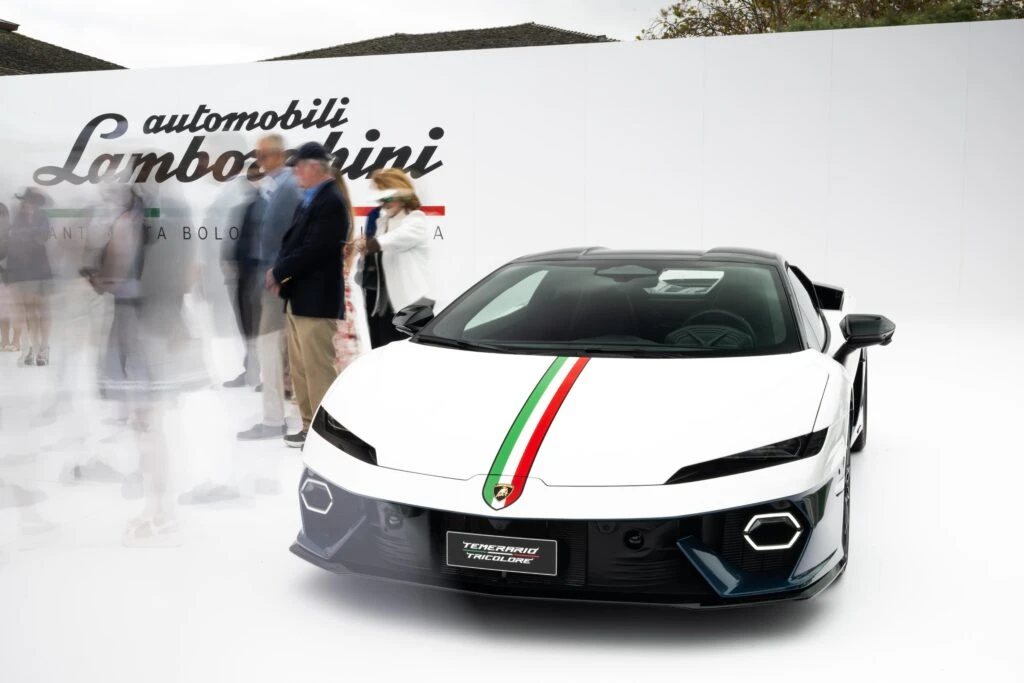
The Lamborghini Temerario Tricolore shows how Ad Personam can turn factory customization into a coherent design story for the hybrid era.
Lamborghini Temerario Tricolore Is Really About Authorship
The most important word in Lamborghini’s announcement is not “Tricolore.” It is “configuration.” The Lamborghini Temerario Tricolore is presented as a bespoke specification of the Temerario, not as a newly announced limited-production model, a faster derivative or a separate mechanical edition. That distinction changes how I think buyers and collectors should read the car.
At this end of the market, a spectacular paint scheme can attract almost as much attention as a new powertrain. Monterey Car Week encourages exactly that kind of theater. The Quail is full of vehicles built to make wealthy enthusiasts stop mid-conversation. Yet the more interesting part of this Temerario is the process behind the colors. Lamborghini says Centro Stile created the design and Ad Personam helped finalize it. That puts the factory personalization program much closer to product design than to a conventional options sheet.
Lamborghini Temerario Tricolore
The result arrived with a useful piece of history attached. Before this reveal, Lamborghini’s previous use of the Tricolore badge dated to 2011’s Gallardo LP 550-2 Tricolore, introduced during celebrations marking a century and a half of Italian unification. The new car revives the green, white and red reference, but does not attempt to recreate the Gallardo. That is a smart choice. Heritage works better when it gives a new car context instead of forcing a new car to dress like an old one.
There is also no separate price or production cap in Lamborghini’s August 24 announcement. That does not make the specification less interesting, but it does mean buyers should resist treating “Tricolore” as automatic shorthand for a numbered special series. The announcement supports a story about design authorship and personalization. It does not, by itself, establish scarcity.
You may also enjoy: How Lamborghini Conquered Monterey Car Week
The Hybrid Hardware Makes the Tailoring Credible
There is a reason Lamborghini can devote an entire reveal to color, material and craftsmanship: the Temerario underneath is already an extreme piece of engineering. Its 4.0-liter twin-turbo V8 works with three electric motors for a stated 920 CV. Lamborghini says 100 km/h arrives from rest in 2.7 seconds, with maximum speed exceeding 340 km/h.
The figure that tells you the most about Lamborghini’s priorities may be 10,000 rpm. Turbocharged engines are often associated with huge midrange shove rather than soaring engine speed, yet this V8 can reach five figures. Electrification is being used in a car whose combustion engine is still expected to provide theater, not merely act as a quiet generator behind the scenes.
Lamborghini Temerario Tricolore
Lamborghini calls the Temerario an HPEV, or High Performance Electrified Vehicle. For readers trying to sort manufacturer branding from the wider vocabulary of electrified propulsion, the U.S. Department of Energy’s plug-in hybrid explainer shows how gasoline engines, batteries and electric motors can share the work. Its overview of electric-drive systems also explains the roles played by motors, power electronics and related hardware.
The electric side should not be treated as a decorative efficiency badge. The Department of Energy’s material on traction motors explains how stored electrical energy becomes mechanical energy, while its battery research provides useful background on why power, weight, durability and packaging matter in electrified vehicles. In a supercar, those engineering tradeoffs are especially difficult because every added component has to justify the mass and space it consumes.
Lamborghini Temerario Tricolore
None of that hardware changes for the Tricolore according to the material Lamborghini released. That is precisely why calling this a configuration matters. You are looking at a visual and material interpretation of the Temerario, not a claim that the Italian-flag stripe suddenly found another tenth of a second.
You may also enjoy: 2026 Lamborghini Temerario vs. Ducati Panigale V4: Italy’s Most Unhinged Family Argument Hits the Drag Strip
Heritage Works Best When It Does Not Become Costume
The exterior is much more sophisticated than simply applying three national colors to a white supercar. Blu Marinus Shiny occupies the lower body, while Bianco Monocerus covers the upper surfaces. Glossy Nero Noctis appears on elements including the mirrors, wheels and engine-cover area. Red brake calipers add another point of contrast, and the unmistakable green-white-red graphic runs down the hood.
That arrangement changes the apparent proportions of the Temerario. The dark lower section visually plants the car closer to the ground, while the white upper body draws attention to the rising line that runs from the front arches toward the rear shoulders. It also leaves the hexagonal lighting, exposed engine and aerodynamic surfacing recognizable as Temerario features instead of burying them under a nostalgia exercise.
Lamborghini Temerario Tricolore
This is where the comparison with Lamborghini’s recent Revuelto Miura 60° Homage is useful. That car uses historic colors and details to refer directly to one of Lamborghini’s foundational models, and Lamborghini limited that program to 99 examples. The Temerario Tricolore is doing something different. It references national identity rather than a single predecessor, and the company’s announcement does not state a fixed production quantity for the configuration.
Those differences matter to collectors because provenance is not the same thing as rarity. A well-resolved factory specification can be desirable because of who designed it, why it exists and how completely its details fit together. A numbered edition adds a separate scarcity story. Buyers should know which story they are paying for.
Lamborghini Temerario Tricolore
The Gallardo connection still gives the Temerario historical continuity. Fifteen years separate the two Tricolore interpretations, but the visual language has moved on. The earlier car made the Italian flag a prominent identifying stripe. The new one lets the national colors sit inside a much broader two-tone composition. It feels more like a design brief than an anniversary sticker.
You may also enjoy: Lamborghini Miura Tribute: Only 99 Will Ever Exist
Ad Personam Is Moving Closer to Product Design
The interior may be the clearest evidence that Lamborghini wants Ad Personam to be understood as something more ambitious than choosing unusual leather. Nero Ade upholstery creates the dark foundation. Rosso Alala stitching supplies the contrast. A dedicated silhouette of the Temerario appears in the rear cabin trim, while Tricolore lettering is embroidered into the door panels.
Individually, none of those details is revolutionary. Collectively, they reveal the discipline required for good personalization. The color story outside has to make sense with the stitching inside. Graphic elements have to repeat without becoming visual noise. The customer should be able to recognize the base car, yet the finished object needs enough specificity to feel intentional.
That is also why Lamborghini’s 20th anniversary of Ad Personam is more than a convenient birthday for the press release. Factory personalization has become part of how the company presents its highest-end products. Earlier this summer at Goodwood, Lamborghini presented a pair of individually tailored Temerario examples through Ad Personam. Monterey adds another example, but this one carries a theme that can be understood immediately from across a lawn.
Lamborghini Temerario Tricolore
For Lamborghini, the strategic value is clear. The company’s model line is now fully hybridized across Revuelto, Urus SE and Temerario. As propulsion systems become more technically complex and more standardized within each model family, personalization gives customers another place to create distinction. It can also deepen the relationship between the buyer and the factory without requiring a different engine, body structure or homologation program for every special-looking car.
There is a fine line here. Personalization can strengthen a design, or it can make an expensive vehicle look like somebody clicked every box in a configurator after a long lunch. The Tricolore succeeds because the colors and details repeat a single idea. The white, deep blue, black, red and Italian flag references have a hierarchy. Nothing has to shout over everything else.
You may also enjoy: Lamborghini Monterey Car Week: Miura Meets 801-HP Urus
What a Buyer Should Ask Before Ordering One
If you are actually in a position to order a Temerario through Ad Personam, the first question is not whether the Tricolore looks good in photographs. It does. The useful questions concern exactly what Lamborghini will allow you to reproduce, change or commission.
Start with status. Ask whether “Temerario Tricolore” is being offered as a defined factory configuration customers can select, whether elements can be altered through Ad Personam, and whether Lamborghini plans any numerical limit. The August announcement describes an exclusive bespoke configuration but does not publish a production total. A collector who values scarcity should get that answer in writing rather than infer it from the name.
Lamborghini Temerario Tricolore
Next, ask what is protected. If the hood graphic, paint split, embroidery or interior silhouette is specific to the Tricolore treatment, it is worth understanding whether those details can appear on other Ad Personam cars. Exclusivity can come from production count, but it can also come from a controlled specification that the factory declines to duplicate elsewhere.
Then separate European consumption figures from U.S. labels. Lamborghini’s release publishes WLTP data for the Temerario. WLTP is a standardized international test procedure governed through UN Regulation No. 154. U.S. shoppers should use the EPA information applicable to their market rather than assume European figures translate directly. The EPA explains how plug-in hybrid fuel-economy labels combine electricity and gasoline information.
Finally, decide what you are buying emotionally. If you want the most mechanically extreme Temerario, this announcement does not establish that the Tricolore is it. If you want a factory-authored specification tied to Italian identity, Centro Stile and two decades of Ad Personam history, that is exactly where this car makes its case.
You may also enjoy: Why the Lamborghini Miura SV Still Feels Out of This World
The Bigger Bet Is Identity in a Fully Hybrid Lineup
Lamborghini’s current challenge is not simply making hybrids fast. It has already demonstrated that it can produce extraordinary performance while adding electric motors. The harder task is making electrification feel culturally native to a brand whose mythology was built around noise, cylinders, outrageous shapes and a stubborn refusal to be ordinary.
The Temerario Tricolore is a small but revealing answer. It takes one of the company’s newest powertrain architectures and surrounds it with unmistakably Italian references that do not depend on pretending the clock stopped in 2011. The car can use a 10,000-rpm twin-turbo V8, three motors, high-voltage electronics and a rechargeable battery while still carrying a design story rooted in Sant’Agata Bolognese.
Lamborghini Temerario Tricolore
That matters commercially as well as emotionally. Test Miles has already examined Lamborghini’s record 10,747 global deliveries in 2025 and the company’s argument that hybridization can coexist with exclusivity. The Tricolore adds another piece to that strategy. Engineering keeps the performance credible; personalization gives customers a way to make increasingly sophisticated hardware feel singular.
The thing I would watch next is whether Lamborghini turns more of these Ad Personam exercises into named, factory-curated configurations. If it does, the line between “optioned car” and “special edition” will become increasingly important. Buyers, auction houses and future collectors will need to distinguish a rare model from a rare specification, because those are not automatically the same thing.
For now, the Lamborghini Temerario Tricolore is best understood as a blueprint for how the company wants bespoke work to operate: begin with a recognizable product, give the design team a coherent theme, let craftsmanship carry that theme through the cabin, and avoid pretending that paint is a horsepower upgrade. In a supercar world where excess is easy, restraint may be the more expensive skill.
You may also enjoy: Lamborghini 2025 Deliveries Hit Record 10,747