THE FIVE MOST BEAUTIFUL CARS ON SALE IN AMERICA THIS YEAR
Beauty isn’t something the numbers tell you. It’s what stops you mid-walk, what makes you take a second glance, what makes the ordinary morning feel just a little better. In a world of EV packaging constraints, safety rules, and aerodynamic efficiency, genuinely beautiful cars are rare and increasingly deliberate. So, here’s a thoughtful countdown of the most beautiful cars on sale in America this year, drawn from proportion, presence, emotional engineering, and that rare ability to make us feel something, not just measure something.
Why does this matter right now?
In 2026, cars are smarter, safer, and more efficient than ever. They haul groceries with autonomy, park themselves with surgical precision, and keep occupants safer than most fortresses of old. Yet amidst all that engineering logic, design has become a battlefield. Battery architecture, pedestrian safety standards, crash structures, and airflow targets conspire to make surfaces and profiles predictable, efficient, and, if we’re honest, somewhat forgettable.
That’s why car beauty matters now. With so many constraints, the vehicles that still draw the eye do so by choice, not accident. They are reminders that the automobile is more than a tool: it’s a piece of kinetic art that interacts with the world in three dimensions, at speed and in motion. They ask something from you, a glance, a moment of appreciation, and they reward you for it.
I’d argue that, right now, cars are culturally under design pressure like never before. Electric vehicles change packaging. Regulations shape surfaces. Cost pressures shrink margins. Yet some designers still push back against the tide. These five cars, from serene electric luxury to unashamed supercar spectacle, represent design in which emotional resonance and engineering logic share equal footing. They matter because they prove beauty isn’t obsolete. It’s a decision.
How does it compare to rivals or alternatives?
Let’s get something clear: none of these cars were chosen because of their 0-60 figures, top speeds, or lap times, though many of them excel at those. They were chosen because, when parked or moving, they feel right. They are cohesive. They have presence. And they each do something different with it.
At the serene end of the spectrum sits the Rolls-Royce Spectre, a battery-electric luxury cruiser that seems to absorb sound itself. Its silhouette is statuesque and poised, yet it doesn’t shout. Then there’s the Audi RS6 Avant, a car with supercar pace but a body that still feels honest as a family hauler, albeit one with a wicked sense of humor. It’s confident, it’s wide-shouldered, and it radiates capability.
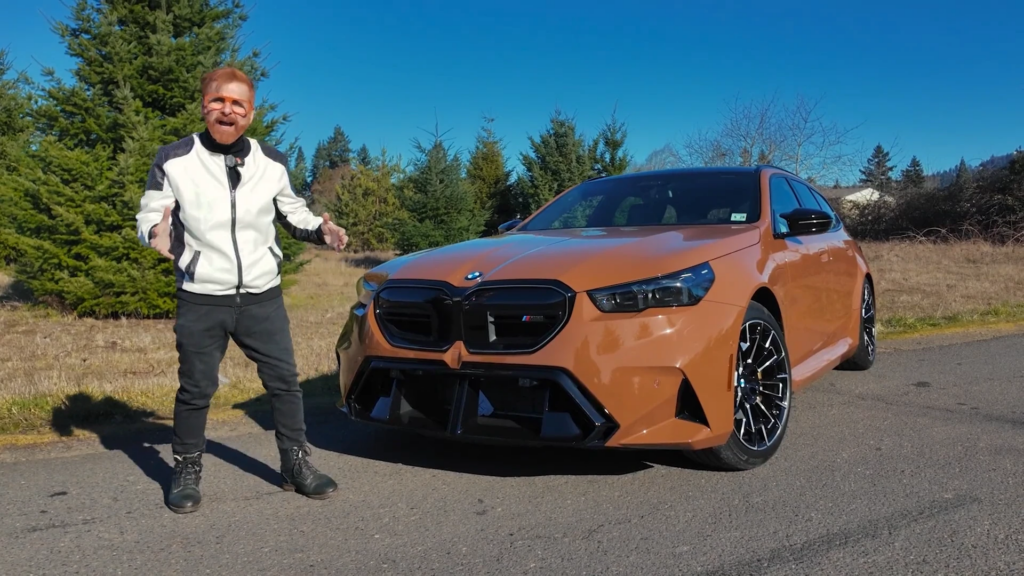
The BMW M5 Touring is a conundrum wrapped in elegance: 717 horsepower, vast cargo space, and an athletic stance that defies typical wagon stereotypes. It’s the sort of car that invites you to rethink what beauty can be, practical but exuberant.
At the more traditional end of high design is the Aston Martin DB12: a coupe that seems hewn rather than built, where proportions feel timeless rather than trendy. It’s a British take on elegance that resists flash for its own sake.
Finally, the Lamborghini Huracán STO represents visual drama in its purest form. Here, beauty is aggressive, kinetic, and unapologetically mechanical. It doesn’t seduce you so much as challenge you to look away. Rivals of each kind exist, and many are fine cars in their own right, but very few combine emotional immediacy with such varied expressions of form.
Who is this for, and who should skip it?
This isn’t a list for everyone. If your primary concern is utility above all, maximum cargo space, best fuel economy, and lowest insurance premium, the emotional qualities of automotive beauty may feel, well, indulgent.
If you’re here because you appreciate the reasoned pleasure of design, the way a roofline can rise with intent, the balance of volumes, the harmony of details, then this list is for you. These cars reward curiosity, not checklist-driven shopping. They are for people who notice the way light plays on a bonnet at dusk, or how a wheel-arch curve makes the haunches seem alive.
They’re also for people who understand that beauty in design isn’t the same as fragility. These are machines engineered to perform, to endure, to do things, but they do those things with expressive form. That’s different from “flashy” or “trend-driven.” It’s thoughtful.
Who should skip it? If you want a utilitarian workhorse, fine. If you’re after the best minivan for carpool duty or the most cost-effective commuter EV, those aren’t the questions here. This is about design that resonates emotionally over time, regardless of segment.
The Cars That Made the Cut
Rolls-Royce Spectre
It feels almost indulgent to start with the Rolls-Royce Spectre, but there’s no other way. This is, objectively, one of the most quietly assured shapes on the road today. Built on Rolls-Royce’s bespoke aluminum architecture, the Spectre brings electric propulsion into a design language that’s rooted in heritage but grounded in the present.
It pairs serene motion with purposeful form: a 102-kilowatt-hour battery, around 260 miles of range, and an impressively low drag coefficient of 0.25, making it the most aerodynamic Rolls ever.
Inside, near-total silence isn’t just marketing bluster. Nearly 4,700 pounds of sound insulation, adaptive air suspension, and rear-wheel steering combine to create what might be the quietest production cabin you can experience. That stillness enhances the proportions, long bonnet, balanced cabin, and stately stance in a way few cars manage.
Pricing starts at around $420,000 before you let Rolls-Royce consult your imagination, and that’s where bespoke touches like starlight fiber-optic doors or hand-veneered woods turn design into a personal narrative. Here, beauty is deliberate, not incidental.
Audi RS6 Avant
If the Spectre whispers, the Audi RS6 Avant roars, not just in performance but in visual language. With 621 horsepower and the ability to sprint to 60 mph in roughly 3.3 seconds, this isn’t subtle. But it’s also intelligently expressive. Wide arches, purposeful lighting signatures, oval exhaust outlets, and substantial wheel packages give the RS6 a stance that seems ready to pounce, even at rest.
Underneath, a twin-turbo V8 with mild-hybrid assist, torque-vectoring all-wheel drive, and adaptive suspension means that the RS6 isn’t just a looker, it’s a believable everyday super-wagon. It has an aesthetic confidence most “family cars” can’t muster precisely because it refuses the label. It’s a performance tool, an emotional machine, and a design statement all at once.
BMW M5 Touring
Here’s where things get interesting: a wagon that combines 717 horsepower with 57 cubic feet of cargo space and an elegance that belies its performance intent. BMW’s M5 Touring is simultaneously practical and poetic, an embodiment of what design can achieve when constraints aren’t excuses.
Its plug-in hybrid drivetrain, adaptive dampers, predictive traction management, and rear-wheel steering give the M5 Touring dynamic competence, but it’s the proportions that sing: the roofline doesn’t descend into vanity, the haunches don’t swell into caricature, and the stance feels poised rather than exaggerated. Inside, curved digital displays, high-resolution graphics, thoughtful switchgear, and comfortable seating elevate the experience beyond mere utility.
This is a car that looks right because it respects visual harmony, not because it shouts for attention.
Aston Martin DB12
Aston Martin has long understood that proportion is beauty’s backbone, and the DB12 embodies that ethos. With 671 horsepower and a top speed north of 200 mph, it’s no slouch, but its elegance isn’t about numbers. It’s about how the roofline flows, how the bonnet curves, how the grille asserts presence without aggression.
This is a timeless design: restrained yet confident, sculpted yet coherent. A 30-percent increase in chassis rigidity over its predecessor allows Aston Martin to tune comfort and handling without compromise, giving the DB12 a presence that feels effortless. It’s not loud. It doesn’t need to be. It is.
Lamborghini Huracán STO
And then there’s the Huracán STO, the wild card of beauty. Here, beauty is drama; beauty is tension; beauty is carbon fiber and visible mechanics. With 631 horsepower, race-derived suspension, extreme aerodynamics, magnesium wheels, and a naturally aspirated V10 singing at full chat, beauty isn’t quiet. It’s unapologetic.
This represents one of the last great naturally aspirated supercars before electrification reshapes the segment. Its lines aren’t about elegance so much as purpose; every scoop, every winglet serves an aerodynamic reason. But when it all comes together, it looks like nothing else. That’s beauty too: unfiltered, expressive, and kinetic.
What is the long-term significance?
Twenty years from now, no one will recall torque curves the way they remember how a car looked on the street, how it made them feel, how strangers paused to glance back at it. Beauty ages better than numbers because it speaks to something deeper than performance alone: presence, aspiration, and human response.
In an era where engineering priorities and regulatory frameworks increasingly shape surfaces, the cars that still manage to evoke emotion do so by choice. That choice matters. It proves that design isn’t accidental, and that emotional engineering still has a place alongside logic and efficiency.
These five cars remind us that the automobile is more than a means of transport. It’s cultural expression in metal and glass, silhouette and surface. They matter not just because they are fast or advanced, but because they feel right. And sometimes, that’s the best reason of all.
In the end, beauty isn’t measured in horsepower or drag coefficients. It’s measured in memories, how a car made you pause, smile, or simply look again. That’s design that lasts.