What Is One More Week on the Market Really Costing Your Seller?
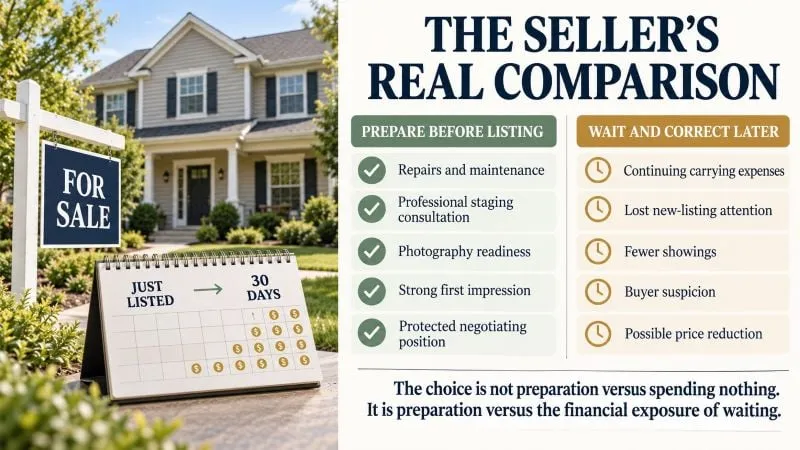
Sellers frequently question whether preparing a property for market is worth the investment. Far fewer ask what it may cost if buyers do not respond. The choice is not between investing in preparation and spending nothing. It is between preparing before marketing and accepting the financial consequences of a weak buyer response.
Every additional day on market carries an expense. Mortgage interest, property taxes, insurance, utilities, maintenance, condominium or HOA fees, and, in some cases, bridge financing or alternative accommodation continue whether the property receives showings or not. Yet those expenses may be only part of what waiting eventually takes from the seller.
Calculate the Daily Carrying Exposure
There is no universal figure to use because every seller’s circumstances are different. Calculate the seller’s monthly mortgage interest, property taxes, insurance, utilities, maintenance, fees, and any temporary accommodation or bridge-financing expenses, then divide by 30. Mortgage principal should not be counted as lost because it continues to build equity. Once sellers see their own daily figure, the conversation changes. For example, a $3,500 staging proposal may seem easy to decline. However, if the seller is carrying $150 a day in unrecoverable expenses, four additional weeks is $4,200 lost, before any discussion of a price reduction begins. Staging cannot guarantee a specific number of days saved, but preparation should be evaluated against the financial exposure of waiting, not an imaginary zero-cost alternative.
The Greater Loss May Not Appear on a Statement
A new listing receives concentrated attention. Buyers receive alerts and agents send it to active clients. That first appearance cannot simply be recreated later. When buyers do not book a showing or make an offer, questions begin. What is wrong with the property? Is the seller becoming more negotiable? As days accumulate, urgency shifts from the buyer to the seller, and buyers may return expecting a concession or skip the property altogether.
PRICE is a number. VALUE is the story.
Pricing determines whether a listing enters the buyer’s range of consideration. Preparation determines what buyers think and feel when they find it. A price reduction will not correct deferred maintenance, confusing function, poor lighting, or photographs that diminish the rooms. Excellent preparation will not persuade buyers to ignore comparable sales. The two must work together.
Sellers may say, “Let’s try it as it is, and we can always stage later.” They can, but they cannot restore the listing’s first appearance or recover the agent’s effort in marketing a property that was not ready to sell. Buyers have already formed an opinion.
Staging Is Not Defined by Furniture
Furniture installation has become the public face of staging, and that may be the industry’s most damaging misconception. It suggests staging is primarily a furniture service for vacant properties and unnecessary when a property is already furnished. Furniture rental is only one possible recommendation. A qualified stager examines condition, maintenance, function, scale, traffic flow, color, lighting, buyer expectations, and photographic presentation. An occupied property may require repairs, editing, repositioning, and selective additions. In a vacant property, furniture helps buyers understand size, function and potential. It is a tool for communicating value, not the definition of staging.
Why Agents and Professional Stagers Report Different Results
The National Association of Realtors’ 2025 Profile of Home Staging found that 83% of buyers’ agents said staging made it easier for buyers to visualize a property as their future home. It also found that 49% of sellers’ agents believed staging reduced market time, with 30% reporting a slight decrease and 19% a significant decrease. These findings are interesting, but it’s only a small sample of agents’ perceptions and reflect very different interpretations of staging, from advice supplied by an agent to comprehensive preparation by a trained professional. They also come from an industry which has been slow to fully embrace staging as a viable strategy for protecting seller equity.
The Real Estate Staging Association reports considerably stronger results submitted by professional staging businesses, including market time, investment, and sale-to-list performance. Its current quarterly insights report an average of 19 days on market across 129 properties, again a small sample, but they are actual outcomes; NAR reports agents’ observations. Both are useful, but they measure different things.
Here is the real problem: real estate research is distributed directly to those advising sellers, while staging results tend to remain within the staging profession. Agents and stagers may therefore use the same word while describing very different services and results. Stagers can help close that gap, but not alone. They can usually track public listing dates, market time, and sale price. Showing activity, buyer feedback, offers, and concessions are often available only through the listing agent. Collaboration connects the preparation strategy with the market response and builds more meaningful evidence.
Measure the Risk Before Listing
There is no single percentage that can predict the result for every individual property. That is very different from saying there is no evidence that professional staging can reduce market time. The evidence exists. The challenge is collecting it consistently, qualifying it responsibly, and placing it before the people making the decision.
A qualified stager identifies conditions that could cause buyer hesitation, recommends priorities, and helps determine where an investment is most likely to protect equity. The purpose is not to decorate according to the seller’s taste. It is to remove obstacles to the buyer’s decision.
Inspection protects the buyer after the offer.A thorough, comprehensive, written consultationprotects the seller before the offer.
Before listing, calculate the daily carrying exposure, identify what may cause rejection, and consider the seller’s negotiating position if early interest is lost. No professional can promise an exact sale date, but agents and stagers can identify avoidable risks before the market discovers them. The least expensive time to correct a presentation problem is before the property is listed. The most expensive time is after buyers have already decided what the property is worth.