Why the Used EV Market May Hide the Best Bargains
The used EV market is gaining supply as new EV demand softens, creating lower prices, stronger choice and a new battery-health test for shoppers.
For years, buying an electric vehicle meant paying for the newest battery, the latest charging hardware and, quite often, the privilege of being early. The next phase of the market may reward a very different buyer: the person willing to let someone else take the first three years of depreciation.
That possibility is becoming much more credible in 2026. U.S. new-EV sales remain well below last year, while off-lease electric vehicles are feeding the used market. At the same time, gasoline has climbed above $4 a gallon nationally. That is an odd combination, because expensive fuel would normally strengthen demand for anything that does not need gasoline.
Instead, the new and used sides of the EV business are beginning to tell different stories. New EVs are still trying to find their post-tax-credit price. Used EVs are accumulating supply, and price pressure can turn into leverage for a careful shopper.
You may also enjoy this:
Why the Used EV Market Is Getting More Inventory
Cox Automotive’s June estimate put used-EV transactions at 35,253. Volume slipped from May, yet it remained 20.3% above June 2025. One month’s tally is less important here than the pipeline feeding the market.
Three-year leases written during the great EV incentive push are coming back. Fleets and first owners are also trading vehicles into a market that is much more crowded than it was when many of those cars were new. A 2023 electric crossover now competes with newer versions that may charge faster, go farther, use a different charging connector or simply carry a lower new-car sticker.
That is rough on residual values, but residual value is a two-sided number. The seller sees depreciation. The next buyer sees a discount.
The mid-August wholesale market demonstrated how quickly that balance can move. Reporting based on Manheim data put electric-vehicle wholesale values 4.2% below July during August’s opening two weeks as more off-lease EVs reached the market. The same data still had EV values about 5% higher than a year earlier, so this is not evidence that every used electric car has suddenly fallen through the floor. It is evidence that fresh supply can move the wholesale market quickly.
This is the number I would watch more closely than another debate about whether Americans “like” EVs. Used-car pricing is brutally practical. Dealers bid according to what they believe they can resell. When wholesale values move, retail asking prices usually have to respond eventually.
You may also enjoy: 2026 Hyundai Ioniq 5 Review: The Value Is Back
KIA EV6
New EV Pricing Is Forcing a Reset
The used market does not exist in isolation. It has to compete with discounted new cars, and that comparison has become unusually complicated.
The Internal Revenue Service’s clean vehicle tax-credit guidance confirms that the federal New Clean Vehicle Credit, Previously-Owned Clean Vehicle Credit and Qualified Commercial Clean Vehicle Credit are not available for vehicles acquired after September 30, 2025. That removed a major piece of the consumer equation and helped produce a sharp correction in new-EV volume. Kelley Blue Book data showed second-quarter U.S. EV sales down 20.5% from a year earlier, even though sales improved from the first quarter.
Manufacturers have responded with their own money. In July, the average new EV transaction price was $56,126, according to Kelley Blue Book. Average EV incentives were $6,626, or 11.8% of the transaction price. The industrywide incentive rate was 6.4%.
That gap matters to anyone shopping used. A two- or three-year-old EV cannot be valued against the original sticker price printed on its old window label. It is competing against today’s new-car transaction price after discounts.
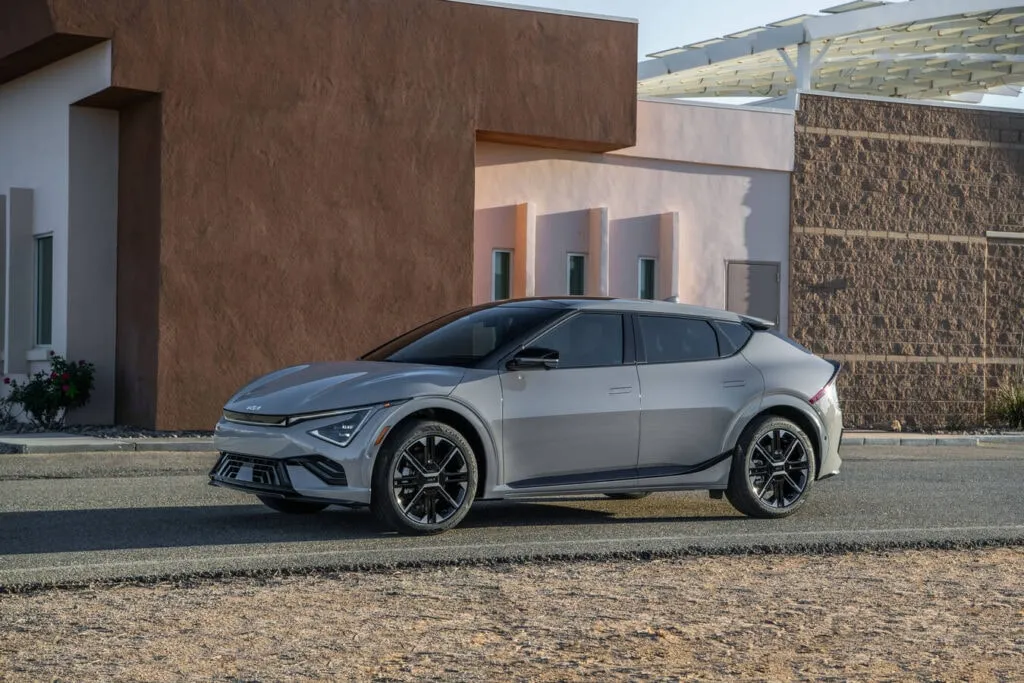
Some automakers have gone further and cut the sticker itself. Hyundai lowered the 2026 Ioniq 5 to a $35,000 starting MSRP before destination, while Kia put the 2026 EV6 at $37,900 before destination. Those are not tiny adjustments. They change the ceiling for what an older example can reasonably command.
This is why the phrase “50% depreciation” can be both technically true and economically misleading. Depreciation may reflect an inflated original transaction, a tax incentive that no longer exists, aggressive lease support, a later manufacturer price cut or genuine deterioration in demand. A used buyer does not need to untangle every cause. The useful question is whether the current used price is attractive compared with the current new alternative.
That is a much better shopping tool than mourning somebody else’s MSRP.
You may also enjoy: EV Discounts Are Getting Hard To Ignore
KIA EV6
Hybrids Explain More Than Politics Alone
It is tempting to explain the U.S. EV slowdown entirely through federal policy. Policy matters, but that explanation is incomplete because American consumers are still buying electrified vehicles in large numbers.
They are buying hybrids.
Cox Automotive expected hybrid sales to grow about 9% over January through June 2026 while the broader new-vehicle market softened. Hybrids solve a very specific consumer problem: they improve fuel economy without asking the owner to change the fueling routine.
That is more important than it sounds. The U.S. Department of Energy’s Alternative Fuels Data Center explains EV charging and ownership considerations, including the importance of charging access. Home charging is what makes an EV easy. If you can arrive home, plug in and start each morning with the energy you need, the ownership experience can be simpler than visiting a gas station. If you live in an apartment, park on the street, travel long distances unpredictably or depend heavily on public fast charging, the calculation changes.
A hybrid avoids that entire decision tree. It carries a smaller battery, captures energy through regenerative braking and uses gasoline for the rest. No charger installation. No adapter discussion. No route planning around a broken station.
For the used-EV market, hybrids are therefore the real benchmark. A three-year-old Ioniq 5, Mustang Mach-E, EV6 or Model Y does not merely have to look cheaper than a new EV. It has to become compelling enough that a buyer chooses charging over the effortless familiarity of a hybrid.
That is where used pricing can become powerful. A sufficiently large discount can compensate for behavioral inconvenience. It can also let a buyer keep money in reserve for home charging equipment, insurance or future repairs.
You may also enjoy: Why Hybrids Are Suddenly the Smarter Choice Over EVs in 2026
KIA EV6
Battery Health Is the Used-EV Price of Admission
This is the section that should stop anyone from buying a used EV purely because the price looks irresistible.
Mileage is not enough.
An EV’s high-voltage battery is its most expensive and consequential component. NHTSA’s electric- and hybrid-vehicle guidance explains battery, charging and safety considerations for electric vehicles. Battery lifespan varies with chemistry, temperature, use and other factors.
The Department of Energy’s electric-vehicle maintenance and safety guidance notes that EV battery systems have different maintenance requirements from conventional powertrains and explains the importance of manufacturer battery warranties. An out-of-warranty battery repair or replacement can still be a significant expense.
That means a serious used-EV inspection should include the battery warranty and, where available, a state-of-health assessment. Buyers should ask the dealer or manufacturer what diagnostic information can be produced for that specific vehicle. A dashboard range estimate by itself is not a battery-health test. It changes with temperature, recent driving and climate-control use.
Charging behavior matters, but it should not be turned into superstition. Frequent DC fast charging does not automatically mean a battery is ruined. Modern battery-management systems actively control charging rates and temperature. What matters is the condition of the actual vehicle, not an internet rule applied to every battery chemistry ever made.
The Department of Energy also provides a useful explanation of how all-electric vehicles operate, including traction batteries, electric motors, onboard chargers and charging ports. Understanding the basic hardware makes it easier to evaluate a used EV rather than simply comparing the range number displayed on the dashboard.
Also check whether the car completes an AC charge normally, whether it accepts DC fast charging, whether there are open battery or charging recalls, and whether the charging port matches the infrastructure you intend to use. The North American market is moving toward NACS, while many used vehicles still carry CCS connectors. Adapter access can solve much of that, but buyers should confirm network compatibility for the exact model and model year.
NHTSA’s Battery Safety Initiative also provides useful background on the agency’s work involving propulsion-battery safety, research, regulations and emergency response as EV adoption expands.
Then check the ordinary used-car items people sometimes forget because the battery is so interesting: tires, collision repairs, brakes, suspension, 12-volt battery, HVAC operation and insurance cost. Electric cars are still cars. They can be cheap for completely non-electric reasons.
You may also enjoy: 2025 EV Consideration Report: Americans Still Kicking the Tires on Electric, Not Quite Buying In
KIA EV6
The Best EV Deal May Be Three Years Old
The strongest argument for a used EV in 2026 is not environmental virtue, political identity or the promise of future technology. It is value.
A buyer who can charge at home and whose daily driving fits comfortably inside the vehicle’s real-world range may be able to purchase a used electric crossover after the steepest part of its depreciation has already occurred. That buyer gets the quiet operation, instant response and low routine powertrain maintenance that make EVs pleasant to live with, but without paying the first owner’s price.
For shoppers trying to understand the practical differences between an EV and a conventional vehicle, the Department of Energy’s consumer guide to electric vehicles covers charging, range, vehicle selection and other ownership considerations worth understanding before making the switch.
The Hyundai Ioniq 5 and Kia EV6 are especially interesting because their fast-charging architecture remains competitive even as newer vehicles arrive. The Ford Mustang Mach-E has broad dealer support and years of market history. The Tesla Model Y remains common enough that shoppers can compare many examples instead of falling in love with the only one within 200 miles.
None should be bought by model name alone. Condition, battery health, software status, charging access, warranty and price determine whether an individual car is a bargain.
The irony is that slower new-EV demand could help create the affordable EV market the United States has been missing. Manufacturers may cut production, raise incentives or lower prices to move new inventory. Lease returns then add more used supply. Each step puts pressure on the next price in the chain.
That is painful if you are trying to preserve residual value. It is much more interesting if you are shopping with cash, good credit and patience.
America’s EV market is not moving in a straight line. New-car demand has retreated from the tax-credit rush. Hybrids are winning buyers who want efficiency with no lifestyle change. Europe and the global market are still expanding. Meanwhile, the American used market is beginning to accumulate exactly what mass adoption eventually requires: choice at lower prices.
The next electric-car breakthrough may therefore have nothing to do with an 800-horsepower launch, a record charging speed or a screen the size of a kitchen window.
It may be a clean three-year-old crossover, with a healthy battery, a remaining warranty and a price low enough that the monthly payment finally makes sense.
You may also enjoy: Why the Rivian R2 Could Be America’s Next Big EV SUV