2027 Kia Sportage Hybrid: FWD Is the Value Play
By Robert R Guio
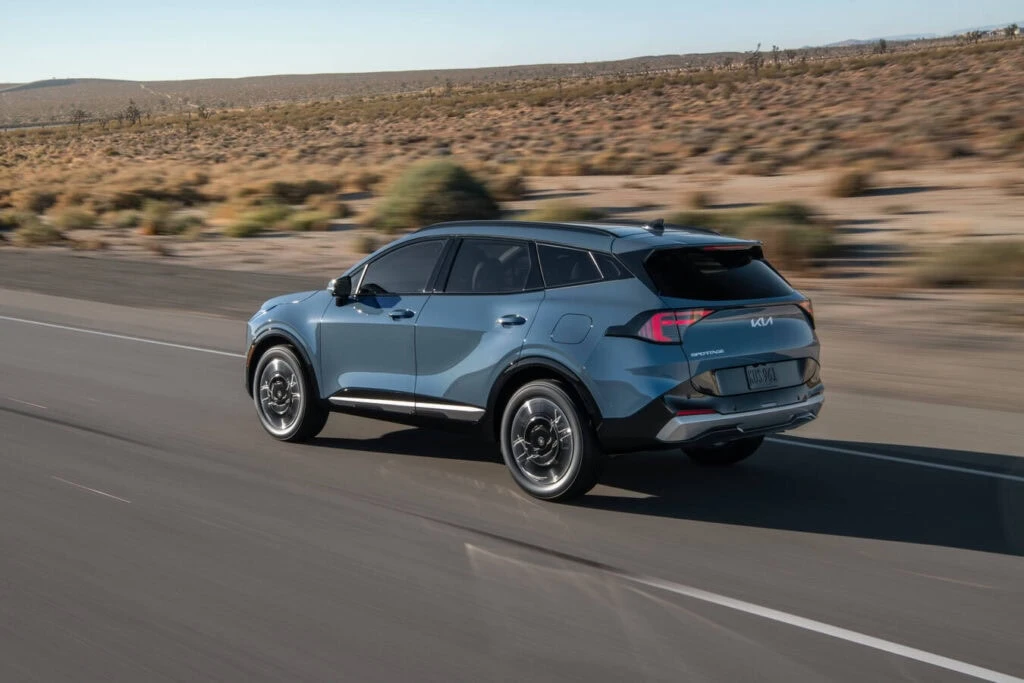
The 2027 Kia Sportage Hybrid adds FWD trims and 41-mpg efficiency, making the less expensive S and EX models the lineup’s value plays.
Kia has made the 2027 Sportage Hybrid more interesting by changing something that sounds almost boring: which wheels receive the power. The new model year brings front-wheel drive to the S and EX trims, and that small rearrangement may be the most important change for shoppers trying to keep a compact hybrid SUV on the sensible side of $40,000.
The Sportage Hybrid still starts at $30,590 before the $1,495 destination charge. What changes is the middle. The new S FWD is $31,290 and the EX FWD is $32,290, while their AWD counterparts are $32,890 and $33,890. In both cases, choosing all-wheel drive adds $1,600. The more expensive X-Line and SX-Prestige remain AWD-only at $35,790 and $40,690.
That creates a straightforward value argument. Unless your climate, roads or recreation genuinely call for all-wheel drive, the new front-drive versions save money at purchase and carry the stronger official fuel-economy numbers. For many households, the smartest 2027 Sportage Hybrid may now sit in the middle of the brochure rather than at either end.
2027 Kia Sportage Hybrid Makes FWD Matter Again
The powertrain does not suddenly become less capable because two driven wheels replace four. Kia lists the 2027 Sportage Hybrid at 232 horsepower and 271 pound-feet of torque from its 1.6-liter turbo-hybrid system, with a six-speed automatic transmission. The crucial difference is efficiency. Front-drive models are rated at an EPA-estimated 40 mpg city, 42 highway and 41 combined. Kia lists the AWD versions at 35 mpg city, 36 highway and 35 combined.
For shoppers sorting out the alphabet soup, the U.S. Department of Energy explains how a conventional hybrid works: the battery is replenished through regenerative braking and the engine rather than by plugging the vehicle into an external charger.
2027 Sportage Hybrid
That is a six-mpg combined gap. Translate it into annual fuel use and the choice becomes easier to understand. At 12,000 miles a year, 41 mpg works out to about 293 gallons. At 35 mpg, the same distance requires about 343 gallons. Fuel prices and real-world mileage move around, of course, but the AWD version starts with roughly 50 more gallons of annual consumption in that simple comparison.
EPA explains how fuel-economy label values are used for comparison, not as a promise that every driver will hit the number. Weather, speed, acceleration and road conditions can all move actual mileage. That is exactly why the 41-versus-35 comparison matters: it gives shoppers a consistent baseline before their own circumstances enter the picture.
You may also enjoy: Kia’s Best Sellers Reveal What Americans Really Want
There is also a market reason Kia can afford to split the lineup more finely. The Sportage has become one of the company’s core U.S. vehicles. Test Miles reported that it led Kia’s May sales with 16,120 units. A high-volume model can support more trim and drivetrain combinations because Kia is not trying to find a niche buyer. It is trying to stop mainstream compact-SUV shoppers from finding a reason to leave the showroom.
All-Wheel Drive Is Useful, but It Is Not Free
There are perfectly good reasons to choose AWD. Kia equips the AWD Sportage Hybrid with Terrain Mode selections for snow, mud and sand. Drivers who regularly deal with mountain weather, unpaved access roads or slippery winter conditions can justify the additional hardware.
What the new S FWD and EX FWD do is separate need from habit. American buyers have become accustomed to treating AWD as an automatic upgrade on crossovers, even when most of their miles happen on dry pavement. The $1,600 purchase premium is only one part of that decision. The lower official combined fuel-economy figure continues to charge rent after the vehicle leaves the dealership.
This is where I would start the buying process: decide whether AWD solves a problem you actually have. If the answer is yes, buy it and enjoy the extra traction options. If the answer is no, the 41-mpg FWD setup makes a strong case for keeping the money and the efficiency.
2027 Sportage Hybrid
The comparison with Honda is useful because it shows how close this segment has become. The 2026 CR-V TrailSport Hybrid pairs standard AWD with a 35-mpg combined EPA rating. It brings its own ruggedized appeal, but it also illustrates the tradeoff: adventure-oriented hardware often pushes an efficient compact SUV away from its best fuel-economy number.
You may also enjoy: 2026 Honda CR-V TrailSport Hybrid: A Best-Selling SUV Goes Off-Road
The Sportage’s answer is not to declare one configuration superior for everyone. It is to let a warm-climate commuter choose differently from a skier in Colorado. That is the kind of choice a mature hybrid market should offer.
The Plug-In Costs More, So Make the Plug Earn It
The 2027 Sportage Plug-in Hybrid returns essentially unchanged, and that makes its role in the lineup easier to judge. The X-Line starts at $40,590 and the X-Line Prestige at $47,390, before destination. Both use standard all-wheel drive and a 1.6-liter turbocharged plug-in hybrid system rated at 268 horsepower and 271 pound-feet of combined torque.
Kia estimates 34 miles of all-electric range. The Sportage PHEV uses a 13.8-kWh hybrid battery and Kia lists approximately two hours for 240-volt charging in its specifications. The U.S. Department of Energy explains how plug-in hybrids work: charge the battery from an external power source, use electricity for some driving, then retain a gasoline engine for longer trips after the usable electric energy is depleted.
That makes the owner’s charging behavior part of the value calculation. A driver with a garage, regular access to Level 2 charging and a daily round trip inside roughly 34 miles can make frequent use of the plug-in portion. A buyer who cannot charge reliably is paying more for capability that may spend much of its life underused.
2027 Sportage Hybrid
You may also enjoy: Kia Is Thinking Outside the Box in America
The most telling price comparison is inside the Sportage family itself. The PHEV X-Line at $40,590 is actually $100 less than the Hybrid SX-Prestige at $40,690 before destination. That is not an apples-to-apples equipment comparison, but it forces a useful question. At about $40,000, do you want the conventional hybrid with the richest trim treatment, or the plug-in powertrain with standard AWD and the ability to cover short trips on electricity?
My answer depends on where the vehicle sleeps. If it has a dependable place to charge, the PHEV deserves serious consideration. If it lives at an apartment complex with uncertain charging or regularly travels long distances without plugging in, the regular hybrid is easier to recommend.
The X-Line Technology Package May Be the Sneaky Sweet Spot
Kia is adding a Technology Package to the Sportage Hybrid X-Line, and this may matter more than its name suggests. The X-Line sits below the SX-Prestige, so giving it more of the high-end camera, audio and assistance equipment lets shoppers buy capability and technology without automatically taking the top trim.
Kia says the package includes a 360-degree Surround View Monitor, Blind-Spot View Monitor, a 12.3-inch digital instrument cluster with navigation, Harman Kardon premium audio, a driver memory seat, Parking Collision-Avoidance Assist-Reverse, side parking sensors, Highway Driving Assist and LED fog lights.
That collection is especially useful in a family crossover because the features address ordinary annoyances. A surround-view camera helps when parking close to curbs. Blind-spot camera views can add information during lane changes. Memory seating matters when two people share the vehicle. Parking sensors are the sort of feature nobody discusses at a launch event but plenty of owners use every day.
2027 Sportage PHEV
NHTSA’s driver-assistance guidance is a necessary reality check. Driver-assistance systems can warn, brake or provide steering support in specific circumstances, but the driver remains responsible for controlling and monitoring the vehicle. Kia makes similar cautions in its own feature disclosures. The technology is assistance, not autonomy.
You may also enjoy: Hybrid Transmissions Surge Back into the Spotlight
The six-speed automatic is another Sportage detail worth noticing. Many hybrids use continuously variable or electronically controlled variable-ratio systems. Kia’s turbo-hybrid pairing keeps a conventional stepped automatic, which can give acceleration and engine-speed changes a more familiar rhythm. Whether a shopper prefers that is subjective, but it is one of the mechanical differences worth experiencing on a test drive rather than deciding from a spec sheet.
Georgia Production Adds a Second Kind of Choice
Kia says the 2027 Sportage Hybrid will be dual sourced and that production will include Hyundai Motor Group Metaplant America in the Savannah, Georgia area. The company’s U.S.-assembly disclosure includes the Sportage while specifically excluding the PHEV. In other words, buyers should not assume every electrified Sportage shares the same assembly story.
That distinction is worth checking on the actual vehicle. Dual sourcing means some hybrid examples can come from Georgia while others may not. If domestic assembly matters to you, confirm the assembly point on the window sticker rather than relying on the model name alone.
2027 Sportage PHEV
The larger strategy is clear. Kia has been widening its American manufacturing footprint while also widening its powertrain choices. Gasoline, hybrid, plug-in hybrid and battery-electric models are increasingly being treated as parallel answers to different customer needs rather than as rungs on a ladder everyone is expected to climb in the same order.
You may also enjoy: Kia Set to Break 800,000 Sales in America
That approach fits what Kia’s sales results have been showing. Hybrid demand has been rising sharply, and the Sportage is already a major volume model. Adding FWD choices is a less glamorous move than launching a new EV, but it can affect more real purchase decisions because it changes the cost and efficiency of trims people are already shopping.
Which 2027 Sportage Hybrid Would I Buy?
For a buyer focused on value, I would start with the S FWD and EX FWD. The S keeps the price close to the base LX, while the EX allows more comfort without forcing the $1,600 AWD step. Both retain the 41-mpg combined EPA estimate that gives the front-drive hybrid its strongest practical advantage.
If you genuinely need AWD, the decision becomes less about avoiding the premium and more about choosing the right equipment level. The X-Line is the interesting middle ground, particularly with the new Technology Package, while the SX-Prestige is the choice for buyers who want the fullest feature set and are comfortable with a pre-destination MSRP above $40,000.
The PHEV is not automatically the better Sportage because it plugs in. Its 34-mile Kia-estimated electric range can be valuable, but only if your daily routine allows you to use it. EPA’s plug-in-hybrid label guidance is useful here because PHEVs must be evaluated in two modes: electricity first, then gasoline operation after the battery’s usable charge is depleted. One efficiency number never tells the entire ownership story.
2027 Sportage PHEV
You may also enjoy: The $25,000 SUV Isn’t Dead Yet
There is one more encouraging point. Kia has not used the 2027 model year simply to push every hybrid shopper upward into a more expensive configuration. By adding FWD to S and EX, it has created two routes that can be cheaper to buy and more efficient on paper than their AWD equivalents. That is the opposite of the usual trim-walk temptation.
The 2027 Kia Sportage Hybrid does not need a spectacular new headline technology to become a better buy. Its strongest improvement is permission to choose less hardware when less hardware is enough. In a market where compact crossovers can turn into $40,000-plus purchases with alarming speed, that may be the most useful upgrade Kia could have made.