The Retirement Rules That Matter More Than Your Number
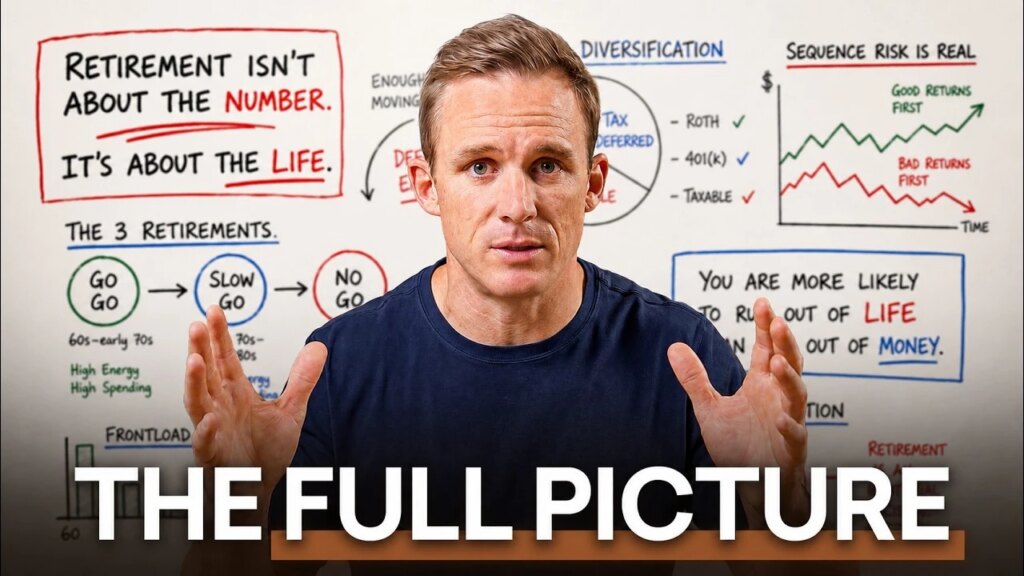
Most retirement advice begins and ends with a number.
Save more. Reach a target. Hit $1 million, $2 million, $3 million, whatever figure feels large enough to make the fear go quiet. That framework is useful up to a point, but it leaves out the part of retirement that actually determines whether the experience feels secure and worthwhile: the laws and patterns that shape how people live once the paychecks stop.
That is the real challenge of retirement.
Many people are financially prepared but emotionally unprepared. Others are so focused on accumulation that they never stop to ask what the money is supposed to do. They treat the number as the destination instead of the tool. Then they reach it and discover that nothing internal changed. They still feel uncertain. They still delay. They still do not know whether the plan actually supports a life they want to live.
That is why the first rule of retirement is that the number itself is not the point.
Money in retirement only has meaning when it is tied to a life. A portfolio balance cannot tell you whether you are ready unless you know what retirement is meant to look like. A person with $4 million who has no idea what freedom, purpose, travel, family time, health, or daily structure will actually look like may feel more anxious than someone with less money and a much clearer vision. The better question is not “What is my number?” It is “What life does this number make possible?”
That shift matters because retirement is not one long, uniform phase. It has its own rhythm.
Most people do not spend the same way at 62 that they do at 82. Retirement typically unfolds in three broad stages. There are the go-go years, when activity is high, travel is appealing, health is stronger, and discretionary spending often peaks. Then there are the slow-go years, when energy declines, travel slows, and spending often starts easing. Then come the no-go years, when daily life becomes more home-based, discretionary spending drops, and healthcare demands usually rise.
This pattern changes everything.
It means retirement spending is often front-loaded, not flat. It means the first decade after leaving work may be the most important one to protect, because those are often the healthiest and most flexible years. It also means delaying retirement by a few years may cost more than people think. The loss is not only financial or actuarial. It can mean sacrificing part of the phase in which money is most useful for enjoyment, movement, and experiences.
That is one reason retirement planning should not be built only around fear of running out.
It should also be built around not missing the years the money was meant to serve.
The second major rule is that tax flexibility matters more than most people realize.
A retiree with all of their money trapped in one tax category has fewer good choices. A retiree with money spread across pre-tax accounts, Roth accounts, taxable brokerage accounts, and perhaps health savings accounts has more control over how income is created. That flexibility can influence tax brackets, Medicare premiums, withdrawal timing, and long-term net spending power. It also allows retirees to choose the most efficient source of income in different market or tax environments.
This is why tax diversification is not an afterthought. It is a form of optionality.
The third rule is that average returns matter less than the order in which they arrive.
This is the sequence-of-returns problem, and it is one of the most misunderstood forces in retirement. Two portfolios can earn the same average return over time and still produce very different retirement outcomes if one suffers heavy losses early while withdrawals are already happening. That is what makes retirement different from accumulation. In the working years, market declines can simply be endured or even welcomed. In retirement, declines become more dangerous when they coincide with the need for cash flow.
That is why portfolio structure matters so much.
A retiree needs more than a target return. They need a withdrawal strategy and an asset allocation that reduce the chance of selling growth assets at the wrong time. Sequence risk is not solved by optimism. It is managed by design.
The fourth rule is that Social Security is not just a benefits decision. It is an investment decision.
Too many discussions reduce claiming to a simple break-even age. Wait until 70 if you live past 81. Claim early if you think you will not. That analysis is too shallow. Delaying benefits means drawing more from the portfolio in the meantime. Claiming early reduces guaranteed income later. The right choice depends on health, assets, taxes, spouse considerations, and the broader structure of the plan. Social Security is not an isolated election. It is part of the income system.
That system has to be judged as a whole.
And that leads to one of the most important truths in retirement planning: the biggest risk is not always running out of money.
For many households, the more common danger is failing to use money when life still has room for it. Many retirees underspend because fear remains stronger than permission. They treat spending as threat instead of function. They preserve wealth so carefully that they wake up years later with a strong balance sheet and a weak memory of having really used it.
This is the quiet tragedy of over-cautious retirement.
A plan should provide safety, but it should also provide permission. The point of saving is not merely to avoid collapse. It is to convert stored-up earnings into a fuller life. That means retirement planning has to be about more than portfolio survival. It has to be about confidence, usefulness, and the ability to enjoy the years that remain.
That is why the final and perhaps most important rule of retirement is that the decision is ultimately emotional.
The math can support retirement and people still hesitate. They may fear losing identity, purpose, structure, or the social role work has given them for decades. That is not irrational. Retirement is not only a financial change. It is a life change. A person is not truly ready until they can answer not only “Can I afford this?” but also “What am I retiring to?”
Those who handle retirement best usually do not treat it as an escape from work alone. They treat it as a deliberate move toward something else, family, travel, learning, volunteering, rest, health, contribution, or some new mix of all of them.
That is what the number was for all along.
Which is why the rules that matter most in retirement are not the ones that help you hit a target. They are the ones that help you turn a target into a life.
You should always consult a financial, tax, or legal professional familiar about your unique circumstances before making any financial decisions. This material is intended for educational purposes only. Nothing in this material constitutes a solicitation for the sale or purchase of any securities. Any mentioned rates of return are historical or hypothetical in nature and are not a guarantee of future returns.
Past performance does not guarantee future performance. Future returns may be lower or higher. Investments involve risk. Investment values will fluctuate with market conditions, and security positions, when sold, may be worth less or more than their original cost.