You May Not Need $1 Million to Retire. You Need This Number Instead.
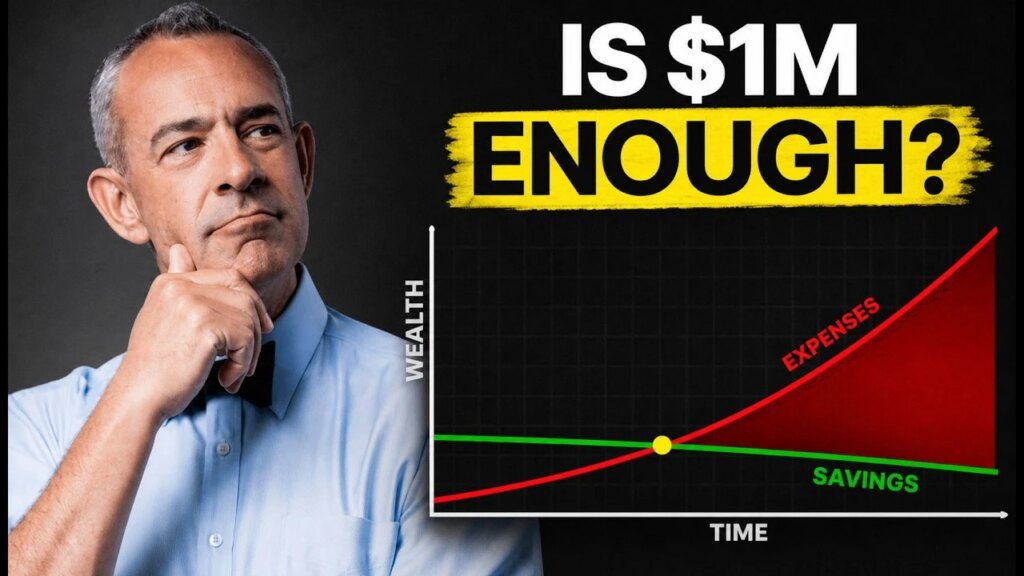
One million dollars has become the unofficial price of retirement. The number appears in advertisements, online calculators and conversations among workers who worry they have fallen behind. It is large enough to sound secure, simple enough to remember and frightening enough to motivate decades of saving. It is also nearly meaningless without knowing how much a household spends.
A retiree who needs $35,000 a year from investments may be financially comfortable with less than $1 million. Another who expects the portfolio to provide $100,000 annually may find that $1 million is nowhere near enough. Social Security, pensions, rental income, taxes, health-care costs and retirement age can change the calculation by hundreds of thousands of dollars. Retirement is not purchased with a universally correct account balance. It is funded through income. The number that matters is the gap between what retirement will cost and what dependable income will cover. Once that gap is identified, it can be translated into a reasonable savings target.
The $1 Million Benchmark Creates the Wrong Question
Workers frequently ask whether they have saved enough compared with other people. National balances can provide context, but they cannot determine whether an individual retirement plan will work.
Among workers ages 55 through 64 participating in Vanguard-administered retirement plans, the average account balance was $244,750, while the median was only $87,571. The large difference shows how a relatively small number of substantial accounts can pull the average upward. It also demonstrates that most participants in that group did not have anything close to $1 million in that particular workplace account.
Those figures do not include every asset a household may own. Someone could have an IRA, a spouse’s retirement account, a pension, a brokerage portfolio or rental property outside the Vanguard plan. They also exclude people who do not participate in an employer-sponsored account.
The statistics are useful primarily because they show why comparisons can mislead. A $300,000 balance could be inadequate for one household and sufficient for another. The outcome depends on the income the assets must produce. Instead of asking, “Have I reached $1 million?” a future retiree should ask, “How much of my annual spending must my investments provide?” That question leads to a number connected to an actual life.
Begin With Spending, Not Salary
Many retirement estimates begin with income replacement. A worker is told to plan for 70% or 80% of current earnings after leaving work.
That method can be convenient, but salary is not the same as lifestyle cost.
A household earning $200,000 may save $40,000 a year, pay payroll taxes, support children and spend heavily on commuting. Several of those costs may decline after retirement. Another household earning $100,000 may spend nearly all of it and face rising medical, housing and travel expenses after work ends.
The most reliable starting point is actual spending.
Bank and credit-card statements from the previous 12 to 24 months can reveal what the household truly costs. Expenses should include mortgage or rent, property taxes, insurance, food, transportation, medical costs, entertainment, travel, gifts and support provided to family members.
Irregular costs must also be included. A roof replacement, vehicle purchase or major dental procedure may not occur every year, but excluding those costs makes retirement appear cheaper than it is. One approach is to estimate the annual average of major periodic expenses and add that amount to the budget.
The future budget can then be adjusted for changes expected after retirement. Payroll taxes and retirement contributions may disappear. Commuting and professional expenses may decline. Travel, hobbies and health-care spending may increase.
The objective is not to forecast every expense perfectly. It is to create a credible estimate of the lifestyle the savings will be expected to support.
Social Security Reduces the Amount the Portfolio Must Provide
Social Security is the foundation of retirement income for many households. The Social Security Administration says benefits replace approximately 40% of annual preretirement earnings for an average worker, although the replacement percentage varies considerably with earnings and personal circumstances. Lower earners generally receive a larger percentage of their former income than higher earners.
That benefit can dramatically reduce the savings required.
Consider a household expecting to spend $70,000 annually after taxes and other adjustments. If combined Social Security benefits eventually provide $40,000, the household does not need its portfolio to generate the full $70,000. It must cover the remaining $30,000, along with taxes and any temporary gaps before the benefits begin.
A pension can reduce the gap further. If the same household also receives a $15,000 annual pension, investments may need to provide only $15,000 a year once both income sources are active.
A retiree with modest savings but substantial guaranteed income can therefore be more secure than someone with a larger portfolio and no pension.
Social Security estimates should come from the worker’s actual earnings record rather than a national average. Benefits are based on the highest 35 years of indexed earnings and the age at which payments begin. Stopping work before completing 35 years or replacing high-earning years with zeros or lower earnings can affect the result.
The claiming age also changes the monthly amount. A plan should specify whether benefits are expected at 62, full retirement age or 70 rather than treating Social Security as one fixed number.
Find the Income Gap Before Calculating the Portfolio
The core retirement calculation can be expressed simply:
Expected annual spending – dependable annual income = annual portfolio gap
Suppose a couple expects to spend $90,000 annually. Social Security is projected to provide $42,000, and a pension will add $18,000.
The calculation is:
$90,000 – $42,000 – $18,000 = $30,000
Once all income sources are active, the couple needs the investment portfolio to provide approximately $30,000 a year before considering the exact tax treatment of each source.
Using a 4% starting withdrawal assumption, the rough portfolio target would be:
$30,000 ÷ 0.04 = $750,000
That household’s initial target is not $1 million because its income sources cover two-thirds of the planned spending.
Now consider another household expecting to spend $110,000 with only $30,000 of Social Security and no pension:
$110,000 – $30,000 = $80,000
At 4%, the rough portfolio requirement would be:
$80,000 ÷ 0.04 = $2 million
The second household requires substantially more savings even though the two couples could have earned similar salaries during their careers.
The difference is the income gap.
The 4% Rule Is a Planning Shortcut, Not a Promise
Dividing the annual gap by 4% is a useful way to convert income needs into a savings target. It should not be mistaken for a guarantee that every retiree can safely withdraw that amount under all circumstances.
Morningstar’s 2026 retirement-income research estimated a 3.9% starting withdrawal rate for a new retiree seeking inflation-adjusted spending over a 30-year period with a 90% probability of funds remaining under its base-case assumptions. The estimate was highest for portfolios holding roughly 30% to 50% in equities rather than for an all-stock allocation, because volatility can be especially damaging when withdrawals are occurring.
Using 3.9% rather than 4% would produce a slightly higher target:
$30,000 ÷ 0.039 = approximately $769,000
The appropriate rate depends on retirement length, asset allocation, spending flexibility and the desire to leave an inheritance. Someone retiring at 50 may need the portfolio to last 40 years or longer. Morningstar’s base-case research placed the highest starting rate for a 40-year period at approximately 3.3%, considerably below the figure used for a 30-year retirement.
A retiree willing to reduce discretionary spending after weak markets may be able to begin with a higher rate than someone demanding the same inflation-adjusted amount every year. Guaranteed income covering essential expenses can also make flexible portfolio withdrawals easier. The withdrawal percentage is therefore an assumption to be tested, not a law to be obeyed blindly.
Retiring Early Can Change the Number Dramatically
A household retiring at 62 may have several years in which pensions and Social Security have not fully begun. Medicare generally does not begin until 65, potentially leaving the retiree responsible for private health-insurance costs during the transition.
Those bridge years can require far more from the portfolio than later retirement. Suppose a couple expects to spend $90,000 annually and will eventually receive $60,000 from Social Security and pensions. Their long-term gap is only $30,000. If they retire five years before those income sources begin, however, the portfolio may initially need to provide most or all of the $90,000. The retirement plan must account for both periods. Applying the long-term $30,000 gap to every year would understate the savings needed. Applying the initial $90,000 withdrawal forever would overstate it.
This is why retirement calculations should be completed year by year. Income sources begin at different ages, mortgages end, taxes change and spending may decline later in life. A single average can conceal the years in which the portfolio faces the greatest pressure. Retiring earlier also lengthens the period over which the investments must support the household. More withdrawals occur before Social Security begins, and the portfolio has fewer working years in which to receive contributions. An early retirement number should therefore usually be higher than the number needed to retire at 67 with immediate Social Security and Medicare coverage.
Spending Often Changes Throughout Retirement
Retirement spending is unlikely to remain perfectly level after inflation. The early years may include extensive travel, hobbies, home improvements and support for adult children. Later years may involve less travel but more medical care or assistance at home. Housing costs can also change after a mortgage is paid off or a household downsizes. A plan based only on today’s monthly expenses may miss these shifts.
Discretionary goals should be quantified rather than described vaguely. “We want to travel” does not provide enough information. Two international trips and several domestic vacations may require $20,000 or more a year, while occasional regional travel may cost far less. Health-care costs deserve their own estimate. Medicare premiums, supplemental coverage, prescription drugs, dental care, hearing services and long-term-care risks are not fully captured by an ordinary household budget. The retirement number should support the spending the household genuinely intends—not an artificially low budget created merely to make the plan appear successful.
Taxes Can Make a Gross-Income Calculation Inaccurate
A household spending $80,000 does not necessarily need exactly $80,000 of gross retirement income. Social Security may be partly taxable. Traditional IRA and 401(k) withdrawals are generally taxed as ordinary income, while qualified Roth withdrawals may be tax-free. Brokerage withdrawals may include a return of cost basis along with taxable capital gains.
A couple drawing $30,000 from a Roth account may have a different tax bill from one taking the same amount from a traditional IRA. State taxes also matter. A retirement number calculated for California or New York may change after a move to a state with no personal income tax. Property taxes, sales taxes and insurance expenses can offset part of that advantage, so the complete cost of the new location must be considered. The initial income-gap formula provides direction, but the finished plan should calculate spending after taxes and estimate how withdrawals from each account affect taxable income.
Part-Time Work Can Replace a Large Amount of Savings
Even modest earned income can reduce the portfolio requirement considerably. Suppose a retiree’s annual income gap is $40,000. At a 4% withdrawal rate, that implies a portfolio target of approximately $1 million. If part-time consulting or seasonal work produces $20,000 a year, the portfolio gap falls to $20,000. The simplified savings requirement becomes approximately $500,000 for the years in which the work continues.
That does not mean employment will remain available indefinitely or that a retirement plan should depend on working into advanced age. It shows why a few years of part-time income can be financially powerful. Work may also allow Social Security to be delayed, preserve investments during an early market downturn or provide access to employer health insurance before Medicare. The value of part-time work is not limited to the paycheck. It can shorten the period in which the portfolio is carrying the entire retirement.
Rental Income and Pensions Must Be Evaluated Conservatively
Rental property can provide useful retirement income, but gross rent should not be treated as dependable spending money. Vacancies, repairs, property taxes, insurance and management costs reduce the amount available. A major roof or heating-system replacement can erase months of income. Rental earnings should therefore be estimated after realistic operating expenses and a reserve for capital improvements.
Pension income is generally more predictable, but the details matter. Some pensions include cost-of-living adjustments, while others remain fixed for life and gradually lose purchasing power to inflation. A survivor option may reduce the initial benefit while continuing income for a spouse after the pensioner’s death. A retirement plan should use the income reasonably expected to reach the household, not the largest number appearing on a statement.
A Larger Portfolio Does Not Automatically Produce Greater Confidence
Retirement anxiety is not always solved by accumulating more money. A worker may have $2 million and still feel unprepared because there is no clear spending plan. Another with $800,000 may feel confident because Social Security, a pension and modest expenses create a visible path from assets to income. Confidence comes from understanding how the retirement will function. The household should know which account will fund the first year, when Social Security begins, how much cash is available during a market decline and which spending can be reduced temporarily. It should understand how taxes and health insurance change after work ends.
A detailed plan does not eliminate uncertainty. Markets can fall, inflation can rise and health can change. It converts undefined fear into risks that can be measured and managed. That preparation also makes it easier to remain invested during volatility. A retiree who knows that essential expenses are covered by Social Security, a pension and several years of stable reserves may be less likely to sell stocks in panic.
Calculate the Number in Four Steps
A practical retirement estimate can begin with four calculations.
First, determine annual retirement spending. Use actual records, adjust for expenses that will disappear and add realistic amounts for travel, medical care and periodic major purchases.
Second, estimate dependable income from Social Security, pensions, annuities, rental profits and any planned work. Record when each source begins rather than assuming all income is available on the retirement date.
Third, subtract dependable income from spending to identify the annual portfolio gap.
Fourth, divide the gap by a reasonable withdrawal assumption. A household using 4% would multiply the income gap by 25. A more conservative 3.5% assumption would multiply it by approximately 28.6.
A $40,000 annual gap would suggest:
- At 4%: $1 million
- At 3.9%: approximately $1.03 million
- At 3.5%: approximately $1.14 million
- At 3.3%: approximately $1.21 million
The result should then be tested for taxes, early-retirement bridge years, poor markets and long-term-care risk.
The calculation is simple enough to provide a useful starting point and flexible enough to show why the correct answer differs for every household.
Your Retirement Number Is a Living Target
A retirement target should not be calculated once at 45 and treated as permanent. Spending changes, investment balances rise or fall and Social Security estimates are updated as additional earnings enter the record. A pension may be frozen, a mortgage may be refinanced or a household may decide to relocate. The estimate should be reviewed regularly and more frequently as retirement approaches. The final years of work provide the clearest information about actual spending, health, housing and available income.
The target may decline if a pension grows, expenses fall or retirement is postponed. It may rise after a divorce, medical diagnosis or decision to retire earlier. That movement does not mean the plan failed. It means the plan is responding to real life rather than forcing the household to pursue an arbitrary number.
Retirement Success Is About Matching Resources With a Life
One million dollars can be more than enough, barely enough or dangerously insufficient.
The number alone says nothing about whether the mortgage is paid, whether Social Security will cover most essential costs or whether the retiree intends to spend $40,000 or $140,000 a year. It does not reveal retirement age, health-care expenses, taxes or the presence of a pension. The real retirement number begins with a lifestyle. Once the household knows what it wants retirement to look like and what that life will cost, it can identify the income already available and calculate what investments must provide.
That process may reveal that the feared $1 million target was unnecessary. It may also show that the household needs considerably more. Either answer is more useful than chasing a round number disconnected from the life it is supposed to fund. Retirement security does not come from reaching the same balance as everyone else. It comes from knowing that personal income, savings and spending can support the years ahead.
Intended for educational purposes only. Opinions expressed are not intended as investment advice or to predict future performance. Past performance does not guarantee future results. Neither the information presented, nor any opinion expressed constitutes a solicitation for the purchase or sale of any security. Consult your financial professional before making any investment decisions. Opinions expressed are subject to change without notice.
IMPORTANT DISCLOSURES:
• Investment Advisory and Financial Planning Services are offered through Pure Financial Advisors, LLC. A Registered Investment Advisor.
• Pure Financial Advisors, LLC. does not offer tax or legal advice. Consult with a tax advisor or attorney regarding specific situations.
• Opinions expressed are subject to change without notice and are not intended as investment advice or to predict future performance.
• Investing involves risk including the potential loss of principal. No investment strategy can guarantee a profit or protect against loss in periods of declining values.
• All information is believed to be from reliable sources; however, we make no representation as to its completeness or accuracy.
• Intended for educational purposes only and are not intended as individualized advice or a guarantee that you will achieve a desired result. Before implementing any strategies discussed you should consult your tax and financial advisors.