The RMD Tax Trap Starts Years Before Your First Required Withdrawal
Required minimum distributions are easy to ignore when retirement is still several years away. The money is growing tax-deferred inside an IRA or 401(k), withdrawals are optional and a large balance feels like evidence that the retirement plan is working. Then the rules change.
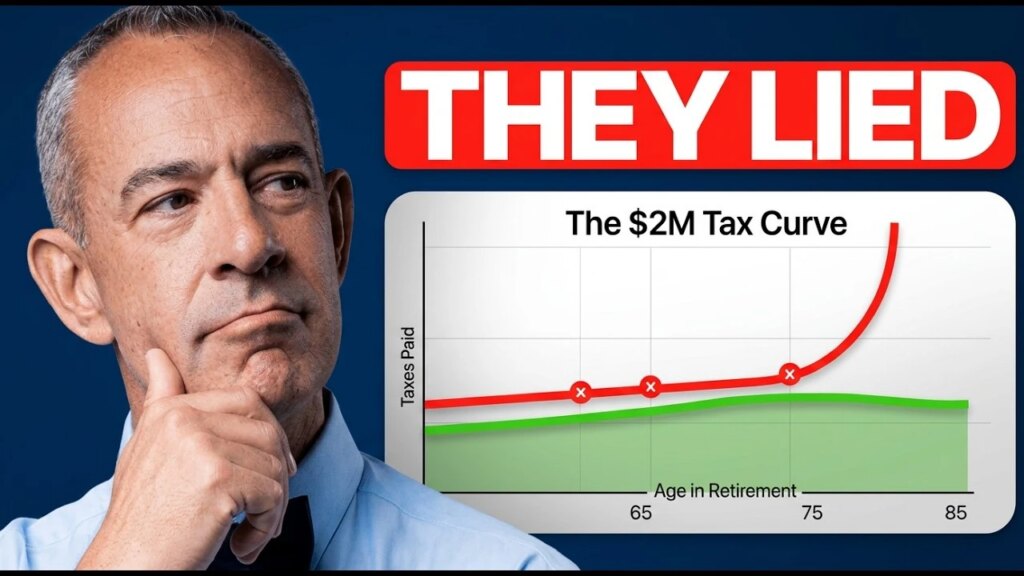
Eventually, the federal government requires distributions from most traditional retirement accounts whether the retiree needs the money or not. Those withdrawals generally become taxable income, potentially pushing the household into higher tax brackets, making more Social Security taxable and increasing Medicare premiums. A large traditional IRA that looked like an asset at 65 can become a substantial tax obligation later in retirement. The most important RMD planning therefore often happens before the first required distribution. The years after retirement but before RMDs begin can provide a rare window in which retirees have unusually strong control over how much taxable income they create.
First, RMDs Do Not Start at 75 for Everyone
The age rules have changed repeatedly, which has created understandable confusion. Many people retiring today still begin required distributions at 73. Under the SECURE 2.0 rules, the applicable RMD age increases to 75 for people born on or after January 1, 1960. Traditional IRAs, SEP IRAs and SIMPLE IRAs are generally subject to these requirements. Workplace plans such as 401(k)s can have somewhat different timing because a participant may sometimes delay the RMD from a current employer’s plan until retirement, depending on the plan and ownership rules.
Roth IRAs are particularly valuable in this context because the original owner is not required to take lifetime RMDs. That difference gives retirees another reason to think about the tax composition of their wealth rather than simply the total balance. The challenge is that delaying RMDs does not make the tax problem disappear. It can allow the traditional account to become larger.
A $2 Million IRA Can Become a Tax Problem
Consider a retired couple in their mid-60s with $2 million in traditional IRAs. Their immediate reaction might be to leave those accounts untouched for as long as possible because withdrawals create taxable income. That can feel tax-efficient today.
Assume the accounts continue growing for another decade. By the time required distributions begin, the balance could be substantially larger. The government then determines a minimum annual distribution based on the prior year-end balance and an IRS life-expectancy factor. The retiree can withdraw more than the required amount, but generally cannot withdraw less without risking an excise tax on the shortfall. Traditional IRA distributions are generally taxable to the extent they contain untaxed contributions and earnings.
Add those RMDs to Social Security, pension income, dividends and interest, and a household that appeared to have modest taxable income at 65 may have very little control over income at 75 or 80. That is why avoiding taxes today is not necessarily the same thing as minimizing taxes over retirement.
The Best Years May Be the “Control Years”
The years between retirement and required distributions can be particularly valuable because several major income sources may not have arrived yet. Wages have stopped. Social Security may be delayed. RMDs have not begun. The retiree can decide how much to withdraw from traditional accounts instead of having the IRS dictate a minimum amount. These are the control years.
Suppose a married couple retires at 65 with enough cash and brokerage assets to support spending. They could take almost nothing from their IRA and report very little ordinary income. But they might instead deliberately withdraw or convert enough traditional IRA money to use deductions and lower tax brackets. For 2026, married couples filing jointly enter the 22% federal bracket when taxable income exceeds $100,800, and that bracket extends through $211,400 before the 24% rate begins.
That does not mean everyone should automatically convert enough to reach $211,400. The correct target depends on deductions, Social Security, capital gains, state taxes, Medicare and future income. The bracket simply provides a boundary that can be tested. A retiree may decide that voluntarily paying 12% or 22% tax today is preferable to allowing the same money to compound until it is later forced out at 24%, 32% or another effective rate.
Roth Conversions Shrink the Future RMD Machine
A Roth conversion moves money from a traditional retirement account into a Roth IRA. The previously untaxed amount converted generally becomes taxable income in the year of conversion. That immediate tax bill is the cost. The potential benefit is that the converted money can then grow inside the Roth, qualified future withdrawals can be tax-free, and the original Roth IRA owner does not face lifetime RMDs.
Imagine converting $100,000 annually for several years before RMDs begin. The household voluntarily creates taxable income while it still has control over the amount. At the same time, hundreds of thousands of dollars are removed from the traditional IRA that would otherwise continue compounding and eventually increase required distributions. The strategy can reduce future taxable income, create a larger pool of tax-free assets and give the household more flexibility later.
But a Roth conversion is not automatically beneficial simply because RMDs are coming. Paying 24% today to avoid a future 12% tax would be poor planning. The analysis should compare the tax cost today with the expected lifetime tax cost if the money remains traditional.
Medicare Creates a Second Tax Bracket That Is Not Really a Tax Bracket
Roth conversions can also affect Medicare premiums, which is why filling a tax bracket without watching IRMAA can become expensive. For 2026, the standard Medicare Part B premium is $202.90 a month. Individuals with 2024 modified adjusted gross income above $109,000, or married couples filing jointly above $218,000, pay an Income-Related Monthly Adjustment Amount in addition to the standard premium.
The first IRMAA tier raises the 2026 Part B premium to $284.10 per person per month. Higher income produces progressively larger surcharges, with the highest 2026 Part B premium reaching $689.90 per person per month. Part D has its own IRMAA surcharge as well. The thresholds operate differently from ordinary marginal tax brackets. Crossing an IRMAA line by a relatively small amount can cause the higher monthly premium to apply, which is why retirees sometimes describe IRMAA as a cliff.
For a married couple on Medicare, crossing a threshold affects both spouses. That makes a poorly timed Roth conversion considerably more expensive than the federal income-tax calculation alone suggests. The key word is timing. Medicare generally uses the tax return from two years earlier, so income generated by a 2026 conversion can affect Medicare premiums later rather than immediately.
Do Not Let IRMAA Prevent a Conversion That Still Makes Sense
Avoiding Medicare surcharges at all costs can be just as shortsighted as ignoring them. Suppose a retiree can convert additional IRA money at 22% today but expects the same dollars eventually to be taxed at 32% after large RMDs begin. Crossing an IRMAA threshold may still be economically worthwhile if the lifetime tax savings substantially exceed the additional Medicare premiums.
The calculation should include all of the costs rather than treating any one threshold as an absolute limit. This is also why statements such as “always convert up to the top of the 22% bracket” are too simplistic. A conversion can affect capital-gains taxation, Social Security taxation, Medicare premiums and deductions tied to income. State income taxes may also change after a planned relocation. The optimal amount may therefore stop below a tax-bracket ceiling, above an IRMAA threshold or somewhere entirely different. The objective is not to win each tax year independently. It is to minimize the household’s lifetime tax burden.
The Widow’s Tax Trap Can Make the Problem Much Worse
One of the strongest arguments for reducing oversized traditional retirement accounts has nothing to do with the original account owner. It is the surviving spouse. While both spouses are alive, they may file a joint return and use the wider married tax brackets. After one spouse dies, the survivor will generally eventually file as a single taxpayer while often retaining much of the same retirement wealth. For 2026, the 22% bracket for married couples filing jointly extends through $211,400 of taxable income. For a single taxpayer, it ends at $105,700. The 24% bracket then begins.
The income does not necessarily fall by half when a spouse dies. One Social Security benefit usually disappears, but the surviving spouse may retain a pension, investments and inherited retirement accounts. Household expenses also frequently decline much less than 50%. The survivor can therefore have similar assets and substantial income while being forced through much narrower tax brackets.
Medicare creates the same problem. The 2026 first IRMAA threshold is $218,000 for a married couple filing jointly but only $109,000 for an individual. A widow or widower can therefore move into higher tax brackets and Medicare surcharges at dramatically lower household income. That is the widow’s tax trap.
The Larger IRA Often Survives, but the Wider Tax Brackets Do Not
Consider a couple with $3 million in traditional retirement accounts. Both are receiving Social Security and neither currently faces a particularly painful tax burden because the income is spread across married filing-jointly brackets. One spouse dies. The surviving spouse inherits the retirement assets, but the account does not suddenly become half as large. Investment income continues. Required distributions continue. Perhaps the survivor retains the larger Social Security benefit and most of a pension. The survivor eventually files single.
This is why Roth conversions performed while both spouses are alive can sometimes be valuable even when the couple’s current tax rate does not look particularly threatening. The comparison should include the likely rate paid by whichever spouse survives. A conversion at a moderate married rate can effectively prepay tax on money that might otherwise be withdrawn years later under much narrower single brackets. Planning only for the couple’s current tax return ignores one of retirement’s most predictable transitions.
RMDs Also Create Problems for Heirs
Traditional retirement accounts can create tax consequences beyond the surviving spouse. Under current inherited-IRA rules, many non-spouse beneficiaries must empty an inherited retirement account by the end of the 10th year after the original owner’s death. Depending on the circumstances, annual distributions may also be required during that period. The exact treatment depends on whether the beneficiary is an eligible designated beneficiary and whether the original owner had already reached the required beginning date.
That can create an unfortunate result for adult children. Someone may inherit a large traditional IRA at age 50 while already earning the highest income of a career. Instead of stretching distributions throughout life under the older rules, the heir may have to recognize substantial taxable income during a relatively compressed period.
A Roth IRA can also be subject to the 10-year distribution rule for many heirs, but qualified Roth withdrawals generally do not create the same federal income-tax burden. This does not mean parents should pay enormous taxes simply to leave heirs a Roth account. It means inheritance should be included when comparing the lifetime cost of leaving a large traditional IRA untouched.
Waiting Until 74 or 75 Can Remove the Best Opportunities
A common mistake is deciding to address RMDs only when the first distribution is approaching. By then, many of the best planning years may be gone. Social Security may already be fully established. Pension income is arriving. Medicare thresholds matter. Traditional accounts may have compounded for another decade. There is simply less empty space left in the lower brackets. A retiree who starts planning at 62 may have 10 or more years to gradually convert traditional money. Someone who begins at 74 may be trying to solve the same problem in one year.
Large conversions create large tax bills. Gradual conversions can spread income across multiple deductions and tax brackets. Time is therefore one of the most valuable tools in RMD planning. The goal is not necessarily to eliminate the traditional IRA. It is to reduce it enough that future mandatory distributions fit comfortably alongside the household’s other income.
Do Not Forget the First-RMD Timing Trap
Taxpayers can generally delay their first RMD until April 1 of the year after the year in which they reach the applicable RMD age. That flexibility sounds attractive, but it can create an unpleasant surprise. If the first distribution is postponed into the following calendar year, the retiree generally must still take that second year’s regular RMD by December 31. The result can be two taxable required distributions in one year.
For someone with a large IRA, doubling up can push income into a higher tax bracket and potentially increase future Medicare premiums. Delaying the first RMD therefore should not be automatic. Sometimes taking it during the first year produces a more balanced tax result. This is another example of why RMD planning is really income planning. The question is not merely when the government allows a distribution but when it creates the lowest total cost.
A Good Strategy Uses the Entire Tax Map
A strong retirement tax plan looks at more than one threshold. It projects traditional IRA balances and future RMDs. It estimates Social Security and pensions. It models the tax brackets for both spouses together and for the eventual survivor. It tracks Medicare IRMAA and examines whether future heirs are likely to inherit taxable accounts during high-earning years. Then it begins testing conversions.
Perhaps the household converts aggressively from 65 through 69 before Social Security begins. Perhaps conversions continue more modestly afterward while remaining near a chosen Medicare threshold. Maybe a market decline creates an opportunity to convert shares at depressed values, moving more future recovery into the Roth account. The strategy should change as circumstances change.
A strong stock market may increase projected RMDs and justify larger conversions. A major charitable goal may reduce future distributions through qualified charitable distributions once the taxpayer reaches the applicable age. A planned move from a high-tax state to a state without personal income tax may justify delaying some conversions until after the move. There is no universal conversion number because there is no universal retirement tax return.
The Biggest RMD Mistake Is Doing Nothing
Required minimum distributions are not inherently bad. They are simply the government’s mechanism for eventually collecting tax on income that was allowed to grow tax-deferred for decades. The problem arises when retirees treat those future withdrawals as someone else’s problem.
A large traditional IRA can create significant taxable income in the owner’s 70s and 80s. It can raise Medicare premiums, force distributions when the money is not needed and leave a surviving spouse facing the same assets under narrower tax brackets. For people born in 1960 or later, the move to an RMD age of 75 creates an even longer potential planning window. That is an opportunity, not simply permission to postpone thinking about taxes.
The years before RMDs begin may be the period when retirees have the greatest control they will ever have over taxable income. They can choose whether to withdraw, how much to convert and which tax brackets to use. Once required distributions begin, some of that choice disappears. The goal is not to eliminate taxes entirely. It is to decide when taxes are paid while you still have a say in the matter before the IRS begins making part of that decision for you.
Intended for educational purposes only. Opinions expressed are not intended as investment advice or to predict future performance. Past performance does not guarantee future results. Neither the information presented, nor any opinion expressed constitutes a solicitation for the purchase or sale of any security. Consult your financial professional before making any investment decisions. Opinions expressed are subject to change without notice.
IMPORTANT DISCLOSURES:
• Investment Advisory and Financial Planning Services are offered through Pure Financial Advisors, LLC. A Registered Investment Advisor.
• Pure Financial Advisors, LLC. does not offer tax or legal advice. Consult with a tax advisor or attorney regarding specific situations.
• Opinions expressed are subject to change without notice and are not intended as investment advice or to predict future performance.
• Investing involves risk including the potential loss of principal. No investment strategy can guarantee a profit or protect against loss in periods of declining values.
• All information is believed to be from reliable sources; however, we make no representation as to its completeness or accuracy.
• Intended for educational purposes only and are not intended as individualized advice or a guarantee that you will achieve a desired result. Before implementing any strategies discussed you should consult your tax and financial advisors.