Should You Retire Now or Work One More Year? The Math Can Change Fast
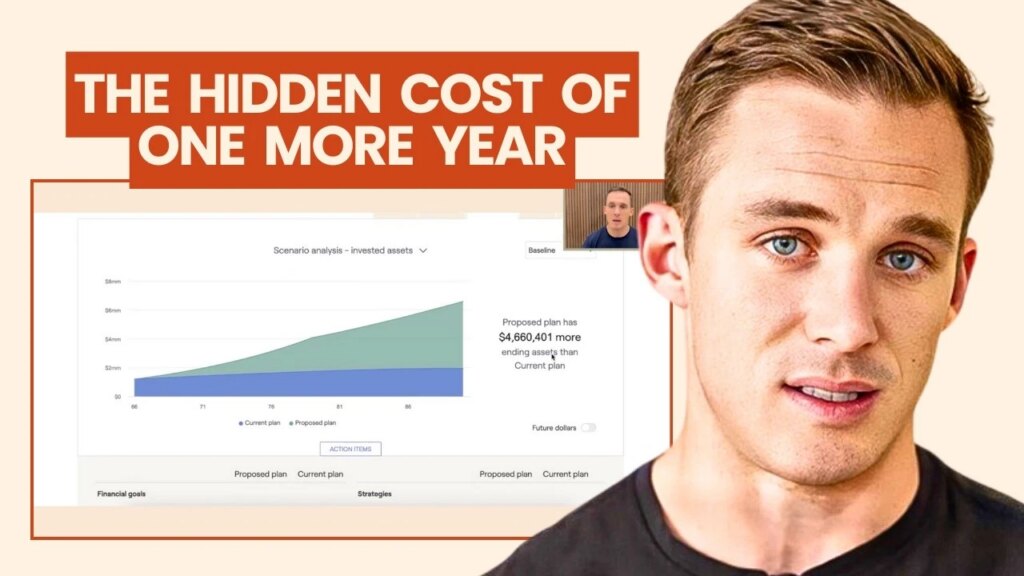
Few retirement decisions are more frustrating than reaching the point where the numbers say retirement is possible but another year of work would make the plan considerably safer. Financial-planning software may show an 83% probability of success today and something approaching 100% after another year. The projected ending portfolio may increase by hundreds of thousands of dollars, or occasionally more than $1 million over a long retirement, because one additional working year creates several benefits at once. You earn another salary, continue saving, postpone withdrawals and potentially increase Social Security.
That can make working longer look like the obvious choice. It is not. A financial model can calculate the value of another paycheck, but it cannot assign a reliable price to another healthy year with a spouse, grandchildren or friends. Retirement timing is therefore one of the places where maximizing wealth and maximizing life can produce different answers.
One More Year Does More Than Add One Year of Salary
The financial power of working another year is easy to underestimate because the benefit is not limited to whatever salary is earned during those 12 months. Suppose someone has $1.5 million saved and expects to withdraw $70,000 during the first year of retirement. Retiring today means the portfolio begins funding the household immediately. Working another year may instead allow that $1.5 million to remain invested, avoid the $70,000 withdrawal and receive another year of retirement contributions. If the portfolio also grows during that year, the difference can compound for decades. A relatively modest improvement at retirement can therefore create a much larger difference in the projected estate at age 90 or 95.
This is why planning software can occasionally show a dramatic increase perhaps from an 83% success rate to 95% or even 100% after only one additional working year. Those percentages are specific to the assumptions in the model, not a universal result. Someone with a substantial shortfall may need several more years, while a household already well funded may barely improve its outcome by delaying retirement. The important lesson is that another year attacks retirement risk from several directions simultaneously.
Social Security Can Become More Valuable Too
Working longer may also allow Social Security to be claimed later. For people born in 1960 or later, full retirement age is 67. Benefits continue increasing after full retirement age until age 70; someone in that group who waits from 67 until 70 receives 124% of the full-retirement-age amount. No additional delayed-retirement increase occurs after 70.
The impact can be meaningful because the larger payment continues for life and receives future cost-of-living adjustments. For a married couple, delaying the higher earner’s benefit can also strengthen the income available to the surviving spouse.
An extra year of employment may improve the underlying Social Security calculation as well if current earnings replace a lower year in the worker’s earnings record. The effect depends on the individual’s history, so someone who already has decades of high earnings may see little change while another worker could receive a more noticeable increase.
That does not mean employment and Social Security have to move together. Someone can retire from work and delay Social Security, using investments temporarily instead. Conversely, another person may continue working while collecting benefits, subject to the earnings-test rules before full retirement age. The retirement date and Social Security date should be coordinated, not automatically treated as one decision.
The First Retirement Years Are Financially Dangerous
One of the biggest advantages of working longer is protection from sequence-of-returns risk. Imagine two retirees who earn identical average investment returns over 30 years. One experiences strong markets during the first five years, while the other suffers a severe decline immediately after retiring. The second retiree can end up with substantially less money because withdrawals occur while asset values are depressed. The danger is not simply that the market falls. It is that the retiree must sell investments while it is down to pay ordinary expenses. Those shares are no longer present when the market eventually recovers.
Working another year can reduce this risk because the paycheck continues covering expenses while investments remain untouched. If markets decline during that year, the worker may be able to wait for recovery instead of selling assets to fund groceries, insurance and housing. That protection is particularly valuable for someone whose retirement plan requires relatively large withdrawals during the first several years. A household with Social Security, pensions and substantial cash reserves may have much less sequence risk and therefore gain less from postponing retirement.
A 100% Probability of Success Is Not Really 100%
Retirement software often expresses readiness as a probability of success. It may run hundreds or thousands of market scenarios and calculate how frequently the portfolio lasts through the assumed planning horizon. The number is useful, but it can easily be misunderstood.
An 83% probability does not necessarily mean there is a 17% chance of bankruptcy. In unsuccessful scenarios, the household might simply need to reduce discretionary spending, sell a second home, work part time or make another adjustment later. Similarly, a 100% result does not guarantee success because the model cannot know future tax laws, medical expenses, investment returns or longevity. The output is only as reliable as its assumptions. A plan ending at age 90 will look stronger than one extending to 100. A model assuming moderate spending will outperform one containing expensive annual travel. Change inflation, investment returns or healthcare costs and the probability can move quickly.
The better question is not whether the software reaches an arbitrary percentage. It is what happens in the unsuccessful scenarios. If an 83% plan fails only when markets are historically terrible and could be corrected by reducing travel for two years, retirement may still be reasonable. If failure requires selling the home or exhausting assets at 82, another year of work deserves much more consideration.
Another Year Can Be Worth More Than Another $100,000
Suppose a worker earns $150,000, contributes $25,000 to retirement accounts and would otherwise withdraw $60,000 after retiring. Even before investment returns, working another year could leave the household roughly $85,000 better positioned through the combination of contributions made and withdrawals avoided.
Now allow that extra capital to remain invested for another 25 or 30 years. The projected difference can become several hundred thousand dollars. This explains seemingly dramatic software projections in which another working year adds $500,000 or even more than $1 million to the eventual estate. The worker did not actually earn $1 million during that extra year. The model is showing decades of compounded growth on assets that were saved or left untouched.
That distinction matters because someone who does not intend to leave a large inheritance may not care about maximizing the final portfolio. If both retirement dates comfortably fund the desired lifestyle, dying with $3 million instead of $4 million may not justify sacrificing another healthy year. The ending balance should not become the scorecard for retirement success.
Spending Changes Can Compete With Working Longer
Another year of employment is not the only way to improve a borderline retirement plan. Suppose someone wants to spend $120,000 annually but the plan looks uncomfortable. Reducing spending to $110,000 may improve the probability meaningfully without requiring another year in an unwanted job. A $10,000 annual reduction also means less must be withdrawn from investments during market declines.
The strongest cuts are usually those that do not meaningfully reduce quality of life. A second property may cost tens of thousands annually in taxes, insurance and maintenance. Downsizing an expensive vehicle, reducing fixed housing expenses or postponing a major renovation can strengthen a retirement plan more than eliminating small pleasures such as dinners or hobbies.
Spending can also be flexible rather than permanently reduced. A retiree could maintain the preferred lifestyle during normal markets while agreeing to trim discretionary travel or large purchases after major declines. That flexibility makes a retirement plan more resilient because it recognizes that spending is one of the variables the household can actually control.
Health Changes the Calculation Completely
Financial planning tends to assume that an additional working year and an additional retirement year are equivalent units of time. They are not. A healthy year at 62 may offer more opportunity than a year at 82. Travel is easier, physical activity is greater and spouses or friends may also be healthy enough to participate. Postponing those years repeatedly creates a form of risk that financial software rarely measures well.
Someone who dislikes work, has sufficient savings and has already experienced significant health concerns may reasonably accept a lower financial margin in exchange for retiring earlier. Someone healthy, engaged in a meaningful career and uncertain about the adequacy of savings may happily continue another year.
The point is not that health should override the math. It is that health belongs in the math. Retirement planning frequently spends enormous effort modeling the possibility of living to 95 while giving insufficient attention to what the retiree will physically be capable of doing during those decades.
Relationships Have a Retirement Window Too
Time with other people can be even less predictable than personal longevity. A retiree may assume travel with a spouse can begin later, only to have the spouse develop a health problem. Grandchildren grow rapidly. Aging parents may need assistance. Friends move or become unable to travel. That does not mean everyone should resign immediately because tomorrow is uncertain. It means that postponing retirement has a genuine cost even when the portfolio becomes stronger.
For someone who has spent decades saying, “I’ll do that when I retire,” an additional working year should have a clear financial purpose. If the plan improves from genuinely fragile to comfortably sustainable, the trade may be worthwhile. If the only improvement is an already large estate becoming even larger, the decision deserves more scrutiny.
Consider a Middle Ground Before Choosing Either Extreme
Retirement does not always require choosing between full-time employment and no employment. Part-time work, consulting, seasonal employment or a reduced schedule can preserve some earnings while returning significant time to the retiree. Even $20,000 or $30,000 of annual income can reduce portfolio withdrawals meaningfully during the early years.
A phased retirement can also provide psychological benefits. Someone accustomed to working 50 hours a week may find that suddenly having no structure is less enjoyable than expected. Gradually reducing work creates time to develop travel, exercise, volunteering and social routines before leaving employment completely.
The same approach can protect against a poor market. A retiree who earns enough to cover some discretionary spending during the first several years may avoid selling investments after a downturn. Instead of asking only, “Can I retire this year?” the better question may be, “How much work do I still need?”
Define the Trigger for Going Back to Work or Cutting Spending
A borderline retirement becomes safer when contingency decisions are made before the retirement date. For example, a household might decide that if the portfolio declines by 20% during the first two years, major travel will be reduced temporarily. If assets fall below a particular level, one spouse might take consulting assignments. A vacation property could be sold if long-term projections deteriorate significantly.
Creating those rules turns an 80% or 85% probability-of-success plan into something more useful. The household is not helpless in the unsuccessful scenarios; it has predetermined actions available. This is also why retirement models that assume identical inflation-adjusted spending every year can be unnecessarily pessimistic. Real households adapt. They postpone vehicles, alter travel and reduce discretionary purchases when circumstances require it. The critical distinction is whether the flexible expenses are genuinely optional. Someone whose plan succeeds only by assuming that essential healthcare or housing expenses can be cut later does not have meaningful flexibility.
Know What the Extra Year Is Buying
Before agreeing to work another year, calculate exactly what changes. How much more will be contributed to retirement accounts? How much will the portfolio avoid distributing? Will Social Security increase? Does employer healthcare avoid an expensive year of private coverage? Does a pension benefit improve? How much does the success rate change?
Then look beyond the success percentage. Compare projected annual spending, worst-case outcomes and assets remaining later in life. If retirement today shows an 83% success rate but the unsuccessful outcomes occur only under extreme market scenarios and can be solved with modest spending reductions, working until the probability reaches 100% may be unnecessarily conservative. If today’s plan repeatedly runs out of liquid assets in the 80s while working another year nearly eliminates that risk, the financial argument becomes much stronger. The extra year should solve a problem, not simply make an already good spreadsheet look prettier.
There Is Always a Financial Argument for One More Year
This is the trap. At 62, working until 63 improves the numbers. At 63, working until 64 improves them again. Another year produces another salary, another contribution and another year without withdrawals. There will almost always be a financially defensible reason to keep going. At some point, retirement requires accepting that maximum wealth was never the goal. For people whose plans remain genuinely underfunded, another year of work can be one of the most powerful tools available. It can improve Social Security, preserve investments, reduce sequence risk and create a larger margin for unexpected costs. The financial value should not be dismissed simply because retirement sounds more appealing.
But once essential spending is covered, contingencies are funded and poor scenarios remain manageable, the calculation changes. The question is no longer whether another year makes the household richer. It almost certainly will. The question is whether becoming richer is worth making retirement shorter. That answer cannot be generated by Monte Carlo software. It requires deciding what the money was supposed to buy in the first place.
You should always consult a financial, tax, or legal professional familiar about your unique circumstances before making any financial decisions. This material is intended for educational purposes only. Nothing in this material constitutes a solicitation for the sale or purchase of any securities. Any mentioned rates of return are historical or hypothetical in nature and are not a guarantee of future returns.
Past performance does not guarantee future performance. Future returns may be lower or higher. Investments involve risk. Investment values will fluctuate with market conditions, and security positions, when sold, may be worth less or more than their original cost.