Hyundai Georgia Robot Factory: The Future Is Here
Inside the Hyundai Georgia robot factory, more than 1,000 machines build cars while Hyundai prepares humanoid Atlas robots for its American workforce.
Imagine walking into an American car factory and discovering that one of the employees is a robot dog. It doesn’t bark, chase squirrels or demand an afternoon walk. Instead, it examines unfinished cars for defects.
Nearby, driverless machines transport partially assembled vehicles across the production floor. Mechanical arms weld metal structures together, while computerized inspection equipment checks the results.
This isn’t a laboratory demonstration. These technologies are operating at Hyundai Motor Group Metaplant America, a manufacturing complex in Ellabell, Georgia.
The facility employs more than 1,000 robots. And Hyundai’s next ambition is considerably more remarkable: introducing humanoid machines that can carry out tasks currently performed by people.
For drivers, however, I think there’s a more useful question than how many robots Hyundai can fit inside a factory.
Will all this technology actually produce better cars?
You may also enjoy this video:
Hyundai Georgia Robot Factory: What the Machines Do
Hyundai’s Metaplant near Savannah began vehicle production in 2024 and officially celebrated its grand opening in March 2025.
The wider manufacturing investment represents approximately $12.6 billion in Georgia, including vehicle assembly and battery operations.
What makes the plant particularly interesting is its combination of robotics, manufacturing data and flexible production equipment.
Robotic welding systems perform precision joining operations. Automated guided vehicles move unfinished automobiles and components between workstations. Digital inspection systems examine production results and help identify potential errors.
Hyundai says artificial intelligence and real-time information help coordinate procurement, logistics and manufacturing throughout the operation.
The basic technologies aren’t entirely new. Automakers have used industrial robots for decades. What distinguishes the Georgia operation is how extensively those machines are integrated into the factory’s daily work.
The National Institute of Standards and Technology identifies artificial intelligence, robotics and connected production systems as increasingly important manufacturing technologies, while cautioning that integrating them reliably remains a challenge.
You may also enjoy: ADAS Calibration: When a Simple Repair Takes Longer
Hyundai Georgia Robot Factory
The Robot Dog Has a Proper Job
Boston Dynamics’ Spot is probably the most visually memorable piece of equipment associated with Hyundai’s manufacturing strategy.
Hyundai Motor Group owns Boston Dynamics, giving the automaker direct access to one of the industry’s best-known robotics developers.
Spot uses its four-legged design to move through the factory and carry out inspection duties in vehicle body production.
The important technology isn’t simply the robot’s ability to walk. It’s the combination of mobility and inspection equipment that allows measurements to be collected without requiring a person to perform every examination manually.
Consider what that means in vehicle manufacturing. A poorly executed weld or assembly irregularity can create problems long before an owner notices anything unusual.
Automated inspection could help identify a defect earlier, potentially preventing additional work on a vehicle that needs correction.
But the existence of robotic inspectors should not be interpreted as proof that defects have disappeared. Every inspection system has limitations, and manufacturers still need reliable methods to confirm their findings.
You may also enjoy: 2027 Car Safety Tests: Which Models Face New Scrutiny?
Hyundai Georgia Robot Factory
Hyundai Wants Human-Shaped Robots on the Production Line
Here is where the story becomes particularly interesting.
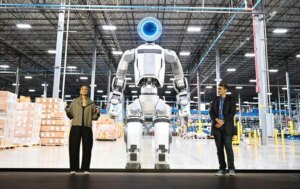
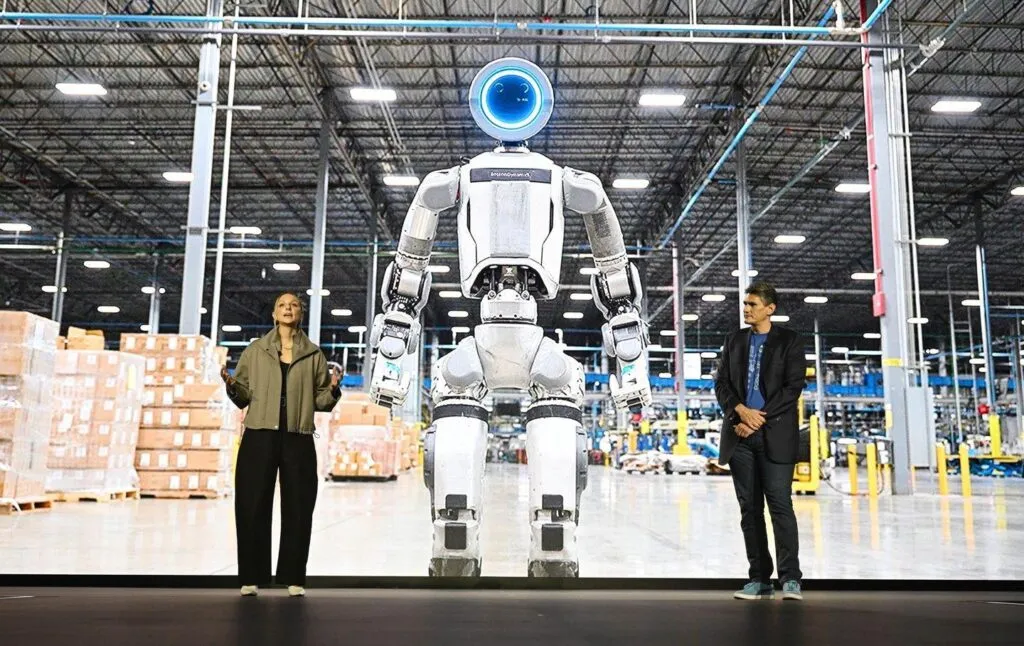
At CES 2026, Hyundai revealed plans to introduce Boston Dynamics’ Atlas humanoid robot into its manufacturing operations.
The Georgia factory is expected to become an early deployment location in 2028, initially using Atlas for repetitive parts-sequencing work.
Hyundai’s longer-term roadmap includes more complicated assembly operations beginning around 2030.
According to the manufacturer, Atlas can lift up to 110 pounds and is designed to operate autonomously, including managing battery replacement.
Hyundai also intends to establish robot production capacity of as many as 30,000 units annually by 2028.
Those numbers describe the company’s broader robotics ambitions. They do not mean 30,000 humanoid robots are scheduled to work at the Georgia factory.
One reason humanoid robotics attracts investment is the possibility of performing different tasks within workplaces built around people. A conventional robot may be excellent at one fixed operation but difficult or expensive to adapt to something entirely different.
Yet physical adaptability is complicated. Robots must recognize objects, manage forces, avoid collisions and react to situations that aren’t perfectly predictable.
Research on digital twins for robot systems explains how virtual representations can help engineers design, test and improve robotic operations before making changes to physical equipment.
Hyundai is pursuing similar simulation and training concepts through its robotics development programs.
You may also enjoy: Tesla Cybercab: Would You Buy a Car You Can’t Drive?
Hyundai Georgia Robot Factory
Why Hyundai Is Building Electric Cars and Hybrids Together
One of the most important details about the Georgia operation has relatively little to do with its robot population.
The factory produces the Hyundai IONIQ 5, the larger IONIQ 9 and the Kia Sportage Hybrid.
That combination tells us something about Hyundai’s approach to the American market.
Electric vehicle demand has not developed at the same pace across every vehicle segment. Hybrids remain attractive to buyers who want improved fuel efficiency without depending on charging infrastructure.
Hyundai’s flexible manufacturing strategy allows the company to adjust its production mix rather than rely entirely on demand for battery-electric vehicles.
For buyers, that flexibility matters more than whether a particular component was installed by a machine or a human being.
Manufacturing flexibility could help an automaker respond to changing demand, although it does not guarantee shorter waiting times or lower vehicle prices.
The NIST research on advanced manufacturing explains how synchronized digital production models can help factories evaluate efficiency, quality and operating costs.
The challenge is turning those technical capabilities into measurable improvements that customers can actually experience.
You may also enjoy: Hybrid Car Sales Could Hit 30% by 2030. Who Wins?
Hyundai Georgia Robot Factory
There Is a Human Question Nobody Can Ignore
Hyundai describes its manufacturing philosophy as human-centered, arguing that robots can assist employees with demanding, repetitive and hazardous work.
That is a reasonable objective. However, it does not remove the difficult employment questions created by increasingly capable machines.
Future factories may require more robotics technicians, software specialists and advanced maintenance workers while changing demand for certain traditional assembly jobs.
How those changes affect total employment remains uncertain.
Safety also deserves serious attention. The Occupational Safety and Health Administration’s robotics guidance identifies hazards associated with industrial machinery, particularly when employees conduct nonroutine maintenance or adjustment work.
Its technical guidance for industrial robot systems explains the importance of safeguarding, risk assessment and protecting workers around automated equipment.
So the future factory still needs well-trained people. The work may look rather different.
You may also enjoy: 2026 Mazda CX-70 Review: Start With the Preferred
Hyundai Georgia Robot Factory
Should Car Buyers Actually Care?
Yes, although not necessarily for the reasons Hyundai’s robotics demonstrations might suggest.
I would not recommend buying a Hyundai simply because its factory contains an impressive collection of machines. Nor would I assume a vehicle built with more automation must be superior to one assembled through a different manufacturing process.
Instead, evaluate the results.
Are the body panels properly aligned? Does the interior fit together consistently? Are safety systems calibrated correctly? Does the vehicle demonstrate reliable long-term performance?
Those are the practical measurements that matter after the spectacular factory machinery has finished its work.
There is also the question of value. If better production technology eventually reduces manufacturing costs, consumers will reasonably want to know whether any savings appear in vehicle pricing.
Hyundai has not established that its current level of factory automation directly translates into lower retail prices.
Affiliate shopping: If you are shopping for all-weather floor mats, Shop OEDRO directly or Shop OEDRO on Amazon. Use code NIKM20 at the OEDRO official store. Check current code terms and vehicle fitment before ordering. Test Miles may earn a commission from purchases made through these affiliate links.
Hyundai Georgia Robot Factory
The Next Big Test Comes in 2028
Hyundai’s American factory is already an impressive example of how far vehicle manufacturing has advanced.
More than 1,000 industrial robots, connected production systems and automated inspection equipment are building real automobiles in Georgia.
The factory has moved well beyond the traditional image of a production line filled with identical machines repeating one operation.
But the next phase could prove even more consequential.
In 2028, Hyundai expects Atlas humanoid robots to begin taking on selected manufacturing tasks. Whether they can eventually handle complicated assembly work reliably, safely and economically is a much bigger engineering question.
Personally, I’m less interested in whether a robot can walk like a human than whether the vehicle it helps assemble will be better built, more affordable and more dependable.
A thousand robots make a remarkable headline. What they deliver to American drivers will determine whether this factory truly changes the industry.